
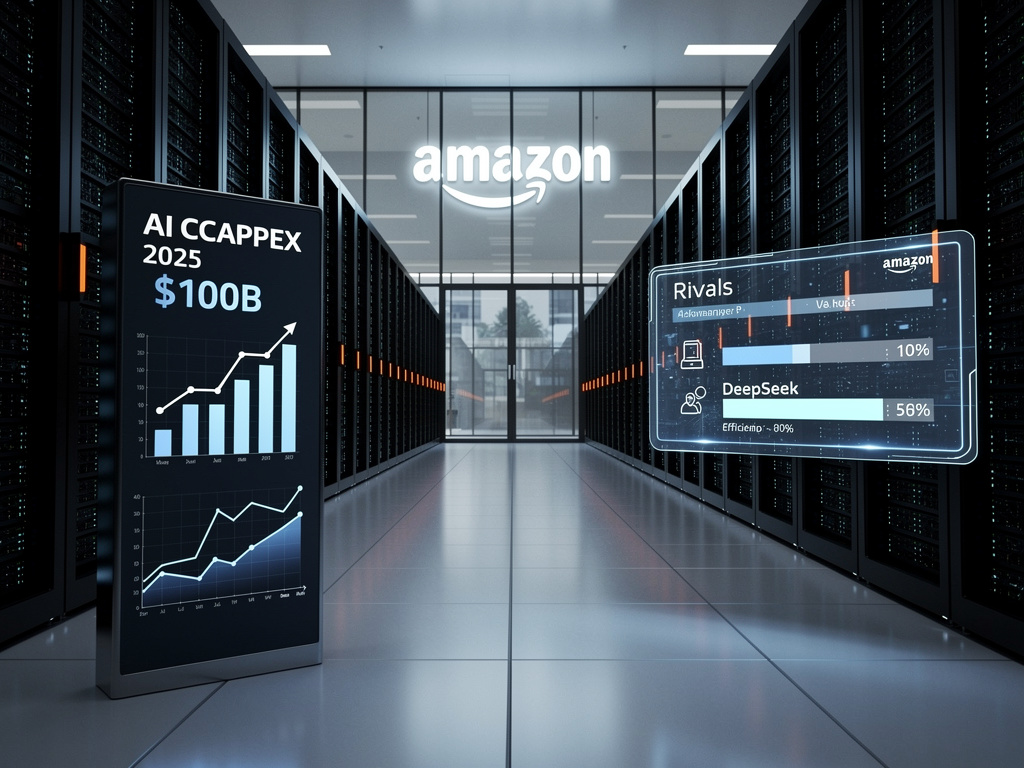
Amazon has thrown down the gauntlet in the artificial intelligence arms race, announcing capital expenditure plans that dwarf those of its mega-cap peers and signal an unprecedented commitment to building out the infrastructure required to dominate the next era of computing. But as the e-commerce and cloud giant doubles down on its AI ambitions, investors are growing increasingly uneasy about whether the staggering sums being poured into data centers, custom chips, and AI infrastructure will ultimately deliver returns commensurate with the investment — or whether the industry is hurtling toward a valuation reckoning.
The company’s latest earnings report revealed that Amazon plans to spend approximately $100 billion in capital expenditures in 2025, a figure that stunned even the most bullish analysts and represents a significant escalation from the roughly $78 billion it spent in 2024. The announcement came on the heels of similar, though somewhat smaller, capex commitments from Microsoft, Alphabet, and Meta Platforms, collectively painting a picture of a technology sector that is betting its future — and hundreds of billions of dollars — on the premise that artificial intelligence will reshape every facet of the global economy, as reported by CNBC.
A Spending Spree That Dwarfs the Competition
Amazon’s $100 billion capex target for 2025 places it firmly at the top of the Big Tech spending hierarchy. Microsoft had previously disclosed plans to invest roughly $80 billion in AI-related infrastructure during its fiscal year, while Meta Platforms indicated it would spend between $60 billion and $65 billion. Alphabet, Google’s parent company, announced approximately $75 billion in planned capital expenditures. Together, these four companies alone are poised to deploy more than $300 billion in a single year — a sum that exceeds the GDP of many nations and represents an industrial buildout not seen since the construction of transcontinental railroads or the electrification of America.
The bulk of Amazon’s spending is directed toward Amazon Web Services, the company’s cloud computing division, which has become the financial engine powering the broader enterprise. AWS generated $28.8 billion in revenue during the fourth quarter of 2024, growing 19% year-over-year, and its operating income of $10.6 billion accounted for the lion’s share of Amazon’s overall profitability. CEO Andy Jassy has been emphatic that the demand signals from enterprise customers for AI-powered cloud services are stronger than anything the company has seen in its history, and that the primary constraint on growth is not demand but rather the availability of infrastructure — particularly GPU capacity and data center space.
Jassy’s Conviction Meets Market Skepticism
“We’re seeing really strong demand signals across virtually every segment of our customer base,” Jassy told analysts during the company’s earnings call, emphasizing that Amazon’s Trainium custom AI chips and its partnerships with Nvidia and Anthropic position AWS to capture an outsized share of the enterprise AI market. Jassy described the current moment as a “once-in-a-lifetime” opportunity, drawing comparisons to the early days of cloud computing when Amazon made similarly aggressive bets that skeptics questioned but that ultimately created hundreds of billions of dollars in shareholder value.
Yet for all of Jassy’s conviction, Wall Street’s reaction was decidedly mixed. Amazon’s stock initially dipped in after-hours trading following the capex disclosure, reflecting a growing tension in the market between enthusiasm for AI’s long-term potential and anxiety about the near-term financial burden of building it out. The concern is not unique to Amazon; it has become the defining question of the current earnings cycle. Investors who have driven the “Magnificent Seven” tech stocks to historically elevated valuations are now grappling with the reality that the AI revolution requires years of massive upfront investment before the revenue streams mature enough to justify the expenditure.
The DeepSeek Disruption and Its Ripple Effects
Compounding investor anxiety is the emergence of DeepSeek, the Chinese AI startup that sent shockwaves through global markets in late January 2025 when it demonstrated that high-performance AI models could be built at a fraction of the cost that Western companies have been spending. DeepSeek’s R1 model, which reportedly cost just $5.6 million to train, raised fundamental questions about whether the hundreds of billions being invested by American tech giants represent a prudent allocation of capital or an exercise in excess. The Nasdaq tumbled sharply on the news, with Nvidia alone losing nearly $600 billion in market capitalization in a single session — the largest single-day loss for any company in stock market history.
The DeepSeek episode crystallized a fear that had been percolating beneath the surface of the AI investment thesis: that efficiency breakthroughs could undermine the economic rationale for the massive infrastructure buildout currently underway. If smaller, cheaper models can achieve comparable performance to those requiring enormous GPU clusters, then the demand for cloud computing capacity may not grow as rapidly as Amazon, Microsoft, and their peers are projecting. Amazon’s leadership has pushed back against this narrative, arguing that DeepSeek’s innovations actually validate the broader AI thesis by making the technology more accessible and therefore expanding the total addressable market. But the market’s initial reaction suggested that investors are not entirely convinced.
Valuation Concerns Across the Magnificent Seven
The valuation question extends well beyond Amazon. The Magnificent Seven stocks — Amazon, Apple, Microsoft, Alphabet, Meta, Nvidia, and Tesla — have collectively added trillions of dollars in market capitalization over the past two years, driven largely by AI enthusiasm. But as these companies report earnings and reveal the true scale of their investment commitments, a more sober assessment is taking hold. The forward price-to-earnings ratios for several of these names remain elevated relative to historical norms, and the gap between current AI revenue and the capital being deployed to generate future AI revenue is widening rather than narrowing.
Amazon trades at roughly 35 times forward earnings, a premium that reflects the market’s expectation that AWS will continue to grow rapidly and that the company’s AI investments will generate substantial returns. But at $100 billion in annual capex, the margin for error is razor-thin. If enterprise adoption of AI services slows, if competition from hyperscalers intensifies, or if efficiency gains reduce the need for raw compute power, Amazon could find itself with billions of dollars in underutilized infrastructure — a scenario that would compress margins and pressure the stock.
The Infrastructure Bottleneck and the Race for Capacity
Despite the valuation concerns, there is a compelling case that the current spending is not only justified but necessary. Enterprise demand for AI infrastructure has created genuine bottlenecks across the industry. Wait times for GPU capacity at major cloud providers have stretched to months, and large enterprise customers are signing multi-year, multi-billion-dollar commitments to secure access to AI computing resources. Amazon disclosed that its AI-related revenue run rate is in the “multi-billion dollar” range and growing at triple-digit percentages year-over-year — a pace that, if sustained, would quickly begin to offset the capex burden.
Moreover, Amazon’s investment in custom silicon — particularly its Trainium and Inferentia chips — gives it a potential cost advantage over competitors who are more reliant on Nvidia’s expensive GPUs. By designing its own chips optimized for AI training and inference workloads, Amazon can offer customers lower prices while maintaining healthy margins, a strategy that mirrors the company’s historical playbook of using scale and efficiency to undercut competitors and capture market share. The Trainium2 chip, which Amazon began deploying in late 2024, has shown promising performance benchmarks that could accelerate enterprise adoption of AWS’s AI services.
The Broader Implications for Capital Markets
The scale of Big Tech’s AI spending spree has implications that extend far beyond the technology sector. The demand for data center construction has created a boom in commercial real estate, electrical infrastructure, and semiconductor manufacturing. Utilities in regions hosting major data center clusters are scrambling to secure enough power generation capacity to meet demand, and in some cases, tech companies are investing directly in nuclear energy and renewable power projects to ensure reliable electricity supply. The ripple effects are being felt across supply chains, labor markets, and energy markets in ways that are reshaping the broader economy.
For investors, the central question remains whether this cycle of massive investment will follow the pattern of previous technology buildouts — where early excess eventually gave way to enormous long-term value creation — or whether it more closely resembles a bubble, where overinvestment leads to write-downs, margin compression, and shareholder destruction. The dot-com era offers cautionary parallels: many of the companies that spent aggressively on fiber-optic networks in the late 1990s went bankrupt, even though the underlying thesis about internet growth proved correct. The infrastructure they built was eventually utilized, but the investors who funded it were wiped out.
What Comes Next for Amazon and the AI Investment Cycle
Amazon’s $100 billion bet is the most aggressive wager in what has become the highest-stakes investment cycle in modern corporate history. The company’s leadership is betting that the demand for AI computing will grow exponentially over the coming decade, that AWS’s combination of scale, custom silicon, and ecosystem partnerships will allow it to capture a disproportionate share of that demand, and that the returns on today’s investments will ultimately vindicate the spending. If they are right, Amazon’s stock could look cheap in retrospect, and the current capex cycle will be remembered as the foundation of a new era of technological dominance.
But if the AI revenue ramp is slower than expected, if competition erodes pricing power, or if efficiency breakthroughs reduce the need for massive infrastructure, then the current spending levels could prove to be a strategic miscalculation of historic proportions. The market’s ambivalence — its simultaneous enthusiasm for AI’s potential and anxiety about its cost — reflects the genuine uncertainty that surrounds what may be the most consequential capital allocation decision in the history of corporate America. For now, Amazon is all in, and the rest of the industry is following close behind. Whether that conviction is rewarded or punished will define the next chapter of the technology sector and the broader market for years to come.


 WebProNews is an iEntry Publication