
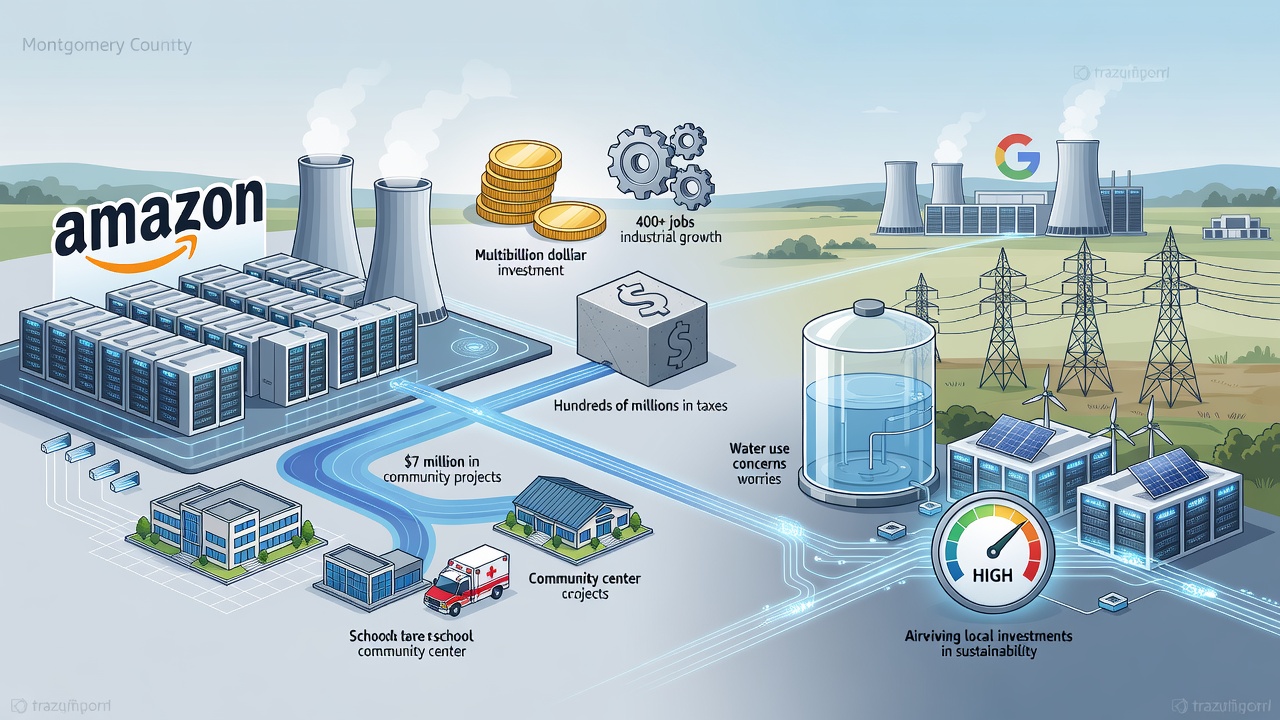
Amazon revealed plans Monday to pour several billion dollars — reports peg the figure near $10 billion — into a sprawling data center campus in rural Montgomery County, Missouri. The move comes as the company races to expand capacity for cloud computing and artificial intelligence workloads that now underpin everything from remote work tools to hospital record systems.
Governor Mike Kehoe welcomed the news with unmistakable enthusiasm. “Today’s announcement represents more than a major investment in Missouri’s future — it represents new opportunities for Montgomery County and the surrounding region,” he said, according to Amazon’s official announcement. The project sits north of Interstate 70, just east of New Florence. It lies a few miles from another massive facility Google announced months earlier.
But the excitement masks a more complicated story. For over a year, local residents have voiced loud concerns about water draw, electricity demand and opaque planning processes. A citizen group even sued the county in February, alleging violations of Missouri’s Sunshine Law and inadequate study of the project’s resource consumption. Those tensions haven’t vanished. They now sit alongside Amazon’s fresh pledges of jobs, tax dollars and community gifts.
The numbers sound substantial at first glance. More than 400 full-time data center positions. Thousands of construction roles during the build-out, which could stretch toward 2032. Hundreds of millions in new property tax revenue over time. The land currently generates less than $9,000 a year in taxes. Once operational, that figure multiplies dramatically. Yet industry watchers know data centers often deliver fewer permanent jobs than promised. A Wall Street Journal analysis from last year highlighted how the AI building boom frequently proves a job-creation bust in rural America.
Amazon moved to address those doubts head-on. The company struck an agreement with local utility Ameren Missouri so that its power costs stay off residential ratepayers’ bills. It has already funded a 138-megawatt carbon-free energy project in the state, enough to supply more than 28,000 homes. And on water, Amazon claims the campus will rely on free-air cooling about 90 percent of the time. When evaporative cooling kicks in during the hottest stretches, usage stays below 7 percent of the year. Rainwater harvesting and on-site recycling should cover 20 percent of needs and reuse water up to six times.
At full capacity the site would draw less than 0.1 percent of the aquifer’s annual recharge from typical rainfall. To sweeten the deal further, Amazon will donate the new water infrastructure to the local public water district once construction ends. It also partnered with agricultural technology firm Arable Labs to cut groundwater withdrawals by an estimated 100 million gallons a year in the surrounding watershed. The tech uses sensors and cloud analytics to help farmers irrigate more precisely.
Still, earlier documents tied to the project, known internally as Project Green, painted a picture of up to 17 buildings on 1,000 acres and potential annual water consumption around 50 million gallons. Residents worried aloud at public meetings last winter. One told reporters the facility could pull electricity and water equivalent to 100,000 homes on scorching summer days. Deep wells reaching 1,500 feet into the aquifer only sharpened those fears. A hydrogeologist advising the opposition group argued that existing state reports failed to account for multiple data centers now planned in the same county.
Amazon responded with more than $7 million in direct community contributions. Three million dollars will bolster emergency dispatch services. More than $1 million buys a new gathering space at the Montgomery County Fairgrounds, complete with pavilion and concessions. Another $3 million funds STEM education, teacher grants, school supplies and sustainability projects. The company launched the Amazon Montgomery County Community Fund with an initial $150,000, offering grants up to $10,000 for local ideas. It will sponsor this year’s county fair as well.
“Missouri has been home to Amazon since 2017 and more than 10,000 Missourians come to work with us every day,” said David Zapolsky, Amazon’s chief global affairs and legal officer. “Today’s announcement reflects what we’ve learned over those years: that when you show up as a real partner, listen to the community, and invest for the long term, everyone benefits.”
The statement carries weight. Amazon already employs thousands across Missouri fulfillment centers, delivery stations and a solar farm. It has trained more than 1,000 workers through free education programs since 2019. Independent sellers in the state moved 43 million items last year. Yet the data center push marks a different scale of commitment, one driven by insatiable demand for AI training and inference capacity.
Shannon Kellogg, AWS vice president for public policy in the Americas, noted that latency matters less for many AI applications than raw compute power. That shift allows the company to site these facilities farther from major metros. Missouri’s business climate, available land and governor’s aggressive recruitment played their parts too. Kehoe framed the project as part of an “AI space race” that America must win. “We’re building trades supporters,” he added. “These are the kinds of jobs that change lives.”
Local leaders echoed the sentiment. Montgomery County Commissioner Ryan Poston called the combined Amazon and Google investments — potentially exceeding $25 billion — a chance for “monumental growth” and a facelift for the region. An open house scheduled for June 23 aims to let residents ask questions directly about water, power and construction timelines.
But goodwill gestures don’t erase structural questions. Data centers consume enormous electricity even with efficiency gains. They generate heat that demands constant cooling. And while Amazon touts its water-positive goal by 2030, critics point to cumulative impact when multiple hyperscale projects cluster together. Google’s $15 billion campus nearby only intensifies the pressure on local infrastructure.
Similar backlash has erupted nationwide. Rural communities in Michigan, Virginia and elsewhere have blocked or delayed projects over fears of rising utility bills, farmland loss and noise. Maine became the first state to pass a moratorium on large data centers this spring. Federal lawmakers have floated bills to shield ratepayers from cost spikes.
Missouri took the opposite tack. Commissioners approved a tax abatement framework for the Amazon project late last year despite packed meetings and vocal opposition. A lawsuit filed in February by Preserving Montgomery County sought to unwind those approvals, citing failures to disclose water and tax details publicly. Whether that legal action gains traction now that Amazon has sweetened its offer remains unclear. The company has not commented directly on the suit.
What is clear is the broader trend. Tech giants continue to sink tens of billions into physical plants that look nothing like the cloud’s ethereal marketing. AWS, Microsoft and Google together plan hundreds of billions in capital spending this year alone. Much of it targets AI. Amazon’s Indiana data center cluster dedicated to Anthropic models opened last fall at a cost of $11 billion. Similar facilities are rising across the Midwest and South where land is cheap and power somewhat more abundant.
In Montgomery County the stakes feel immediate. Schools could gain new funding. Roads and bridges will improve, including a new crossing over the Norfolk Southern rail line. Yet the transformation also risks altering a quiet farming region forever. Residents wonder whether the promised economic lift will outweigh long-term strains on aquifers and the electrical grid.
Amazon insists it has listened. Its executives point to partnerships with community colleges to build training pipelines for roles like electricians, HVAC technicians and network specialists. They highlight competitive pay and benefits from day one. And they stress that the data centers support services millions rely on daily. The pitch lands differently depending on whom you ask.
One thing appears certain. This announcement won’t be the last. As AI models grow more demanding, the physical footprint of the digital economy will keep spreading into places like Montgomery City. Missouri has positioned itself as a willing host. The test now is whether its rural counties can absorb the scale without regret. So far the state bets yes. Time, water meters and electric bills will deliver the verdict.


 WebProNews is an iEntry Publication