
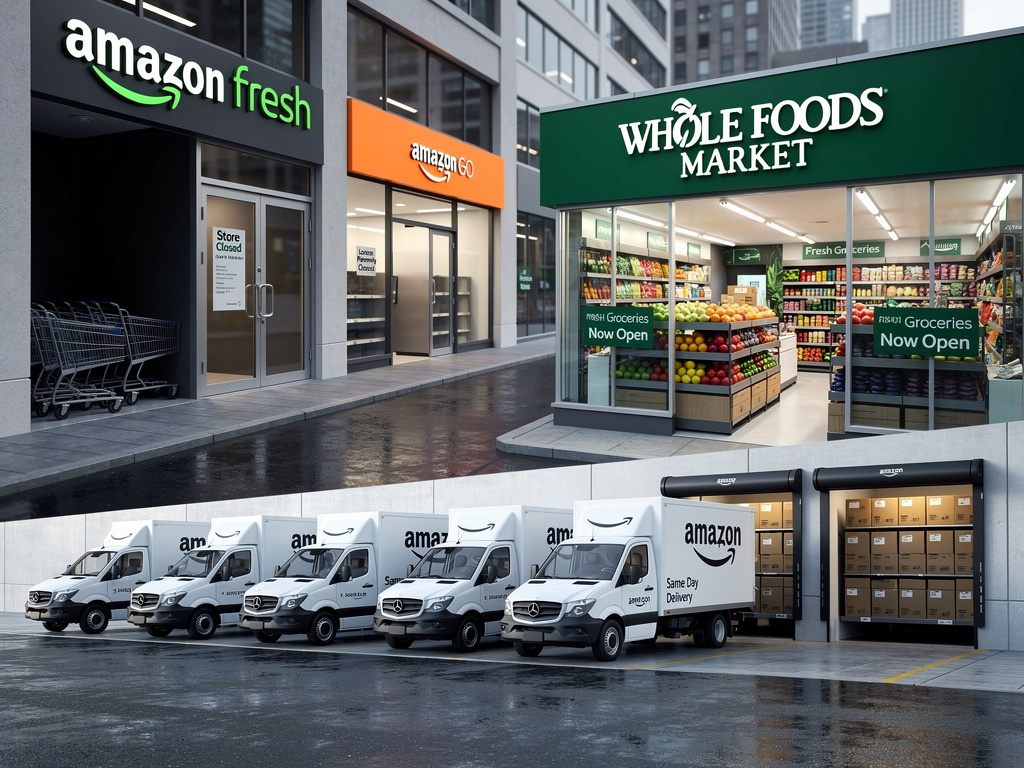
Amazon.com Inc. is executing a sharp pivot in its grocery operations, closing all physical Amazon Fresh supermarkets and Amazon Go convenience stores while channeling resources into Whole Foods Market expansion and accelerated online delivery. The move, detailed in an internal memo from grocery chief Jason Buechel, signals a strategic retreat from underperforming store formats after years of experimentation.
Buechel, vice president of Worldwide Grocery Stores and Whole Foods CEO, wrote to employees that the Worldwide Grocery Stores organization ‘delivered strong results in 2025,’ but required ‘deliberate choices’ for 2026 growth. ‘After a careful evaluation of the business and how we can best serve customers, we’ve made the difficult decision to close our Amazon Go and Amazon Fresh physical stores,’ he stated in the memo, obtained by CNBC.
The closures affect 57 Amazon Fresh stores and 15 Amazon Go locations, with most shutting by Feb. 1, according to reports from USA Today and CSP Daily News. Some sites will convert to Whole Foods, aligning with Amazon’s plan to open over 100 new Whole Foods stores in coming years.
Store Closures Signal Format Failures
Amazon Go, launched in 2018 with cashierless ‘Just Walk Out’ technology, and Amazon Fresh, which debuted physical stores in 2020, showed ‘encouraging signals’ but lacked ‘a truly distinctive customer experience with the right economic model needed for large-scale expansion,’ the company said in a statement cited by Reuters. The pivot mirrors Amazon’s UK strategy, where it closed all Fresh stores and converted some to Whole Foods.
Layoffs accompany the shutdowns, with notifications completed and support including 90 days of pay, benefits, career services and severance offered to affected workers. Buechel thanked teams: ‘To our team members who helped develop, build, and run our Fresh and Go stores: thank you.’ Exact job numbers remain undisclosed.
Chief merchant John Farrell, who oversaw Fresh buying since joining from Tesco in 2019, announced his departure on LinkedIn Monday to ‘explore new challenges,’ per the CNBC report.
Logistics Shift to Operations Core
Amazon is folding its Amazon Grocery Logistics unit into Udit Madan’s Worldwide Operations division, overseen by CEO Andy Jassy’s senior team. Viswanath Subramanian, prior logistics head, shifts roles, while pickup/return operations at Whole Foods move under Bill Jordan’s Store Operations. ‘This strategic decision reflects both the maturity of our grocery logistics capabilities and the massive growth opportunities ahead,’ Buechel wrote.
A new ‘product and order quality’ leadership role joins the Worldwide Grocery Stores team soon, emphasizing standards from farms to doorsteps as part of the ‘One Grocery’ integration effort Buechel leads since last January.
Amazon claims top-three U.S. grocer status with over $150 billion in gross sales and 150 million annual grocery shoppers. Jassy told investors in May he remains ‘very bullish,’ calling it ‘a very significant business’ with growth levers.
Whole Foods Emerges as Anchor
Whole Foods, acquired for $13.7 billion in 2017, anchors the revamp. Plans include expanding Daily Shop mini-markets—now in five spots—to 10 by year-end, per Amazon’s blog cited by About Amazon. These offer grab-and-go meals, coffee and essentials.
New formats test ahead: Amazon Grocery launched beside Whole Foods in Chicago; a ‘store within a store’ runs in Plymouth Meeting, Pennsylvania Whole Foods; and a superstore concept brews in Orland Park, Illinois, blending groceries, merchandise and order services, as noted by Grocery Dive.
Same-Day Delivery of perishables hits over 2,300 cities/towns, with fresh items topping nine of top-10 bestsellers last year. Expansion continues to more areas in 2026, now reaching 5,000 communities including partnerships like Weis Markets and Winn-Dixie, per Nosh.com.
Amazon Grocery Private Label Push
The unified Amazon Grocery private brand now spans over 1,000 items at ‘exceptional value,’ with 2026 expansion planned. Just Walk Out tech extends internally to over 40 North American fulfillment centers’ breakrooms, more coming.
This refocus prioritizes high-return investments amid nearly two decades chasing grocery dominance against Walmart and Kroger. Online Fresh persists for delivery, underscoring digital priority.
X posts from users like @swangentr highlighted the ‘massive brand consolidation,’ while @briefing_block_ noted physical retail’s rebrand under Whole Foods.
Broader Strategic Implications
The changes build on prior integrations, like 2025 corporate pay alignment across grocery units reported by Reuters. Buechel’s optimism shines: ‘I’m genuinely optimistic about the future of our grocery business… The future is bright.’
Amazon eyes capturing surging essentials demand, leveraging its fulfillment scale for perishables via Same-Day networks. Whole Foods sales have grown over 40% since acquisition, per The Packer.
As closures wrap, Amazon presses forward with innovations, positioning grocery as a core growth engine in its retail empire.


 WebProNews is an iEntry Publication