
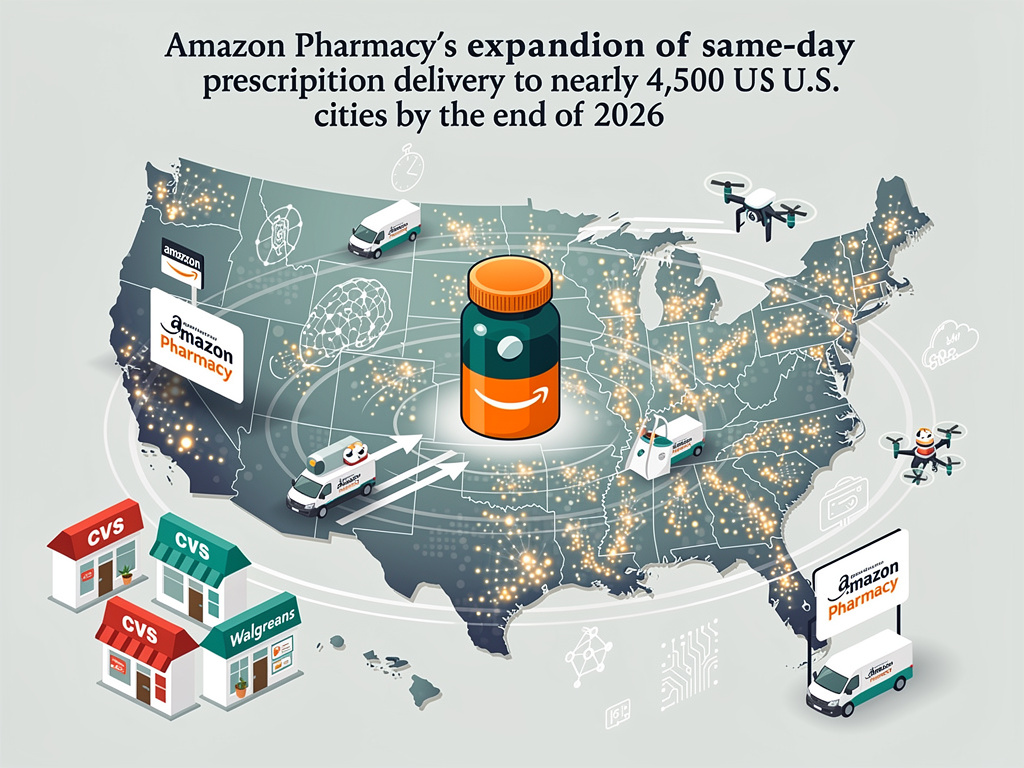
Amazon is making its most aggressive move yet to reshape how Americans get their prescription medications, announcing plans to bring same-day pharmacy delivery to almost 4,500 U.S. cities and towns by the end of 2026 — an expansion that adds nearly 2,000 new communities to its existing footprint and puts traditional pharmacy chains on notice that the e-commerce giant is no longer content to nibble at the margins of a $600 billion industry.
The announcement, made in February 2026, represents a dramatic scaling of a service Amazon first piloted in a handful of cities just a few years ago. According to Amazon’s corporate blog, the expansion will leverage the company’s vast logistics network, including its network of fulfillment centers and last-mile delivery infrastructure, to get prescriptions to patients’ doorsteps within hours of an order being placed. The company currently offers same-day delivery in approximately 2,500 communities, meaning the planned expansion nearly doubles its geographic reach in a single calendar year.
From Side Project to Strategic Pillar: Amazon’s Healthcare Ambitions Come Into Focus
Amazon Pharmacy’s origins trace back to the company’s 2018 acquisition of PillPack, an online pharmacy that specialized in pre-sorted dose packaging for patients managing multiple medications. What began as a relatively modest foray into mail-order prescriptions has since evolved into a full-spectrum pharmacy operation that now includes same-day and next-day delivery, a prescription discount program, and integration with the company’s Prime membership ecosystem. As TechCrunch reported, the latest expansion underscores Amazon’s determination to make pharmacy a core component of its consumer health strategy rather than a peripheral add-on.
The timing is significant. Amazon has been steadily building out its healthcare portfolio, which now includes Amazon Clinic (a telehealth service), its One Medical primary care practice acquired for $3.9 billion, and various AI-driven health tools. The pharmacy expansion fits neatly into this broader architecture. As PYMNTS noted, the company is accelerating its medical ambitions by pairing faster prescription deliveries with artificial intelligence-powered health insights, creating a vertically integrated healthcare experience that starts with a virtual consultation and ends with a package on a patient’s porch.
The Logistics Machine Behind the Promise
Delivering prescriptions the same day they are ordered is a fundamentally different logistical challenge than shipping a book or a pair of headphones. Medications require temperature-controlled environments, pharmacist verification, compliance with state-by-state regulations, and careful handling of controlled substances. Amazon’s ability to scale this operation to nearly 4,500 communities speaks to the maturity of its pharmaceutical supply chain — and to the billions of dollars it has invested in last-mile delivery infrastructure over the past decade.
According to CNET, Amazon Pharmacy will offer same-day delivery to 2,000 additional communities throughout 2026, with the rollout happening in phases across the year. The company is reportedly positioning pharmacy items alongside its broader same-day delivery offerings, allowing delivery drivers to bundle prescription drop-offs with other Amazon orders — a move that improves route density and reduces per-delivery costs. This bundling strategy is a classic Amazon playbook: use existing infrastructure to subsidize new services until they reach the scale needed to stand on their own.
Pricing Pressure and the Prime Advantage
One of Amazon Pharmacy’s most potent weapons is its pricing model. The service offers significant discounts on generic medications — in some cases up to 80% off — for Prime members, effectively turning a $139-per-year membership into a healthcare savings vehicle. Amazon has also introduced transparent pricing tools that allow customers to compare costs across insurance plans and discount programs before filling a prescription, a level of price visibility that traditional pharmacies have historically resisted.
As Yahoo Finance reported, the expansion is expected to intensify pricing pressure across the retail pharmacy sector, which is already reeling from thin margins on prescription drugs, declining foot traffic, and a wave of store closures. CVS Health announced the closure of 900 stores over a three-year period beginning in 2022, while Walgreens has shuttered hundreds of locations and agreed to a go-private deal. Rite Aid emerged from bankruptcy in 2023 with a significantly smaller store count. Into this environment of retrenchment, Amazon is pushing forward with an asset-light model that doesn’t require expensive real estate on every corner.
What This Means for CVS, Walgreens, and the Incumbents
The traditional pharmacy business model — anchored by physical storefronts that generate revenue from both prescriptions and front-of-store retail sales — is under existential strain. Amazon’s expansion doesn’t just threaten prescription revenue; it undermines the entire logic of the pharmacy as a destination. If patients no longer need to visit a store to pick up their medications, the incidental purchases of toothpaste, greeting cards, and snacks that subsidize pharmacy operations evaporate as well.
Industry analysts have noted that Amazon’s pharmacy push is particularly threatening because it targets the most profitable segment of the pharmacy business: maintenance medications for chronic conditions. These are the prescriptions that patients refill month after month — statins, blood pressure medications, diabetes drugs — and they represent a reliable, recurring revenue stream. Amazon’s subscription-based refill model, combined with same-day delivery, makes it trivially easy for patients to shift these prescriptions away from their local pharmacy. According to Quartz, this is precisely the kind of consumer behavior shift that keeps pharmacy executives up at night.
AI, Personalization, and the Data Flywheel
Beyond logistics and pricing, Amazon’s pharmacy ambitions are deeply intertwined with its artificial intelligence capabilities. As PYMNTS reported, the company is deploying AI-powered tools to provide patients with personalized health insights, medication interaction warnings, and proactive refill reminders. These features are designed not just to improve patient outcomes but to deepen engagement with the Amazon health ecosystem — creating a data flywheel in which every prescription filled, every telehealth visit completed, and every health question asked feeds back into algorithms that make the service more useful and more sticky.
This data advantage is something traditional pharmacies will struggle to replicate. While CVS and Walgreens have invested in digital health platforms, they lack Amazon’s core competency in machine learning, cloud computing, and personalized recommendation engines. Amazon Web Services, the company’s cloud division, already powers a significant portion of the healthcare industry’s digital infrastructure; now, Amazon is using that same technological backbone to build a consumer-facing health service that could redefine patient expectations.
Regulatory Hurdles and Consumer Trust Remain Key Variables
For all its momentum, Amazon Pharmacy faces real obstacles. Pharmacy regulation in the United States is a state-by-state patchwork, with varying rules around licensure, controlled substance dispensing, and pharmacist supervision. Scaling same-day delivery to 4,500 communities means navigating this regulatory complexity at speed — a challenge that has tripped up other would-be disruptors in the past. Amazon has invested heavily in compliance infrastructure, but each new market requires careful coordination with state pharmacy boards and regulatory agencies.
Consumer trust is another variable. Many patients — particularly older Americans who account for a disproportionate share of prescription spending — have deep relationships with their local pharmacists. The personal interaction, the ability to ask questions face-to-face, and the comfort of a familiar routine are not easily replicated by an app and a delivery driver. TechCrunch noted that Amazon is aware of this dynamic and has been investing in pharmacist-led customer support, including live chat and phone consultations, to bridge the trust gap.
A Defining Year for Amazon’s Healthcare Bet
The expansion to nearly 4,500 cities and towns by the end of 2026 is more than a logistics milestone — it is a declaration of strategic intent. Amazon is signaling that it views healthcare not as an experiment but as a pillar of its next phase of growth, alongside cloud computing, advertising, and artificial intelligence. The company’s willingness to invest at this scale, in a sector known for its complexity and regulatory burden, suggests a level of conviction that competitors ignore at their peril.
For consumers, the promise is straightforward: faster, cheaper, more convenient access to prescription medications, delivered with the same reliability they expect from any other Amazon order. For the incumbent pharmacy industry, the message is equally clear — adapt or risk irrelevance. As Amazon stated in its announcement, the goal is to make pharmacy “as simple as any other part of your day.” If the company delivers on that promise at the scale it is now projecting, the reverberations will be felt far beyond the pharmacy aisle.


 WebProNews is an iEntry Publication