
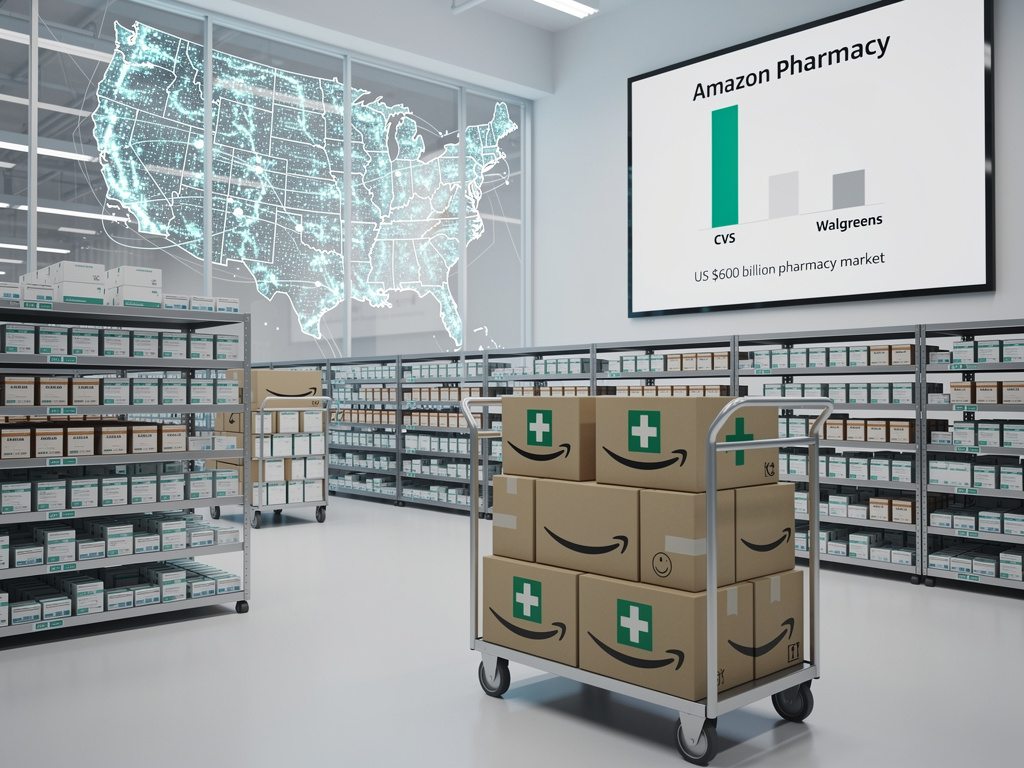
Amazon is making its most aggressive move yet into the American pharmacy business, announcing plans to expand same-day prescription delivery to nearly 4,500 cities and towns across the United States. The expansion, which represents a dramatic scaling of the e-commerce giant’s healthcare ambitions, threatens to reshape how millions of Americans fill their prescriptions and could accelerate the decline of traditional brick-and-mortar pharmacies already struggling with razor-thin margins and shifting consumer habits.
The announcement, first reported by TechCrunch, marks a significant escalation in Amazon’s strategy to become a dominant force in the roughly $600 billion U.S. pharmacy market. The company has been methodically building out its pharmaceutical logistics infrastructure since acquiring online pharmacy PillPack in 2018 for approximately $753 million, and this latest expansion signals that the years of groundwork are beginning to pay off at scale.
From Niche Offering to Nationwide Ambition
Amazon Pharmacy’s same-day delivery service was initially available in a limited number of metropolitan areas, primarily concentrated in cities where Amazon already had dense fulfillment networks. The expansion to nearly 4,500 cities represents a quantum leap in coverage, effectively bringing the service within reach of a vast majority of the U.S. population. According to the TechCrunch report, the rollout leverages Amazon’s existing delivery infrastructure, including its network of last-mile delivery stations and its growing fleet of delivery drivers, to ensure prescriptions can move from pharmacist to patient’s doorstep in a matter of hours.
The service is available to Amazon Prime members, adding yet another layer of value to the subscription program that already serves as the backbone of the company’s consumer ecosystem. For Prime members, the same-day delivery option comes at no additional charge for eligible prescriptions, a pricing strategy that undercuts the convenience fees charged by many competing delivery services. Non-Prime customers can also access the pharmacy but may face delivery charges or longer wait times, creating a powerful incentive for new Prime sign-ups.
The Logistics Machine Behind the Prescription Counter
What makes Amazon’s pharmacy expansion particularly formidable is the company’s unmatched logistics capability. Unlike traditional pharmacy chains that must rely on their existing store footprints or partner with third-party delivery services, Amazon can tap into a delivery network that already reaches virtually every address in the country. The company has spent tens of billions of dollars over the past decade building out fulfillment centers, sortation facilities, and delivery stations — infrastructure that can be repurposed for pharmaceutical distribution with relatively modest incremental investment.
Amazon has established dedicated pharmacy fulfillment centers that are staffed by licensed pharmacists and equipped to handle the unique regulatory and storage requirements of prescription medications. These facilities operate under strict temperature controls and chain-of-custody protocols mandated by state and federal pharmacy boards. The company has invested heavily in automation within these centers, using robotic systems to pick, verify, and package prescriptions with a level of accuracy and speed that would be difficult for traditional pharmacies to match.
A Direct Challenge to CVS, Walgreens, and the Pharmacy Status Quo
The timing of Amazon’s expansion could hardly be worse for the incumbent pharmacy giants. CVS Health and Walgreens Boots Alliance have both been navigating turbulent waters in recent years, with Walgreens filing for bankruptcy protection and CVS undertaking significant cost-cutting measures and store closures. Both companies have been closing hundreds of locations as they grapple with declining foot traffic, reimbursement pressures from pharmacy benefit managers, and the broader shift toward online commerce that Amazon itself has done so much to accelerate.
Walgreens, which announced plans to close a significant number of its U.S. stores, has been particularly vulnerable. The company’s struggles have been compounded by opioid litigation settlements, declining front-of-store sales, and a failed attempt to pivot toward healthcare services. CVS, while in stronger financial shape, has also acknowledged the competitive threat posed by Amazon and has been investing in its own delivery capabilities and digital health platforms. However, neither company can match Amazon’s scale of delivery infrastructure or its willingness to absorb short-term losses in pursuit of long-term market dominance.
The Prime Membership Flywheel Spins Faster
Amazon’s pharmacy push is as much about strengthening the Prime ecosystem as it is about capturing pharmacy market share. Every new service added to Prime — from video streaming to grocery delivery to prescription fulfillment — increases the perceived value of the membership and makes it harder for subscribers to cancel. With more than 200 million Prime members globally, even a modest conversion rate to pharmacy services would represent a massive patient population.
The strategy mirrors what Amazon has done in grocery with its acquisition of Whole Foods and the expansion of Amazon Fresh. By integrating pharmacy into the same app and delivery infrastructure that customers already use for household goods, electronics, and groceries, Amazon is creating a one-stop ecosystem that traditional retailers simply cannot replicate. A customer who orders toothpaste, dog food, and a blood pressure medication in a single transaction is far more valuable — and far more loyal — than one who visits three separate stores.
Regulatory Hurdles and the Complexity of Pharmacy
Despite Amazon’s logistical prowess, the pharmacy business presents unique challenges that differentiate it from selling books or consumer electronics. Pharmacy is one of the most heavily regulated sectors in the American economy, with oversight from state pharmacy boards, the Drug Enforcement Administration, the Food and Drug Administration, and numerous other agencies. Each state has its own licensing requirements, and Amazon must maintain pharmacy licenses in every state where it operates — a compliance burden that requires significant legal and operational resources.
Controlled substances, which include commonly prescribed medications such as certain pain relievers, anti-anxiety drugs, and ADHD medications, are subject to even stricter regulations. Amazon has been gradually expanding its ability to fulfill controlled substance prescriptions, but the regulatory complexity means that not all medications are available for same-day delivery in all markets. The company must also navigate the intricate web of insurance billing, pharmacy benefit manager negotiations, and patient privacy requirements under HIPAA, all of which add layers of complexity that Amazon’s retail operations do not typically encounter.
What This Means for Patients and the Broader Healthcare System
For consumers, particularly those with chronic conditions who require regular medication refills, the convenience of same-day delivery to nearly 4,500 cities could be transformative. Medication non-adherence — the failure to take prescriptions as directed — is one of the most persistent and costly problems in American healthcare, contributing to an estimated $290 billion in avoidable medical spending annually, according to data frequently cited by the Centers for Disease Control and Prevention. By removing the friction of pharmacy visits, Amazon could meaningfully improve adherence rates, particularly among elderly patients, those with mobility limitations, and people living in areas where pharmacy access has been reduced by store closures.
However, critics have raised concerns about the potential downsides of Amazon’s growing healthcare footprint. Privacy advocates worry about the company’s access to sensitive health data, while independent pharmacists fear that Amazon’s pricing power could drive even more small pharmacies out of business. The National Community Pharmacists Association has previously expressed concern about the consolidation of pharmacy services among a handful of corporate giants, arguing that independent pharmacies provide personalized care and community health services that large-scale delivery operations cannot replicate.
The Road Ahead for Amazon’s Healthcare Empire
Amazon’s pharmacy expansion is just one piece of a broader healthcare strategy that has been taking shape over several years. The company acquired One Medical, a primary care practice with locations across the country, and has been integrating those services with its Prime membership. Amazon has also launched Amazon Clinic, a virtual care platform that connects patients with healthcare providers for common conditions. Taken together, these initiatives suggest that Amazon envisions a future in which it serves as a comprehensive healthcare platform — from diagnosis to prescription to delivery — all accessible through a single app.
The expansion to nearly 4,500 cities is a statement of intent. Amazon is not content to nibble at the edges of the pharmacy market; it is positioning itself to become the default pharmacy for a generation of consumers who already trust it with their shopping, their entertainment, and their groceries. For the traditional pharmacy chains, the message is clear: adapt or risk irrelevance. For patients, the promise is simple but powerful — your medication, delivered to your door, the same day you need it. Whether that promise can be consistently fulfilled across thousands of cities and millions of prescriptions will determine whether Amazon Pharmacy becomes the next great disruption in American healthcare or merely another ambitious bet in a sector that has humbled many before it.


 WebProNews is an iEntry Publication