
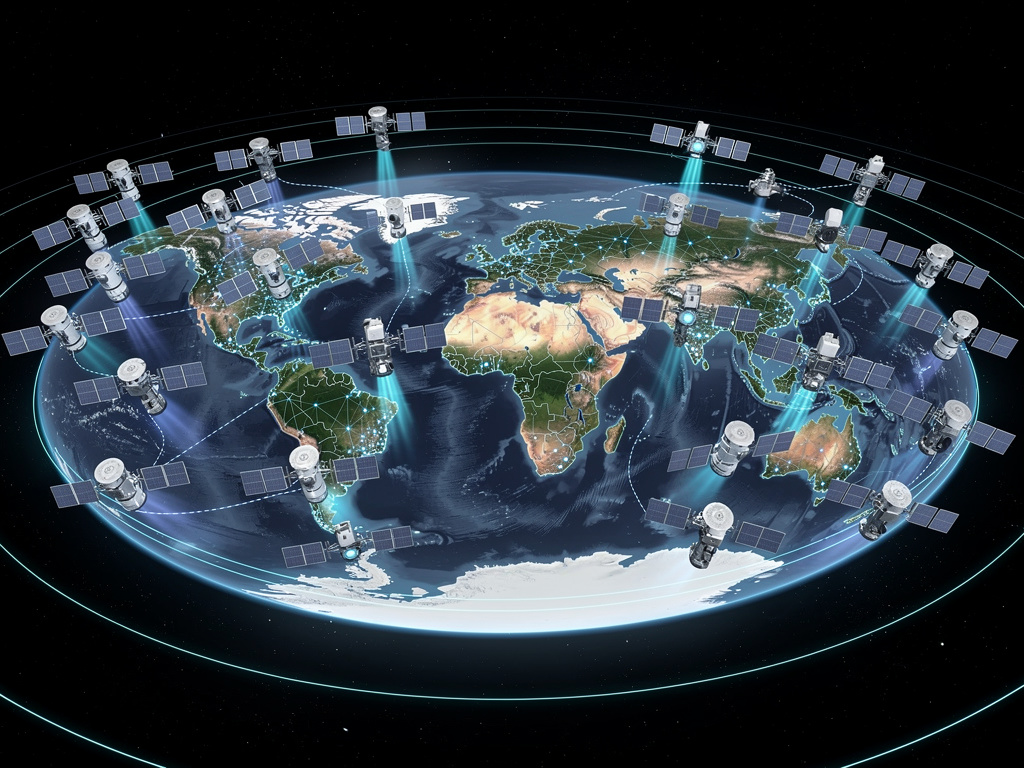
Wall Street has watched satellite internet for years. Once dismissed as too costly and too slow, the sector now draws billions in capital. SpaceX’s Starlink leads with more than 10,000 satellites in orbit and roughly 10 million subscribers as of early 2026. Yet Amazon refuses to sit on the sidelines. Its project, rebranded from Project Kuiper to Amazon Leo late last year, stands ready to launch commercial service in mid-2026.
Andy Jassy laid it out in his annual letter to shareholders. Amazon Leo sits “on the verge of launching.” The company has already secured revenue commitments from enterprises and governments. The Guardian reported those exact words in April. Jassy didn’t stop there. He promised integration with Amazon Web Services that lets businesses shuttle data for storage, analytics and AI. The pitch targets places traditional broadband never reached. Billions lack reliable access. Leo aims to change that equation.
Performance claims raise eyebrows. Jassy told investors Leo will deliver download speeds up to 1 Gbps. He added it should run about two times better on downlink and six times better on uplink than existing alternatives. Those alternatives point squarely at Starlink. Typical Starlink downloads range from 45 to 280 Mbps according to company documents. The gap sounds substantial on paper. Real-world tests will decide if it holds.
But here’s the scale difference. Starlink operates more than 10,000 active satellites. Amazon had launched just over 300 by late April 2026. Amazon’s own updates confirm the company completed 11 missions in its first full year of launches and now ranks as the third-largest constellation. Plans call for more than 3,200 satellites total, with regulatory approval sought for thousands more. The gap remains wide. Catching up demands hundreds of launches in coming years.
Partnerships offer Amazon a different edge. Delta Air Lines committed half its fleet to Leo for in-flight connectivity starting in 2028. JetBlue signed on too. Deals extend to AT&T, Vodafone, DirecTV Latin America, Australia’s national broadband network and NASA. CNET detailed these agreements after Amazon’s earnings call. Such enterprise and government contracts provide early revenue before consumer rollout. They also build credibility.
Starlink, meanwhile, keeps growing fast. The service generated an estimated $11.4 billion in revenue last year, according to Reuters. Subscriber numbers crossed 10 million in February 2026. Monthly active users and app downloads more than doubled in the first quarter. Growth appears in both developed and emerging markets. Average revenue per user fell 18 percent to $81 a month between 2023 and 2025 as the company introduced cheaper plans and expanded globally. SpaceX accepts the trade-off. Volume matters more than premium pricing right now.
Kiplinger examined the broader investment wave months earlier. Companies pour money into satellite constellations because the economics finally align. Reusable rockets slashed launch costs. Demand for connectivity in remote areas, aviation, maritime and disaster zones continues to climb. That Kiplinger analysis captured the shift from skepticism to serious capital allocation across multiple players.
Amazon brings unique assets. Its cloud business already serves enterprises that need reliable data movement. Leo’s satellites can feed information straight into AWS infrastructure. Jassy highlighted this advantage. Governments and large organizations gain one-stop connectivity plus computing. The combination could prove hard to match.
Competition stretches beyond these two giants. China advances its own satellite IoT pilots. Reliance in India eyes space-based services. Smaller operators test direct-to-cell capabilities. Starlink itself experiments with direct-to-device through partnerships. The sky grows crowded. Orbital slots, spectrum and regulatory approvals become battlegrounds.
Yet technical hurdles persist. Satellites must maintain precise orbits. User terminals require clear sky views. Latency, though low in LEO systems, varies with network load. Weather still affects signals. Scaling to millions of simultaneous users tests engineering limits. Both Amazon and SpaceX pour resources into solving these problems.
Financial stakes run high. Amazon committed more than $10 billion so far. Additional spending continues. Starlink’s path to profitability accelerated with subscriber growth. Analysts project the business could reach $20 billion in annual revenue within a few years if trends hold. Public market investors watch closely. SpaceX eyes an IPO where Starlink performance will drive valuation.
Consumer impact could arrive sooner than expected. Early beta testing for enterprises began. Amazon opened a waitlist. If Leo delivers on speed and price promises, rural households and businesses gain options. Prices matter. Starlink already cut hardware costs and offers promotions. Amazon says its service will cost less than competitors. Details remain sparse.
And the timeline slipped before. Original targets moved. Full-scale deployment began in 2025. By April 2026 more than 300 satellites circled Earth. Launches accelerate with contracts for Atlas V, Ariane 6, ULA and others. Blue Origin rockets join from 2027. Execution speed will determine whether Amazon grabs meaningful share or trails far behind.
Investors bet on both. Satellite internet no longer sits on the fringe of telecom strategy. It forms core infrastructure for a connected world. Airlines want it for passengers. Governments need it for remote operations. Enterprises see new data possibilities. The two leaders, SpaceX and Amazon, approach the challenge with different strengths. One dominates in orbit and user numbers today. The other wields cloud computing scale and deep corporate relationships.
Outcomes remain uncertain. Technology evolves quickly. Regulatory decisions could tilt the field. Market adoption depends on real performance, pricing and reliability. For now the race intensifies. Mid-2026 marks another milestone. Amazon Leo’s arrival will test whether one dominant player can hold its lead or if the market supports vigorous competition. Billions in potential revenue hang in the balance. So do connectivity gains for millions still waiting for reliable internet.


 WebProNews is an iEntry Publication