
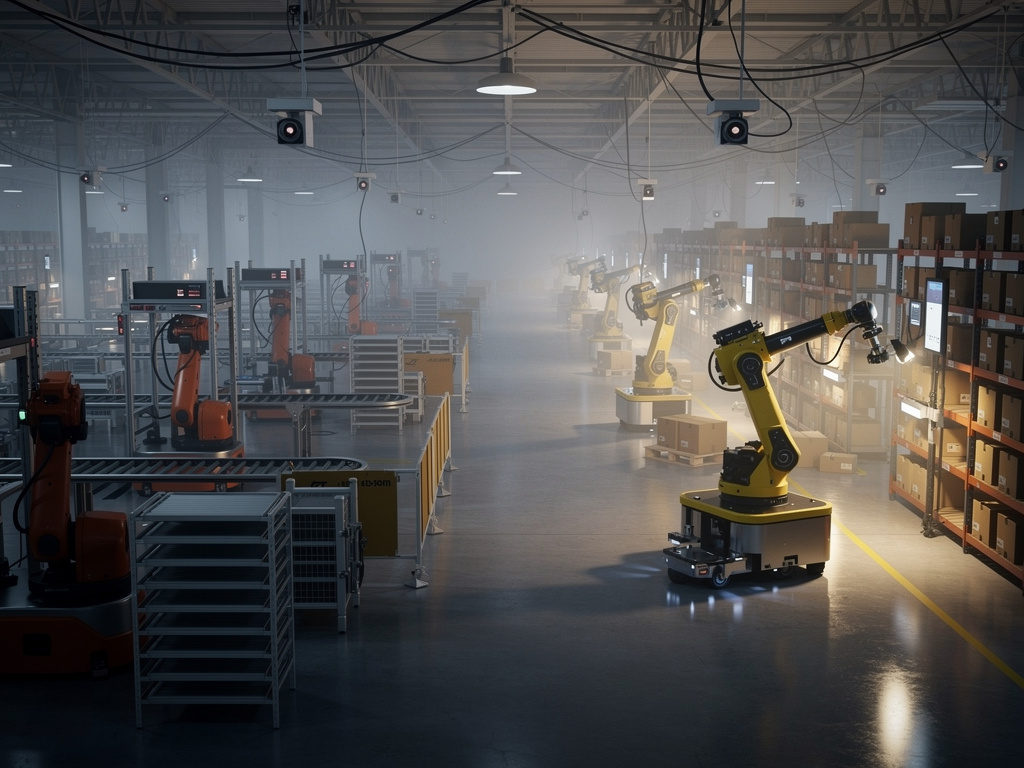
Amazon is laying off several hundred employees from its robotics division, a move that signals a significant recalibration of how the company intends to automate its massive fulfillment network. The cuts, first reported by TechRepublic, affect workers across Amazon’s robotics and automation teams, with the company framing the decision as a strategic realignment rather than a retreat from automation itself.
Not a retreat at all, actually. Quite the opposite.
Amazon confirmed the layoffs in a statement, noting that the company is restructuring its robotics efforts to focus on newer technologies — particularly those driven by artificial intelligence and machine learning. The affected roles span engineering, program management, and operational positions tied to older automation systems. According to TechRepublic, the layoffs are expected to take effect by March 2026, giving impacted employees time to find internal transfers or external roles.
Here’s the context that matters. Amazon has been one of the most aggressive investors in warehouse robotics on the planet. The company acquired Kiva Systems back in 2012 for $775 million, rebranded it as Amazon Robotics, and deployed hundreds of thousands of mobile robots across its fulfillment centers. Those orange Kiva bots became iconic — small, flat machines scurrying beneath shelving units to deliver products to human pickers. But the technology, while effective, is now over a decade old. And Amazon’s ambitions have grown far beyond shuffling shelves around a warehouse floor.
The company has been developing and testing a new generation of robotic systems. Sparrow, a robotic arm capable of identifying, selecting, and handling individual items, was unveiled in late 2022. Sequoia, a more integrated fulfillment system combining robotics with AI-driven inventory management, followed in 2023. These systems represent a fundamentally different approach: instead of simply moving goods to people, they aim to reduce human involvement in the picking, packing, and sorting process altogether. Amazon has also invested in Proteus, its first fully autonomous mobile robot designed to operate safely alongside human workers without being confined to restricted areas.
So the layoffs aren’t about Amazon losing faith in robotics. They’re about Amazon shifting investment from legacy systems to AI-native ones. The distinction matters for anyone watching the industrial automation space.
The broader industry trend supports this interpretation. Warehouse automation is moving rapidly from rules-based robotics — machines that follow fixed instructions — toward systems that can perceive, reason, and adapt. Companies like Covariant (recently acquired by Amazon, notably), Locus Robotics, and Agility Robotics with its Digit humanoid are all pushing in this direction. Amazon’s own $1.7 billion acquisition of Covariant’s AI talent and technology in 2024, reported by Reuters, underscored just how seriously the company is betting on AI-first robotics.
For the workers affected, the situation is complicated. Amazon says it’s offering severance packages and assistance with internal mobility. But robotics engineering roles tied to older platforms don’t always translate neatly into positions requiring deep expertise in foundation models, computer vision, or reinforcement learning. The skills gap is real, and it’s one the entire manufacturing and logistics sector is grappling with as automation becomes more software-defined.
There’s a financial dimension too. Amazon has been under pressure to improve margins in its retail and logistics operations. CEO Andy Jassy has repeatedly emphasized efficiency and cost discipline since taking the helm. Consolidating robotics teams and sunsetting older programs fits that mandate. Every dollar redirected from maintaining legacy robot fleets toward AI systems that promise higher throughput and lower per-unit costs is a dollar Jassy can point to on an earnings call.
The competitive pressure is intense. Walmart has partnered with Symbotic to automate its distribution centers. Shopify’s logistics ambitions, while scaled back, pushed the industry forward. Chinese e-commerce giants like JD.com and Alibaba’s Cainiao have deployed highly automated warehouses that set a global benchmark. Amazon can’t afford to stand still, and it clearly isn’t planning to.
What this means for the robotics industry more broadly: expect consolidation. Companies building single-purpose warehouse robots without strong AI capabilities are going to face a tougher market. The buyers — Amazon, Walmart, DHL, and other logistics giants — want systems that learn and improve over time, not machines that need to be reprogrammed every time a new product SKU enters the warehouse. That’s the through line connecting Amazon’s layoffs to its acquisitions to its R&D priorities.
A few hundred jobs lost. Billions in new investment redirected. The math is cold but clear — Amazon is rebuilding its automation strategy from the silicon up, and the workers tied to the old architecture are paying the price of that transition.


 WebProNews is an iEntry Publication