
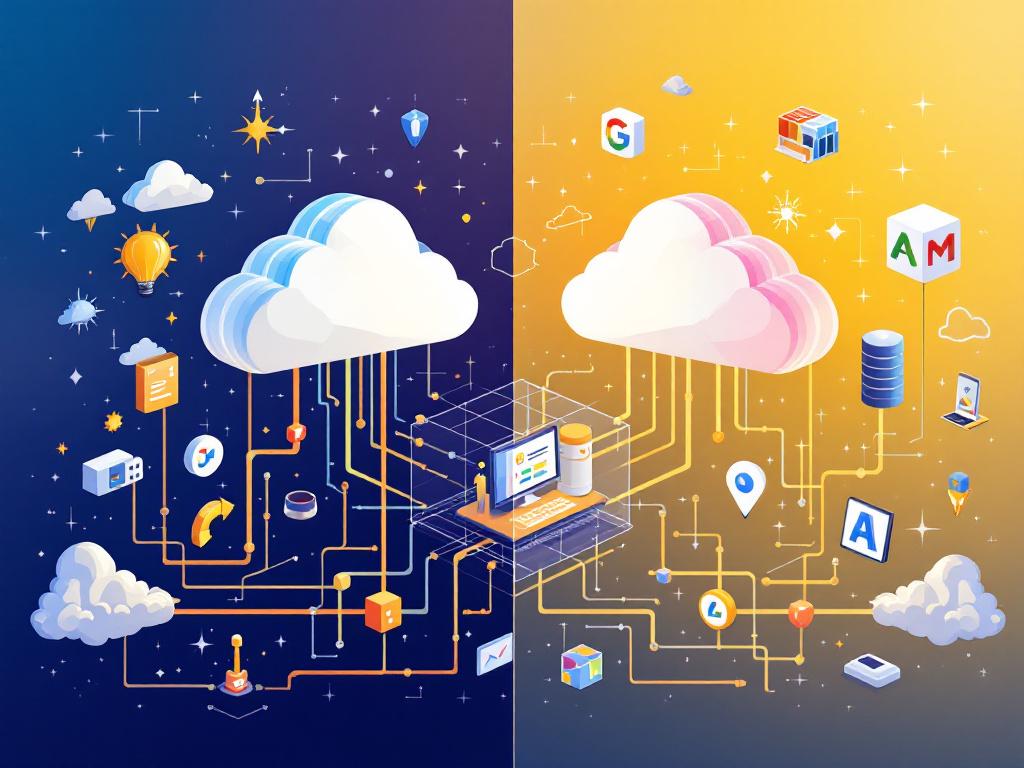
Cloud Rivals Forge a New Path: Inside the Amazon-Google Multicloud Alliance
In a surprising twist that underscores the evolving dynamics of the cloud computing sector, Amazon and Google have unveiled a collaborative multicloud networking service aimed at streamlining connectivity between their respective platforms. This joint initiative, announced on December 1, 2025, promises to enable businesses to establish private, high-speed links in mere minutes rather than the weeks typically required. The move comes amid heightened scrutiny on cloud reliability, particularly following a major Amazon Web Services (AWS) outage in October that disrupted countless online services.
The service integrates AWS’s Direct Connect with Google Cloud’s Cross-Cloud Interconnect, creating a seamless bridge for data transfer across the two giants’ infrastructures. Early adopters, including software powerhouse Salesforce, are already testing the waters, highlighting the potential for reduced downtime and enhanced performance in an era where artificial intelligence workloads demand unprecedented bandwidth. This partnership marks a rare instance of cooperation between two fierce competitors who together command a significant share of the global cloud market.
Industry analysts view this as a strategic response to the growing preference among enterprises for multicloud strategies, where organizations leverage multiple providers to avoid vendor lock-in and optimize costs. By simplifying interconnections, Amazon and Google are positioning themselves as enablers rather than isolated silos, potentially reshaping how businesses architect their digital operations.
The Catalyst: Lessons from Recent Outages
The timing of this launch is no coincidence. Just over a month ago, an AWS disruption on October 20 sent shockwaves through the internet, taking down popular applications like Snapchat and Reddit. Such incidents underscore the fragility of relying on a single provider, prompting calls for more robust failover mechanisms. Google, too, has faced its share of service interruptions, though less publicized in recent years.
This new offering aims to mitigate these risks by facilitating rapid setup of dedicated connections, bypassing public internet vulnerabilities. According to statements from both companies, the service will support bandwidth-intensive applications, from AI model training to real-time data analytics, ensuring minimal latency and higher throughput.
For insiders, the technical underpinnings are particularly intriguing. The integration leverages standardized protocols and automated provisioning, reducing the manual configuration that has long plagued multicloud deployments. This could lower barriers for smaller enterprises previously deterred by complexity and cost.
Competitive Pressures and Market Shifts
Beyond reliability, the alliance reflects broader competitive forces. Microsoft Azure, the third major player, has been aggressive in multicloud integrations, partnering with the likes of Oracle and VMware. Amazon and Google’s move could be seen as a counterplay to maintain their dominance, especially as AI-driven demands surge.
Recent financial reports indicate AWS remains the market leader with over 30% share, followed by Azure and Google Cloud. However, growth rates have slowed post-pandemic, pushing providers to innovate. This service might accelerate adoption among hybrid cloud users, where on-premises systems connect to multiple clouds.
Posts on X (formerly Twitter) from industry observers echo this sentiment, with users noting the partnership’s potential to “normalize cloud-to-cloud connectivity” and reduce the “DIY mess” of custom integrations. Such real-time discussions highlight enthusiasm but also skepticism about whether this will truly democratize access or favor large-scale enterprises.
Technical Deep Dive: How the Service Works
At its core, the multicloud service builds on existing tools: AWS Direct Connect for dedicated fiber connections and Google Cloud’s Network Connectivity Center for managing global networks. The joint offering introduces a unified interface that automates link provisioning, supporting speeds up to 100 Gbps initially, with plans for scaling.
Engineers familiar with these systems will appreciate the emphasis on security, incorporating end-to-end encryption and private routing to prevent data exposure. This is crucial for regulated industries like finance and healthcare, where compliance with standards such as GDPR and HIPAA is non-negotiable.
Moreover, the service includes monitoring and analytics features powered by both companies’ AI capabilities, allowing for predictive maintenance and automated scaling. This integration could serve as a blueprint for future collaborations, potentially extending to other providers if adoption proves successful.
Early Adopters and Use Cases
Salesforce’s involvement as an early tester is telling. The CRM giant, which operates across multiple clouds, stands to benefit from faster data synchronization between AWS-hosted applications and Google Cloud’s BigQuery for analytics. This could enhance customer experiences by enabling real-time insights without the lag of traditional transfers.
Other potential use cases abound in sectors like media and entertainment, where streaming services require low-latency connections for content delivery. Imagine a video platform seamlessly pulling AI-generated subtitles from Google Cloud while hosting core infrastructure on AWS—all without noticeable delays.
Industry reports suggest that by 2026, over 85% of enterprises will employ multicloud strategies, up from 75% today. This service positions Amazon and Google to capture a larger slice of that pie, potentially generating new revenue streams through usage-based pricing.
Strategic Implications for the Industry
This partnership challenges the narrative of cutthroat rivalry in cloud computing. Historically, Amazon and Google have vied for supremacy through exclusive features and aggressive pricing. Yet, as customer needs evolve toward interoperability, such alliances may become more common.
Consider the broader ecosystem: chipmakers like Nvidia, whose GPUs power AI workloads across both platforms, could see increased demand as easier connectivity encourages larger cluster deployments. Recent X posts highlight partnerships like Google’s with Anthropic for TPU access, underscoring the race for compute power.
From a regulatory standpoint, this move might alleviate antitrust concerns by demonstrating cooperation that benefits consumers. However, it could also invite scrutiny if it strengthens the duopoly’s hold on the market.
Innovation Amid Economic Headwinds
Economic factors play a role too. With inflation cooling but budgets tight, enterprises are scrutinizing cloud spends. By offering a cost-effective way to interconnect, this service could help justify investments in premium cloud features.
Looking ahead, expansions are likely. Sources indicate plans to include more regions and integrate with edge computing for IoT applications. This aligns with trends in distributed computing, where data processing occurs closer to the source for faster response times.
For developers, the service opens new possibilities in application design, allowing microservices to span clouds without performance penalties. This could foster innovation in areas like autonomous vehicles and smart cities, where real-time data fusion is essential.
Voices from the Field: Analyst Perspectives
Analysts at firms like Gartner and Forrester are buzzing about the implications. One report from Gartner predicts that multicloud management tools will see 20% annual growth through 2030, driven by services like this.
On X, tech influencers are debating the long-term effects, with some praising the “power move” while others question if it’s a defensive play against Azure’s advances. These discussions provide a pulse on sentiment, revealing optimism tempered by calls for open standards to prevent proprietary lock-ins.
Incorporating insights from Reuters, the initiative is framed as a direct response to outage risks, emphasizing reliability in an AI-heavy world.
Broader Ecosystem Impacts
The ripple effects extend to partners and competitors alike. Oracle, for instance, has its own multicloud pacts with Microsoft, setting the stage for a web of interconnections. This could evolve into a more federated cloud environment, where data flows freely across providers.
For startups, easier multicloud access lowers entry barriers, enabling them to compete with established players by mixing and matching best-of-breed services. Imagine a fintech startup using AWS for transaction processing and Google Cloud for machine learning—all interconnected seamlessly.
Economic Times coverage, via The Economic Times, notes the service’s launch at AWS re:Invent 2025, tying it to announcements on agentic AI and expanded infrastructure.
Future Horizons: What’s Next?
As the service rolls out, monitoring adoption will be key. Initial availability is in select regions, with global expansion slated for early 2026. Pricing details remain under wraps, but insiders expect competitive rates to drive uptake.
This collaboration might inspire similar deals, perhaps involving IBM Cloud or Alibaba, further blurring lines between competitors. In the AI arms race, where compute clusters span providers, such connectivity is indispensable.
Drawing from Yahoo Finance, the announcement highlights the combination of AWS Interconnect-multicloud with Google Cloud’s tools, aiming for improved network interoperability.
Reflections on a Changing Arena
Ultimately, this partnership signals maturity in the cloud sector, where cooperation complements competition. For industry veterans, it’s a reminder that user-centric innovations often trump isolationist strategies.
Challenges remain, including ensuring equitable access for all sizes of businesses and addressing potential security gaps in cross-cloud traffic. Yet, the potential for a more resilient digital foundation is immense.
As one X post aptly put it, this could “transform multicloud from a headache to a superpower,” capturing the excitement around this pivotal development. With Amazon and Google leading the charge, the future of cloud connectivity looks brighter—and faster—than ever.


 WebProNews is an iEntry Publication