
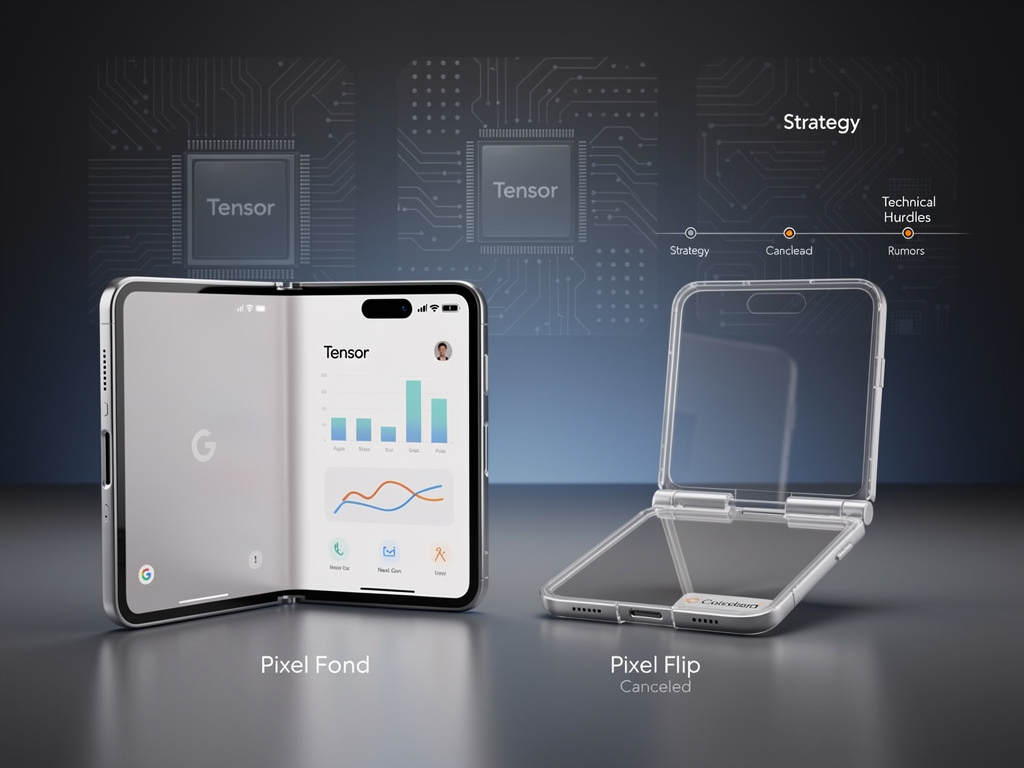
MOUNTAIN VIEW, Calif. — In the high-stakes arena of smartphone innovation, Google made a decisive, if belated, entry into the foldable category last year. The Pixel Fold, with its $1,799 price tag, was a statement piece—a meticulously engineered device designed to showcase the company’s software prowess on a new canvas of flexible glass. It was Google’s declaration that it could compete at the bleeding edge. Yet, as the foldable market matures, a strategic paradox has emerged within Alphabet’s hardware division: while Google has proven it can build a compelling, book-style foldable, it remains conspicuously absent from the segment that actually drives volume and consumer adoption—the clamshell.
The Pixel Fold served its purpose as a “halo” product, demonstrating a mastery of the software experience that competitors often struggled with. Google leveraged its deep integration with Android to create a fluid, multitasking-friendly interface that justified the expansive inner display. The device, despite first-generation quirks like substantial bezels, was lauded for its thoughtful design and robust hinge, establishing a foothold in the ultra-premium space. According to an analysis by Android Central, Google successfully proved its hardware capabilities, making its subsequent inaction in the more popular flip-phone category all the more puzzling for industry watchers.
This absence is stark when viewed against market data. The clamshell form factor, popularized by Samsung’s Galaxy Z Flip series and Motorola’s revitalized Razr line, is not just a part of the foldable market; it is the dominant force. These devices, which fold into a compact square, appeal to a broader demographic through their lower-than-a-Fold price points, portability, and fashion-forward aesthetics. Data from market analysis firm Counterpoint Research shows that the clamshell type has consistently accounted for the majority of shipments, turning foldables from a niche productivity tool into a mainstream style statement. For a company aiming to grow the market share of its Pixel line, forgoing this larger segment appears to be a deliberate and costly omission.
A Calculated Retreat or a Strategic Pivot?
The mystery deepens with reports suggesting that a Pixel Flip was not just an idea, but a project deep in development that was ultimately shelved. Whispers from within the supply chain and code commits have long pointed to a device codenamed “g,” a clamshell counterpart to the “Passport” and “Felix” codenames that became the Pixel Fold. Sources inside the company, as reported by 9to5Google, indicated that Google has postponed, if not entirely canceled, its clamshell plans, opting to skip a 2024 release to focus its resources elsewhere. The decision was reportedly made because the device was not deemed competitive enough to challenge established players.
This hesitation speaks to a broader, often cautious, and sometimes fickle hardware strategy at Google. The company has a history of launching ambitious projects only to shutter them when they don’t achieve immediate market dominance, from Google Glass to the Stadia gaming platform. In the fiercely competitive smartphone business, launching a “me-too” product is a recipe for expensive failure. The success of devices like the Motorola Razr+, with its massive and highly functional cover screen, has raised the bar significantly. For Google, entering the fray would require a device that not only matches but exceeds the competition on features, user experience, and price—a tall order for a first-generation product.
A critical factor in this calculus is Google’s custom Tensor silicon. The in-house chip is the heart of the Pixel experience, powering the AI and machine learning features that differentiate Google’s phones. However, in terms of raw performance and thermal efficiency, Tensor has consistently trailed the flagship Snapdragon processors from Qualcomm that power its chief rivals. According to performance benchmarks from outlets like Digital Trends, this efficiency gap can be significant. In the larger chassis of a Pixel Fold, managing heat and battery life is more feasible. But in the tightly constrained dimensions of a clamshell phone, a less efficient chip could lead to overheating and disappointing battery performance, critically wounding the product’s reception.
Doubling Down on the Ultra-Premium Vision
Instead of dividing its focus, evidence suggests Google is concentrating its efforts on perfecting its book-style foldable. Leaks and detailed CAD-based renders of a purported Pixel Fold 2 point toward a radical redesign that addresses many of the criticisms of the original. The device, which may be rebranded as the “Pixel 9 Pro Fold” to align with the flagship line, appears dramatically thinner and sports a new aspect ratio for both its outer and inner displays. These renders, first published by Smartprix in collaboration with notable leaker @OnLeaks, showcase a device that looks less like a prototype and more like a refined, mature product ready to challenge Samsung’s Galaxy Z Fold series directly.
This strategic choice indicates Google may see the larger foldable as the true flag-bearer for its vision of Android’s future—a productivity powerhouse that seamlessly blends the utility of a phone and a tablet. By focusing all its foldable engineering talent on one halo device, Google aims to perfect that experience. This approach prioritizes demonstrating technological leadership and defining the software paradigm for large-format foldables over chasing volume in the more crowded clamshell segment. It is a top-down strategy: establish the ultimate expression of the technology first, and let the innovations trickle down later.
This is a high-risk, high-reward strategy. The ultra-premium foldable market remains a small fraction of overall smartphone sales. By concentrating on the $1,800+ category, Google is betting on a small pool of wealthy early adopters and enterprise customers, ceding the more accessible portion of the market to its rivals. It’s a move that protects the brand from the potential reputational damage of a flawed mainstream product but also limits the growth potential of its hardware division, a unit that remains a rounding error on Alphabet’s balance sheet. The company is choosing to play a long game, waiting for the technology to mature and costs to decrease before potentially re-evaluating a more accessible form factor.
The Path Forward is Hinged on a Single Device
For now, Google’s foldable ambitions appear to rest entirely on the successor to the Pixel Fold. The company is signaling to the market and to developers that its priority is the book-style form factor, which it likely views as more integral to the future of computing and its own ecosystem of services. A successful launch of a Pixel 9 Pro Fold could solidify Google’s position as a serious hardware innovator and provide a powerful platform to showcase the next generation of its Tensor chip and AI capabilities.
This focused approach, however, leaves a significant opportunity on the table. Samsung continues to build a loyal following for its Z Flip series, effectively making the clamshell foldable synonymous with its brand. By the time Google decides it is ready to compete, it may find the market all but locked up. The company is making a calculated bet that perfecting its premium offering will ultimately create more value for the Pixel ecosystem than chasing market share with a product that might not be ready for prime time.
The fate of the rumored Pixel Flip is therefore intrinsically tied to the performance of its larger, more ambitious sibling. If the next-generation Pixel Fold is a critical and commercial success, it could give Google the confidence and the technological foundation to finally tackle the clamshell. If it falters, it could call into question Google’s entire foldable hardware project, leaving the industry to wonder not just about a missing flip phone, but about the company’s long-term commitment to the category it is working so hard to define through software.


 WebProNews is an iEntry Publication