
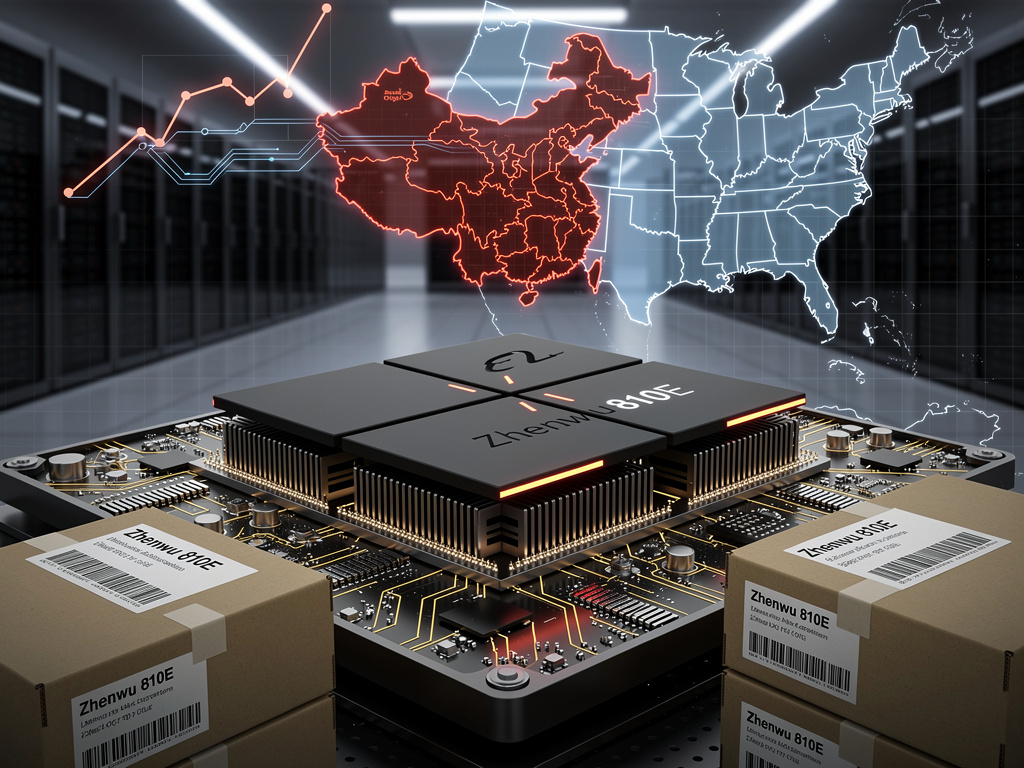
Alibaba Group has quietly emerged as a formidable force in China’s semiconductor industry, delivering more than 100,000 units of its Zhenwu 810E artificial intelligence chip, according to sources familiar with the matter. The milestone, first reported by the South China Morning Post, marks a significant achievement for the e-commerce giant’s cloud computing division and positions it ahead of domestic rival Cambricon Technologies in the intensifying competition to develop indigenous AI processors amid escalating U.S. export restrictions.
The Zhenwu 810E, an application-specific integrated circuit designed for both AI training and inference workloads, represents Alibaba’s strategic pivot toward vertical integration in the technology stack. Unlike general-purpose graphics processing units from Nvidia, which have faced increasingly stringent export controls to China, ASICs like the Zhenwu 810E are optimized for specific computational tasks, offering potential advantages in power efficiency and performance for targeted applications. This achievement underscores how Chinese technology conglomerates are leveraging their substantial internal computing needs to bootstrap semiconductor capabilities that could eventually challenge established players.
Alibaba’s Cloud Computing Catalyst Drives Internal Chip Adoption
The bulk of Zhenwu 810E deployments have occurred within Alibaba’s own cloud infrastructure, where the company operates one of China’s largest public cloud platforms. This captive demand has provided Alibaba Cloud with a critical testing ground and deployment base that pure-play chip designers like Cambricon lack. Industry analysts note that Alibaba’s ability to control both the hardware and software layers gives it a distinct advantage in optimizing performance and identifying design improvements through real-world workloads spanning e-commerce recommendations, logistics optimization, and natural language processing applications.
The strategic importance of this vertical integration cannot be overstated. While Cambricon must convince external customers to adopt its chips and navigate complex integration challenges across diverse computing environments, Alibaba can mandate deployment within its own data centers and fine-tune both silicon and software in tandem. This approach mirrors strategies employed by American hyperscalers like Amazon Web Services with its Graviton processors and Google with its Tensor Processing Units, which initially served internal needs before expanding to external customers.
Geopolitical Pressures Accelerate Domestic Chip Development
The achievement comes against a backdrop of intensifying technological decoupling between the United States and China. Washington has progressively tightened restrictions on advanced semiconductor exports to China, with the Biden administration expanding controls in October 2023 to prevent Chinese entities from accessing cutting-edge AI chips and the manufacturing equipment needed to produce them. These measures have created urgent imperatives for Chinese technology companies to develop alternatives to American semiconductor products, particularly in AI computing where Nvidia has maintained overwhelming market dominance.
Alibaba’s progress with the Zhenwu 810E suggests that Chinese firms are making measurable strides in closing the technology gap, at least for certain applications. While the chip may not match the raw performance of Nvidia’s latest H100 or H200 offerings, its deployment at scale demonstrates that Chinese companies can produce functional AI accelerators suitable for production workloads. This development carries implications for global semiconductor supply chains and the effectiveness of export controls as a tool of technological containment.
Cambricon’s Challenges Highlight Market Dynamics
Cambricon Technologies, founded in 2016 and once considered a frontrunner in China’s AI chip sector, has struggled to achieve comparable deployment volumes despite being a dedicated semiconductor company. The Beijing-based firm went public on Shanghai’s STAR Market in 2020 with considerable fanfare, but has faced persistent challenges in converting technical capabilities into commercial success. Unlike Alibaba, Cambricon lacks captive demand from internal cloud operations and must compete for customers in a market where established relationships and ecosystem integration create high switching costs.
The contrast between Alibaba’s shipment volumes and Cambricon’s market position illuminates a broader dynamic in China’s semiconductor industry. Companies with substantial internal computing needs—including Alibaba, Baidu, and ByteDance—have leveraged their scale to develop custom silicon that serves proprietary requirements first and external markets second. This approach provides more predictable revenue streams and reduces dependence on external validation, while pure-play chip designers face the challenge of building market acceptance without guaranteed anchor customers.
Technical Specifications and Performance Characteristics
While Alibaba has disclosed limited technical specifications for the Zhenwu 810E, industry sources indicate the chip is manufactured using mature process nodes available from Chinese foundries, likely in the 7-nanometer to 14-nanometer range. This positions it behind the cutting-edge 4-nanometer and 5-nanometer processes used for the most advanced AI accelerators from Nvidia and AMD, but represents a pragmatic approach given China’s current semiconductor manufacturing capabilities and the constraints imposed by Dutch export restrictions on extreme ultraviolet lithography equipment.
The chip’s design emphasizes inference workloads—the deployment phase of AI models where trained algorithms make predictions or generate outputs—rather than the more computationally intensive training phase. This focus aligns with the operational realities of cloud computing providers, where inference tasks vastly outnumber training workloads and where efficiency gains can translate directly into reduced operating costs and improved margins. By optimizing for inference, Alibaba has targeted a market segment where the performance gap with leading American chips may be less pronounced and where energy efficiency carries particular importance.
Broader Implications for China’s Semiconductor Ambitions
Alibaba’s achievement with the Zhenwu 810E represents one data point in China’s broader campaign to achieve semiconductor self-sufficiency, an effort that has intensified following the imposition of American export controls. The Chinese government has committed hundreds of billions of dollars to developing domestic semiconductor capabilities through its “Made in China 2025” initiative and subsequent programs, viewing chip independence as essential to economic security and technological sovereignty.
However, significant challenges remain. While China has made progress in chip design, the country continues to lag in semiconductor manufacturing equipment, advanced packaging technologies, and electronic design automation software—areas where American, European, and Japanese companies maintain commanding positions. The ability to ship 100,000 AI chips demonstrates capability in design and production at mature nodes, but does not necessarily translate to competitiveness across the full spectrum of semiconductor technologies required for sustained leadership in AI computing.
Market Positioning and Future Commercial Strategy
Looking ahead, Alibaba faces strategic decisions about whether to position the Zhenwu 810E and successor products purely as internal infrastructure or to pursue external commercialization. The company has historically shown willingness to productize internal technologies, having spun out its cloud computing division and various software platforms as commercial offerings. Entering the merchant semiconductor market would put Alibaba in direct competition not only with Cambricon but also with other Chinese tech giants developing custom silicon, including Baidu’s Kunlun chips and Huawei’s Ascend processors.
The competitive dynamics of China’s AI chip market remain fluid, with multiple well-capitalized players pursuing overlapping strategies and the government actively supporting domestic alternatives to American semiconductors. Alibaba’s advantage lies in its massive scale and integrated cloud platform, which provide both a testing ground for chip development and a ready market for deployment. Whether this translates into sustainable competitive advantage will depend on the company’s ability to maintain technological pace with international competitors while navigating the complex geopolitical environment that increasingly shapes semiconductor markets. The 100,000-unit milestone suggests Alibaba has moved beyond experimental deployments to production-scale implementation, a transition that many semiconductor startups never successfully complete.


 WebProNews is an iEntry Publication