
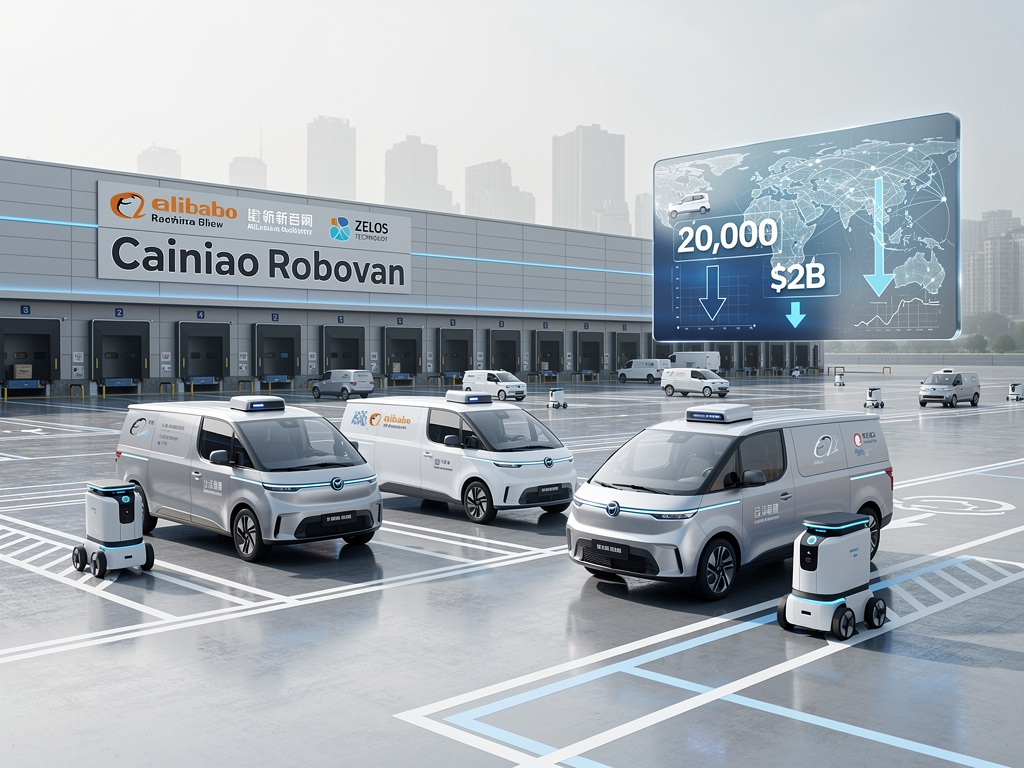
Alibaba Group Holding Ltd.’s logistics powerhouse Cainiao is merging its autonomous-driving unit with Zelos Technology, forging a combined entity valued at roughly $2 billion, according to people familiar with the matter. The deal positions Zelos to operate the new venture, dubbed Cainiao Robovan, which will command a fleet exceeding 20,000 robovans tailored for last-mile delivery. This move accelerates China’s push into driverless logistics amid soaring e-commerce demands and labor shortages.
Deal Mechanics and Valuation Surge
Under the agreement, Cainiao will contribute its unmanned-vehicle operations—complete with self-driving delivery vans—into Zelos, securing an equity stake in return. Zelos, founded in 2021 by Kong Qi, a veteran of Baidu and JD.com autonomous units, will helm the merged business. A senior Cainiao executive is slated to join Zelos’s board, while select managers and technical staff from Cainiao transfer over, as detailed in reports from the Wall Street Journal and Reuters.
The $2 billion valuation reflects Zelos’s dominance in Level-4 autonomous logistics vehicles, where it claims over 70% market share in China for major express clients. Post-merger, the fleet combines Zelos’s production prowess—six factories with 45,000 annual capacity—and Cainiao’s deployment scale across postal, retail, and e-commerce sectors, per insights from Startup News FYI.
Zelos’s Rapid Ascent in Robovan Tech
Zelos pioneered mid-to-large urban autonomous trucks, launching the RoboVan series in 2023 with over 10,000 units deployed globally. The firm recently expanded internationally, initiating full-scale RoboVan operations in Abu Dhabi on January 20, 2026, partnering for postal and urban delivery, and announcing a deal in Kuala Lumpur with Pos Malaysia Berhad, as reported by Gasgoo. China Post’s record order of 7,000 driverless vans underscores Zelos’s lead, outpacing rivals like Neolix and Rino.ai.
Cainiao brings complementary strengths, having developed low-cost L4 vehicles like the GT-Lite at $2,385—ushering in sub-$10,000 robovans—with approvals in over 200 Chinese cities, according to Pandaily. Earlier, Alibaba’s DAMO Academy autonomous lab merged into Cainiao in 2023, powering ‘Little Donkey’ robovans for last-mile needs, per TechCrunch.
Cainiao’s Logistics Evolution
Launched in 2013 as Alibaba’s smart logistics network, Cainiao fully integrated under group control in 2024 after Alibaba bought out minority shares. Its global footprint spans pilots with Saudi Post in Riyadh and expansions in Brazil, Mexico, and Chile. The merger aligns with cost pressures in China’s e-commerce delivery, where robovans slash per-order expenses by 35%-45% on repeatable routes, dropping unit costs from ¥0.32 to ¥0.126 per parcel, as analyzed in Tech Buzz China.
Competitors like Meituan, JD Logistics, SF Express, Baidu Apollo, and Haomo are piloting similar driverless fleets, with international trials in the Middle East and Southeast Asia proving L4 model transferability. Zelos and Cainiao’s tie-up could dominate urban freight, leveraging shared data for end-to-end autonomy from last-mile to distribution networks.
Strategic Imperatives Amid Regulation
The partnership grants Zelos access to Cainiao’s vast network and road data, accelerating unmanned capacity amid rising labor costs and thin margins. Regulatory approvals remain pending in China, where authorities scrutinize autonomous safety and data governance. Neither company has confirmed terms, with Reuters noting no immediate response to comment requests.
Alibaba shares rose in pre-market trading on the news, signaling investor optimism. This deal marks a pivot from R&D to alliances, prioritizing commercial ROI in delivery over passenger mobility pursuits by Baidu or Pony.ai, as highlighted in TipRanks.
Global Ripples and Competitive Pressures
Zelos’s overseas push positions the merged entity for exports, challenging Western incumbents. Cainiao’s prior collaborations, like with Neolix, evolve into deeper integration, potentially reshaping supply chains worldwide. Rivals ramp production—Neolix, SF-backed Rino.ai—fueled by government procurement and falling hardware costs, per Jiemian Global.
For industry insiders, the merger signals consolidation in autonomous freight, blending Zelos’s 76% deployment share with Cainiao’s orchestration. Expect accelerated rollouts, with economics favoring high-frequency urban routes and hints of broader adoption in 2026.


 WebProNews is an iEntry Publication