
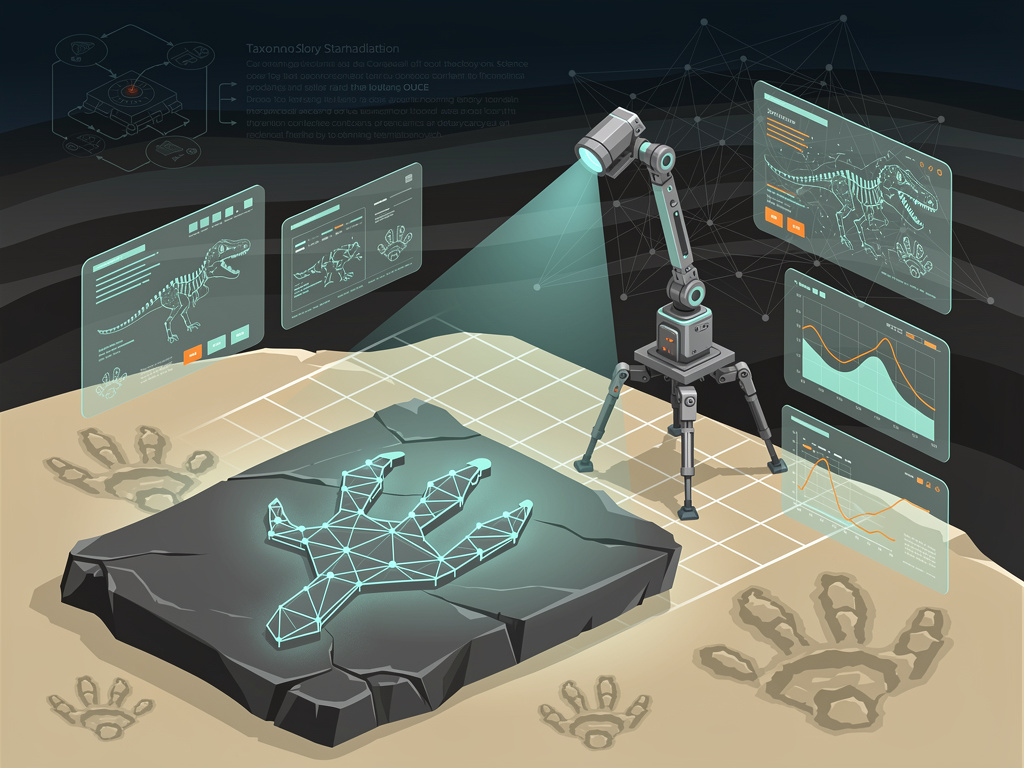
For more than a century, the practice of ichnology—the study of trace fossils such as footprints and burrows—has relied heavily on the subjective interpretation of the human eye. A paleontologist standing on a wind-swept ridge in geologic formations like the Paluxy River tracks in Texas or the coastline of the Isle of Skye often faces a distinct challenge: distinguishing a genuine dinosaur footprint from a random erosion pattern in the rock. The margin for error is significant, driven by lighting conditions, weathering, and the observer’s own bias. However, a seismic shift is currently underway in the field, moving excavation from physical picks and brushes to the high-powered servers of deep learning. As reported by CNET, researchers are now successfully deploying artificial intelligence to identify dinosaur footprints with a level of accuracy that rivals, and in some cases surpasses, human experts.
This technological intervention is not merely academic; it represents a fundamental change in how biological history is cataloged and understood. The integration of Deep Convolutional Neural Networks (DCNNs) allows scientists to process vast datasets of topographical information that would take decades to analyze manually. By training algorithms on thousands of confirmed track images, researchers can now deploy software capable of identifying the subtle geometric markers of Theropod, Ornithopod, and Sauropod tracks, even when those tracks are partially obscured or degraded. This transition marks the industrialization of paleontology, where data throughput begins to match the scale of the fossil record itself.
The End of Subjectivity in Stratigraphy
The core of this innovation lies in the removal of ambiguity. In traditional fieldwork, the identification of a footprint often depends on the angle of the sun; a track visible at dawn might disappear by noon due to the flattening of shadows. To combat this, scientists are utilizing photogrammetry—a technique that stitches together multiple photographs to create 3D models—combined with AI analysis. According to a study published in Frontiers in Earth Science, these machine learning models visualize depth and contour in ways the human retina cannot, effectively stripping away the “noise” of rock texture to reveal the biogenic signal beneath. This capability is crucial for distinguishing between actual tracks and “ghost tracks,” which are impressions made in layers of sediment below the surface that the animal actually walked on.
The implications for the industry are profound. Museums and research institutions, often underfunded and understaffed, are sitting on backlogs of unclassified specimens and field data. The automation of identification allows senior paleontologists to shift their focus from rote classification to high-level synthesis and theory construction. It essentially turns the field site into a structured data mine. As noted by Nature, this methodologies shift is akin to the introduction of carbon dating; it provides a standardized metric against which all findings can be measured, reducing the infighting and interpretative disagreements that have historically plagued the discipline.
Data Mining the Mesozoic Era
The technical architecture supporting this revolution borrows heavily from computer vision systems used in autonomous vehicles and facial recognition software. The neural networks analyze the morphology of the print—the angle of the digits, the presence of claw marks, and the weight distribution evident in the heel impression. This requires a massive amount of training data. To feed these algorithms, institutions are digitizing their collections at an unprecedented rate. This digital transformation creates a secondary asset class: the digital fossil. These high-fidelity 3D assets can be shared globally instantly, allowing an algorithm trained in Berlin to identify a track found in Utah within seconds.
However, the deployment of AI in this sector is not without its technical hurdles. The software is only as good as the data it is fed, and the fossil record is notoriously fragmentary. If an algorithm is trained primarily on clear, museum-quality specimens, it may fail to recognize the messy, eroded tracks found in real-world scenarios. To address this, researchers are employing “data augmentation,” synthetically degrading high-quality images to train the AI to recognize footprints in various states of decay. This robustness is essential for field applications where ideal conditions are the exception, not the rule.
Cost-Benefit Analysis of Digital Excavation
From a resource allocation perspective, the adoption of AI offers a significant return on investment for grant-funded research bodies. Field expeditions are expensive, involving travel, logistics, and heavy equipment. The ability to use drones equipped with LIDAR and high-resolution cameras to scan acres of terrain, and then process that data through an AI filter to pinpoint promising excavation sites, dramatically reduces the cost per discovery. It minimizes the time scientists spend hiking over barren rock and maximizes the time spent extracting significant finds. This efficiency is attracting attention not just from academia, but from private land surveyors and the energy sector, where geological assessments are routine.
Furthermore, this technology aids in the preservation of sites that are at risk of destruction. Erosion, vandalism, and commercial development threaten trackways globally. By rapidly documenting and analyzing these sites with AI-assisted photogrammetry, scientists preserve the data even if the physical site is lost. As highlighted by Scientific American, this digital preservation acts as an insurance policy for natural history, ensuring that future generations can study these sites virtually with even better tools than we possess today.
Overcoming the Erosion of Time
The sensitivity of modern AI models allows for the detection of tracks that are practically invisible to the naked eye. In many cases, a dinosaur’s foot pressure deformed the sediment layers centimeters below the surface without leaving a clear surface indentation. Over millions of years, as top layers erode, these sub-surface deformations are exposed but remain cryptic. AI models trained on stress-deformation physics can identify these anomalies as biological in origin. This expands the potential fossil record exponentially, turning previously “barren” rock formations into rich sources of paleo-biological data.
This capability also extends to identifying the speed and gait of the animals. By analyzing the depth and displacement of sediment in a trackway with high-precision metrics, AI can model the biomechanics of the dinosaur with greater accuracy than traditional formulas. This provides clearer insights into the behavior, metabolism, and movement patterns of extinct species, moving the science from static anatomical descriptions to dynamic behavioral simulations.
A New Era of Collaborative Science
The democratization of this technology is perhaps its most disruptive feature. The code and models used for these identifications are often open-source or shared via academic networks. This allows for a standardization of taxonomy across borders. Previously, a track found in China might be classified differently than a similar track in North America due to regional academic traditions. AI offers a neutral, data-driven baseline that facilitates global comparative studies. It forces a consensus based on geometry and probability rather than reputation and tradition.
Moreover, this shift invites cross-disciplinary collaboration between computer scientists and biologists. The skillset required to be a top-tier paleontologist is expanding to include Python programming and data science. Universities are beginning to adjust their curricula accordingly, producing a new generation of “computational paleontologists” who are as comfortable with a server rack as they are with a rock hammer. This hybrid expertise is accelerating the pace of discovery, leading to papers that are more statistically robust and less anecdotal.
The Limitations of Machine Vision
despite the enthusiasm, industry veterans urge caution. AI is prone to “hallucinations”—seeing patterns where none exist—especially when analyzing chaotic geological textures. A crack in the limestone can easily be disjointed by a neural network into a toe digit if the parameters are set too loosely. Therefore, the role of the human expert remains critical. The AI serves as a triage tool, flagging potential areas of interest, but the final verification must remain a human endeavor. The Wall Street Journal style of skepticism is warranted here; technology is a lever, not a replacement for expertise.
Ultimately, the integration of AI into paleontology is a microcosm of the broader digital transformation occurring across the natural sciences. It represents a maturation of the discipline, moving from the romanticized era of the lone explorer to the high-tech reality of data-driven analysis. As algorithms continue to refine their understanding of the Mesozoic world, we are likely to see a rewriting of natural history books, not because new rocks are being found, but because we are finally learning how to read the ones we already have.


 WebProNews is an iEntry Publication