
Scientists have raised fresh alarms about the Atlantic Meridional Overturning Circulation. This vast network of ocean currents keeps Europe milder than its latitude suggests. It moves heat from the tropics northward. Yet mounting evidence shows it slowing under human-driven warming. And a study released this month indicates the damage may already be irreversible in some scenarios.
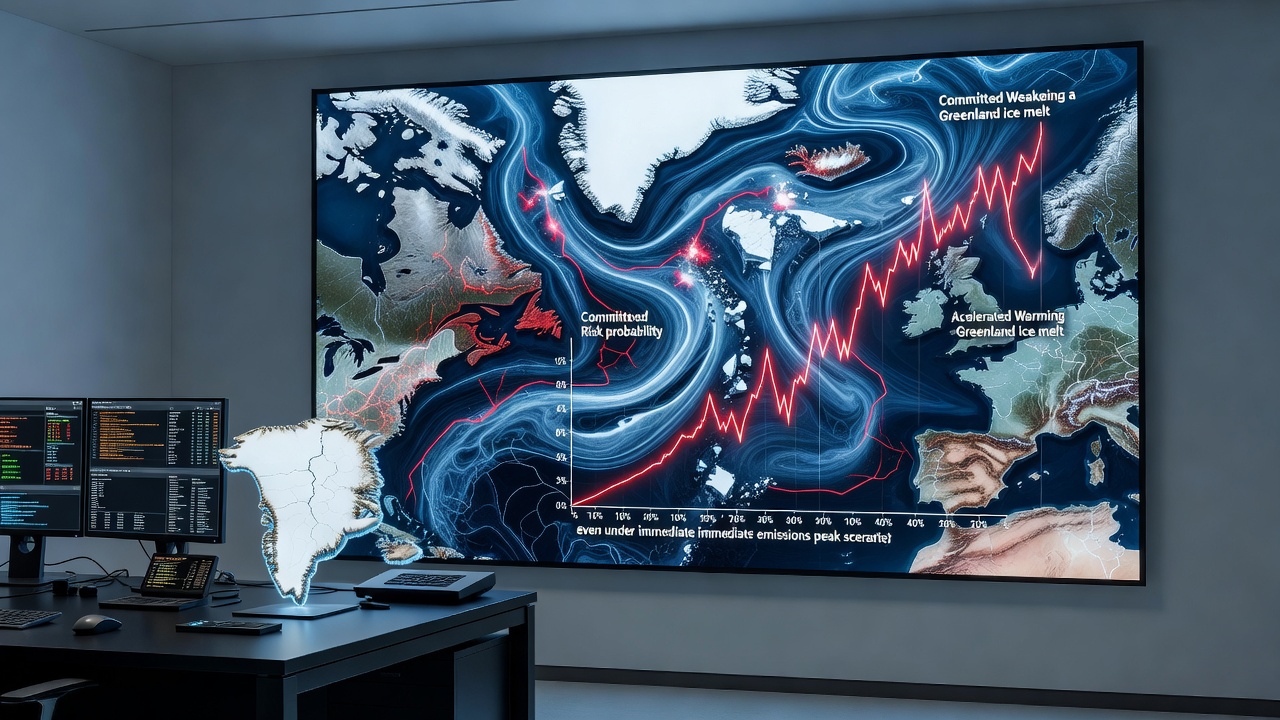
The preprint posted on EarthArXiv deploys a climate model that factors in ocean-atmosphere interactions along with Greenland ice melt. Even if greenhouse emissions peak this year the analysis finds a 10 percent probability that collapse is committed. That figure climbs to 23 percent when freshwater runoff from the ice sheet accelerates. Under continued high emissions the odds reach 80 percent by 2100. “Our analysis shows that there is a greater than 10% probability that collapse is already committed regardless of the speed of any feasible future mitigation and rising steeply under continued emissions” the authors write.
Stefan Rahmstorf has spent more than 35 years studying these waters. The oceanographer at the Potsdam Institute for Climate Impact Research reviewed the work. He called the conclusions plausible despite the reliance on a single model. Rahmstorf noted the system’s current fragility in a post on X.
But not every voice agrees the end is near. A June article in Science argues the circulation could prove more resilient than feared. Susan Lozier of Georgia Tech told the publication the long-held paradigm of freshening and warming forcing a slowdown “isn’t holding up.” Marine sediment cores suggest the system did not fully shut down at the end of the last ice age. Some models show weakening up to 40 percent yet recovery once emissions stabilize. The circulation behaves less like a single conveyor and more like a “belt of belts” with semi-autonomous segments.
Observations complicate the picture further. The RAPID array moored at 26.5 degrees north has recorded a decline of roughly one sverdrup per decade since 2004. That unit equals one million cubic meters of water per second. Yet the drop sits within natural variability for now. Other arrays such as OSNAP farther north reveal similar fluctuations driven as much by weather as by long-term climate trends. Eleanor Frajka-Williams at the University of Hamburg points out that scientists still lack a unified simple theory for how the whole system operates.
Earlier warnings painted an even darker scene. A 2023 paper cited by The Guardian estimated the tipping point could arrive as soon as 2025 with a central projection around 2050. That work relied on sea-surface temperature proxies. Critics questioned its assumptions. Still it fueled public concern and comparisons to the film The Day After Tomorrow.
More recent modeling tempers some fears while sharpening others. Research published in April 2026 and discussed in Carbon Brief applied observational constraints to climate ensembles. It projected a 51 percent slowdown by 2100 under medium emissions. That exceeds earlier averages from the Coupled Model Intercomparison Project. The same explainer notes the IPCC expects a 24 to 39 percent decline this century with low confidence in an abrupt collapse before 2100. Yet several studies now place the critical temperature threshold near 2.5 degrees Celsius above pre-industrial levels. We have already passed 1.5 degrees.
High-emission pathways look particularly grim. A 2025 study in Environmental Research Letters extended CMIP6 runs centuries beyond 2100. Lead author Sybren Drijfhout of the Royal Netherlands Meteorological Institute and co-author Stefan Rahmstorf examined nine such simulations. All showed the deep overturning shutting down after 2100 following a collapse of winter convection in the Labrador Irminger and Nordic seas. “The deep overturning in the northern Atlantic slows drastically by 2100 and completely shuts off thereafter in all high-emission scenarios and even in some intermediate and low-emission scenarios” Drijfhout said. “That shows the shutdown risk is more serious than many people realize.”
The mechanism feeds on itself. Atmospheric warming reduces heat loss from the ocean surface in winter. Surface waters stay warmer and lighter. They resist sinking. Less warm salty water flows north. Salinity drops further. The loop reinforces. Heat transport from the far North Atlantic falls below 20 percent of current levels in the models sometimes near zero. Rahmstorf added that standard models omit extra freshwater from accelerated Greenland melt which would push the system harder. “This is why it is crucial to cut emissions fast. It would greatly reduce the risk of an AMOC shutdown even though it is too late to eliminate it completely.”
What would a full collapse mean? Temperatures in northern Europe could plunge by 5 to 15 degrees Celsius. London might feel like present-day Oslo in winter. The U.S. East Coast would see accelerated sea-level rise as the current’s grip on ocean height relaxes. Tropical rain belts would migrate. Some regions would face prolonged drought others catastrophic flooding. Agriculture in the United Kingdom could suffer severe losses. Global food systems would strain. A separate 2026 study linked collapse to an additional 47 to 83 parts per million of atmospheric carbon dioxide further amplifying warming.
These projections carry large uncertainties. Models disagree on exact timing. Proxy records from corals and sediments offer snapshots not continuous data. Freshwater from the Beaufort Gyre has flushed south before without catastrophe. And some high-resolution simulations presented at the 2026 Ocean Sciences Meeting show the system rebounding even under quadrupled carbon dioxide.
Yet the weight of evidence tilts toward caution. A May 2026 release on ScienceDaily reported strong signs of ongoing weakening. Another August 2025 piece on Phys.org stressed that once the tipping point passes shutdown becomes self-sustaining. Recent X posts from climate researchers echo the worry with one viral thread citing a 10-to-23 percent chance the collapse is already locked in under conservative melt assumptions.
Policy makers face a narrow window. Rapid cuts in emissions could still lower the odds. They cannot erase past warming or the melt already under way. International talks continue to lag behind the science. Observational arrays need sustained funding beyond 2033 to separate human signals from natural noise.
The debate will persist. Some experts fear sensational headlines distract from other certain climate damages. Others insist the circulation’s potential collapse ranks among the highest-stakes risks precisely because its effects would unfold over decades yet prove nearly impossible to reverse. One thing seems clear. The Atlantic is sending signals. Scientists are listening. The question is whether the rest of the world acts before those signals turn into a new normal.


 WebProNews is an iEntry Publication