
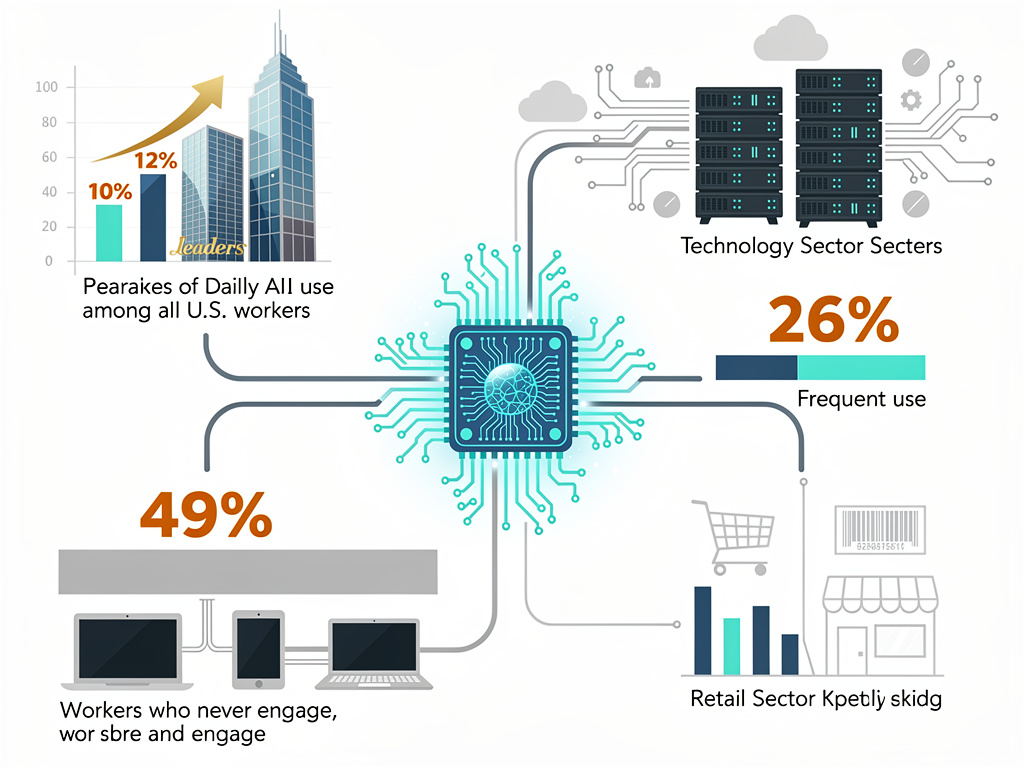
In the closing quarter of 2025, a subtle shift emerged in American workplaces: 12% of employed U.S. adults reported using artificial intelligence daily on the job, up from 10% in the third quarter and 8% in the second, according to Gallup. Yet nearly half—49%—said they never touch AI in their roles, underscoring a stark divide in adoption. Frequent use, defined as at least a few times weekly, climbed to 26%, a three-point gain, while overall usage held steady after earlier surges.
This plateau in total adoption signals maturation among early adopters, even as barriers persist for others. Gallup’s survey of 22,368 employed adults, conducted October 30 to November 13, 2025, via its probability-based panel, carries a margin of error of plus or minus 1 percentage point. The data reveals deepening engagement in select pockets, with leaders and knowledge workers pulling ahead.
Leaders Surge Ahead in AI Reliance
Executives and leaders reported 69% total AI use—at least a few times yearly—compared to 55% for managers and 40% for individual contributors. Frequent use among leaders hit 44%, far outpacing the 30% for managers and 23% for individual contributors, per Gallup. This hierarchy suggests top-down momentum, yet broad rollout lags.
Remote-capable roles showed 66% total use, including 40% frequent and 19% daily, versus 32% total, 17% frequent, and 7% daily in non-remote positions. Knowledge-based sectors dominate: technology at 77% total (57% frequent, 31% daily), finance leaping six points to 64%, and professional services up five to 62% (36% frequent), as detailed in the Gallup analysis.
Retail trails at 33% total (19% frequent, 10% daily), with manufacturing around 43% after a three-point Q4 bump. These disparities highlight how AI embeds in desk-bound, cerebral tasks but struggles in frontline operations.
Industry Fault Lines Exposed
Technology workers lead with about six in 10 using AI frequently and three in 10 daily, though growth may plateau after 2024-2025 spikes, noted AP News citing Gallup. Chatbots and virtual assistants power 61% of workplace AI tasks, followed by consolidating information or generating ideas at four in 10 users.
Real-world examples illustrate the grind: Home Depot associate Gene Walinski taps AI hourly on his phone for supply queries, saying, “I think my job would suffer if I couldn’t [use AI] because there would be a lot of shrugged shoulders and ‘I don’t know’ and customers don’t want to hear that,” per AP News. Investment banker Andrea Tanzi at Bank of America synthesizes hours-long documents in minutes via internal tools like Erica.
High school art teacher Joyce Hatzidakis refines parent notes with Google Gemini, noting fewer complaints: “I can scribble out a note and not worry about what I say and then tell it what tone I want.” Yet pastor Rev. Michael Bingham rejects AI for sermons, calling chatbot outputs “gibberish” and insisting, “You don’t want a machine, you want a human being.”
Organizational Haze Persists
Only 38% of employees report employer AI implementation for productivity, matching Q3 levels, with 41% saying none and 21% unsure. This opacity fuels uneven uptake, as Gallup observes. Since Q2 2023, frequent use has doubled in remote roles but remains modest elsewhere.
Economist Sam Manning of the Centre for the Governance of AI warns of risks for 6.1 million vulnerable workers in clerical roles—mostly women, older, in smaller cities—who lack adaptable skills: “If their skills are automated, they have less transferable skills to other jobs and they have a lower savings… An income shock could be much more harmful,” he told AP News.
Job fears linger, but Gallup’s separate 2025 survey found half deem job loss from AI “not at all likely” in five years, down from six in 10 in 2023. PwC’s 2025 Global AI Jobs Barometer, analyzing a billion job ads, shows AI-exposed sectors accelerating revenue since ChatGPT’s 2022 rise.
Tools and Tasks in Focus
Among users, practical applications rule: email drafting, code writing, document summaries, image creation. Advanced coding aids appeal to 22% of frequent users versus 8% casuals, per earlier Gallup data echoed in eWeek. Q3 2025 saw 45% total use, up from 40%, with frequent at 23%.
LinkedIn commentators like Joben Kronebusch stress practical integration: “Adoption requires strategy beyond pilots,” linking to Gallup in his post. LaShonna Dorsey notes leaders and remote roles advance, polling followers on usage.
McKinsey’s 2025 State of AI survey of 1,993 global respondents found 88% organizational use in at least one function, but only 33% scaling past pilots, aligning with Gallup’s employee-side flatline, as reported by WebProNews.
Broader Economic Ripples
Anthropic’s Economic Index pegs 49% of U.S. jobs using AI for 25% of tasks, up from 36% early 2025, with augmentation trumping automation at 52%. Software debugging leads at 6% usage. Pew Research in October 2025 found 21% worker AI use, rising to 28% among bachelor’s holders.
Despite hype, Gallup Q3 barriers like unclear value (16%) endure. Fortune reports tech daily/regular use ballooned since 2023 but hints at plateau. Business Insider lists top uses: info consolidation, idea generation.
As 2026 dawns, workplaces face imperatives: tailor AI for roles, clarify policies, train laggards. The 12% daily cadre deepens reliance, but bridging the 49% non-users demands more than tools—it requires proving value across the board.


 WebProNews is an iEntry Publication