
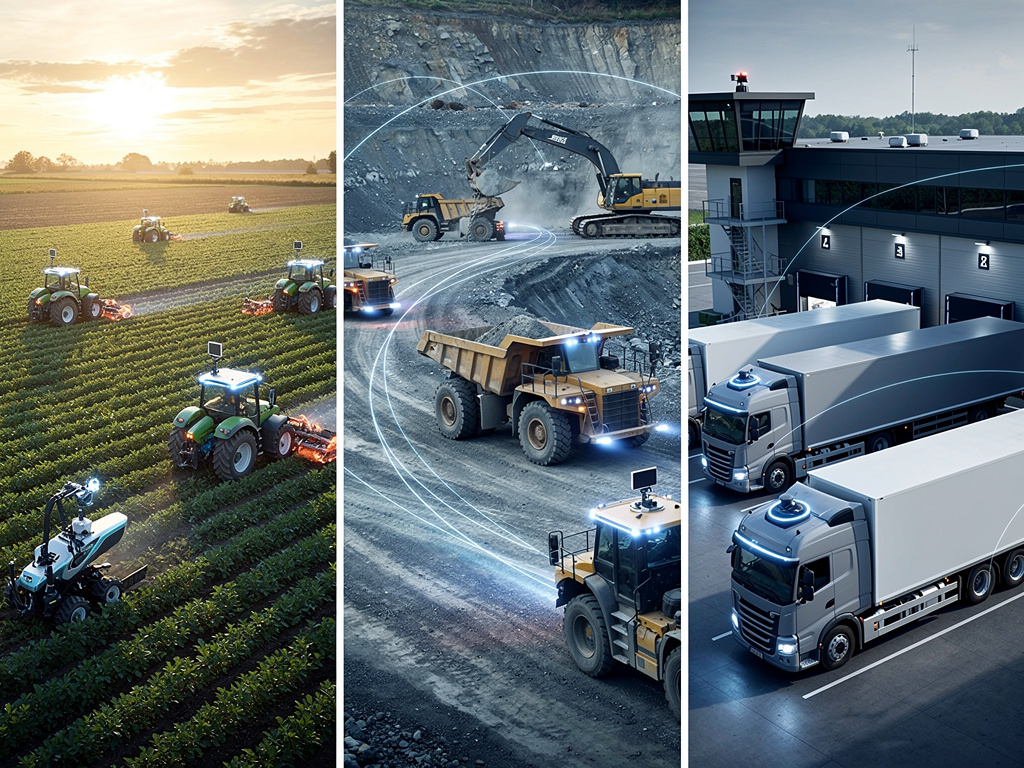
The biggest beneficiaries of artificial intelligence won’t be tech companies. They’ll be farms, mines, trucking fleets, and the vast blue-collar industries that most AI discourse ignores entirely. That’s the core argument emerging from a growing body of evidence, and it’s more convincing than the hype around yet another chatbot startup.
Business Insider reported that the real AI winners are shaping up to be industries where software adoption has historically lagged — agriculture, logistics, mining, construction, and manufacturing. These sectors represent trillions in global GDP but have operated for decades on paper forms, radio calls, and gut instinct. AI doesn’t need to be magical here. It just needs to be marginally better than a clipboard.
Consider agriculture. John Deere has deployed computer vision systems on its sprayers that can distinguish weeds from crops in real time, reducing herbicide use by up to 77% on treated fields. That’s not a theoretical model. That’s a machine rolling through a soybean field in Iowa right now, saving a farmer thousands of dollars per season. Deere’s See & Spray technology, which the company has been scaling since its acquisition of Blue River Technology, represents exactly the kind of AI application that prints money: narrow, well-defined, and deployed against a problem where even a 20% improvement justifies the hardware cost.
Mining tells a similar story. Reuters has reported extensively on how companies like Rio Tinto and BHP operate autonomous haul trucks across their Australian iron ore operations. Rio Tinto’s autonomous fleet in the Pilbara has been running since 2018 and now moves more than a billion tonnes of material. The trucks don’t take breaks. They don’t get fatigued at 3 a.m. And they reduce the single largest safety risk in mining — human error in vehicle operation.
Trucking is where the numbers get staggering. The American Trucking Associations estimates the U.S. faces a shortage of roughly 60,000 drivers, a figure projected to balloon as the current workforce ages out. AI-powered logistics optimization from companies like project44 and autonomous trucking firms such as Aurora Innovation aren’t solving an abstract problem. They’re responding to a labor crisis that costs the freight industry billions annually in delayed shipments and inflated wages.
Aurora launched its first driverless commercial routes in Texas in April 2024, hauling freight between Dallas and Houston without a safety driver. Not a demo. Not a pilot. A commercial service.
So why does so much AI investment still flow toward consumer chatbots and enterprise copilots? Partly because that’s where the venture capital attention concentrates. Silicon Valley funds what Silicon Valley understands. But the margin opportunity in industrial AI dwarfs what’s available in saturated software markets. McKinsey estimated in its 2023 analysis that generative AI could add between $2.6 trillion and $4.4 trillion annually across industries — and manufacturing, agriculture, and transportation were among the top sectors by potential impact.
The pattern is clear. Industries with thin margins, high physical risk, labor shortages, and minimal existing software infrastructure stand to gain the most from AI that actually works. Not AI that generates marketing copy. AI that tells a combine harvester which plants to spray and which to leave alone.
Construction offers another data point. Built In has covered how firms are adopting AI-driven project management tools that predict delays before they cascade. Procore, one of the largest construction software platforms, reported that customers using its AI-powered analytics reduced project cost overruns by measurable percentages. In an industry where the average large project runs 80% over budget according to McKinsey’s earlier infrastructure research, even a 10% improvement is worth millions per site.
But here’s where skepticism is warranted. Many of these industrial AI deployments require massive upfront capital, long integration timelines, and domain expertise that most AI startups simply don’t have. A language model can be fine-tuned in weeks. An autonomous mining truck system takes years of site-specific calibration, regulatory approval, and workforce retraining. The companies that win here won’t be nimble startups — they’ll be incumbents like Deere, Caterpillar, and Komatsu that already own the customer relationship and the physical hardware.
That’s an uncomfortable truth for venture investors betting on pure-play AI companies targeting these verticals. The distribution advantage belongs to the equipment manufacturers. Always has.
There’s also the question of data. Industrial environments generate enormous volumes of sensor data, but it’s messy, inconsistent, and often trapped in proprietary formats. Wired has noted that the biggest bottleneck in industrial AI isn’t model capability — it’s data pipeline quality. Cleaning and structuring operational data from a fleet of 500 trucks or a network of grain elevators is unglamorous work. It’s also where most projects stall.
None of this means industrial AI is overhyped. The opposite. It means the opportunity is real but the execution bar is extraordinarily high. The winners won’t be the companies with the best foundation models. They’ll be the ones that understand soil composition, haul road gradients, cold chain logistics, and concrete curing times — and happen to also deploy good AI.
The money will follow the dirt. It always does, eventually. Right now, the smartest capital is already moving. Deere’s stock has outperformed most pure-play AI companies over the past 18 months. Caterpillar’s autonomous and AI-related revenue segments are growing faster than its traditional lines. And Aurora’s commercial launch has given public markets a concrete proof point that autonomous freight isn’t five years away. It’s here.
For industry insiders who’ve watched AI hype cycles come and go — remember IBM Watson’s healthcare promises? — the blue-collar AI thesis is different. Not because the technology is better. Because the problems are simpler, the economics are clearer, and the customers are desperate enough to pay.
That combination is rare. And it’s real.


 WebProNews is an iEntry Publication