
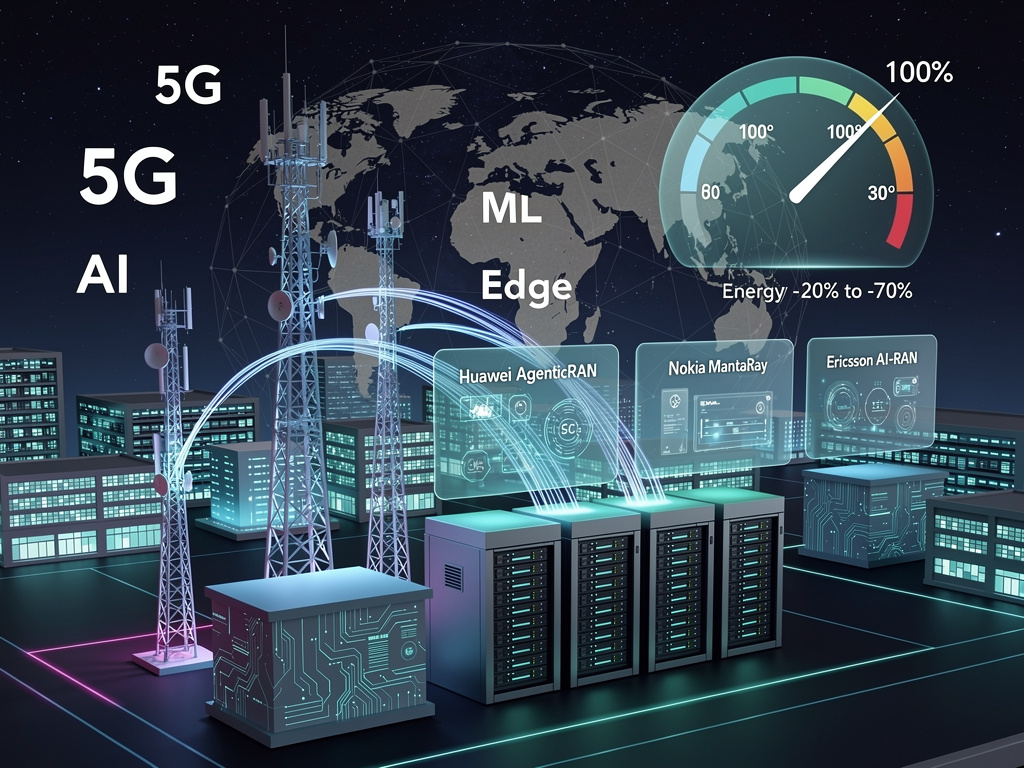
Telecom operators have poured billions into 5G infrastructure, yet many grapple with turning those investments into tangible gains amid persistent radio access network challenges. Interference management and spectrum utilization remain the thorniest issues, as highlighted by Shaun McCarthy, president and chief revenue officer at Spectrum Effect, in a Fierce Network sponsored feature. Spectrum Effect treats the RAN as a vast sensor array, deploying machine learning and AI to sift through data and trigger real-time fixes that boost performance, efficiency, and user satisfaction across massive deployments.
AI’s role in telecom has matured beyond experimental pilots into core operations. Operators now pursue two vital tracks: furnishing engineers with actionable insights and enabling closed-loop automation for self-resolving issues. This shift sidesteps endless ROI debates, prioritizing swift deployment and scaling, according to the same Fierce Network analysis. Monetization beckons through enterprise services, spectrum sharing, and edge AI, urging faster iteration to seize 5G’s next growth phase.
RAN as AI Nerve Center
Huawei echoes this urgency with its AgenticRAN vision, embedding intelligence into spectrum, energy, and operations & maintenance. Samuel Chen, vice president of marketing at Huawei’s Wireless Network Business, detailed in a Huawei press release how 5G-A fuses with AI for intent-driven workflows, elevating automation to autonomy level 4 across scenarios. By August 2025, these capabilities spanned over 60 carriers and 500,000 sites globally, delivering unmanned maintenance, real-time tweaks, and energy savings.
Ericsson advances AI-RAN integration for programmable networks, blending 5G Advanced, rApps, and native AI to sharpen performance and cut energy use. The company’s platform boasts 44 ecosystem members and leads O-RAN contributions at 18%, as noted on Ericsson’s AI-RAN page. Trials like Umniah Jordan’s with Ericsson’s Intelligent RAN Power Saving yielded 20% daily reductions, while Three UK hit 70% at select sites.
Nokia’s MantaRay suite takes self-organizing networks further with AI-driven AutoPilot for real-time orchestration sans manual tweaks. Mark Atkinson, head of RAN at Nokia, emphasized in an AI Magazine report on its TNN expansion in Denmark: “This enhanced deal reflects Nokia’s position as a trusted technology provider delivering industry-leading 5G solutions and advanced AI and automation capabilities for enhanced operational efficiency and network quality.”
Closed-Loop Automation Takes Hold
Closed-loop systems exemplify AI’s leap to autonomy, where networks sense issues, decide, and act independently. Spectrum Effect’s approach, per Fierce Network, empowers engineers while automating resolutions. Vodafone UK, partnering with Ericsson, deployed 5G Deep Sleep—AI algorithms hibernating radios during lulls for up to 70% power cuts—alongside cell sleep orchestration, as covered by RCR Wireless.
5G Americas’ whitepaper underscores layered AI impacts, from physical-layer signal tweaks to L3 mobility, quoting Ericsson’s Christina Chaccour: “The growing complexity of cellular networks… has strained traditional management approaches.” Dr. Eren Balevi of Qualcomm adds, “AI offers unprecedented capabilities for enabling automation and enhancing network intelligence,” per the 5G Americas report.
Uplink surges from AI apps like generative models threaten 5G limits by 2027, warns a Mobile Experts forecast cited in Fierce Network. Nokia counters with spectrum refarming, advanced scheduling, and slicing for QoS, as Taiwan Mobile noted: operators must leverage AI for efficiency and peak AI experiences.
Edge AI and Enterprise Frontiers
Edge processing slashes latency for autonomous apps needing sub-100ms responses via chips like Nvidia Jetson, per a Forbes Tech Council post. AT&T’s piece details AI spotting latency black spots for small-cell placement and preempting disruptions, enabling distributed AI in factories with real-time IoT over 5G.
World Economic Forum highlights open 5G standalone nets for enterprise automation, paving AI-native 6G paths. China’s robotics boom and U.S. fixed wireless lead show market-driven wins, as in a WEF article. Nokia’s NTTDocomo deployment of MantaRay SON brings multi-vendor AI to Japan, boosting 5G ops.
Vodafone’s generative AI platform with Zinkworks automates code for 5G features in weeks, not months, slashing ops timelines, reports Telecoms Tech News. Huawei’s AgenticRAN promises spectral and energy records, with Eric Zhao affirming in RCR Wireless: it pushes industry forward.
Global Deployments Signal Scale
Real-world proofs abound: ZTE’s L4 autonomous nets cut PON power 10% with 95% automation, per RCR Wireless. Nokia’s Far EasTone trial saved 25% RAN energy via Service Continuity AI. These gains align with Ericsson’s 4G-to-5G AI evolution for spectrum smarts and traffic steering.
5G-A unlocks mobile AI revenues, Huawei’s Samuel Chen projects 100 million premium subs by year-end, blending cost cuts with premium charging beyond gigabytes, via Telecoms.com. Operators like China Mobile Guangdong launch AI-5G-A phones for agents and encryption.
As AI traffic flips uplinks dominant—GenAI, glasses, vision—U.S. carriers lag Asia’s 20% midband TDD uplink allocation, per TeckNexus analysis on X. Levers like dynamic TDD and UL CA loom critical for FWA’s 14M subs amid softening speeds.


 WebProNews is an iEntry Publication