
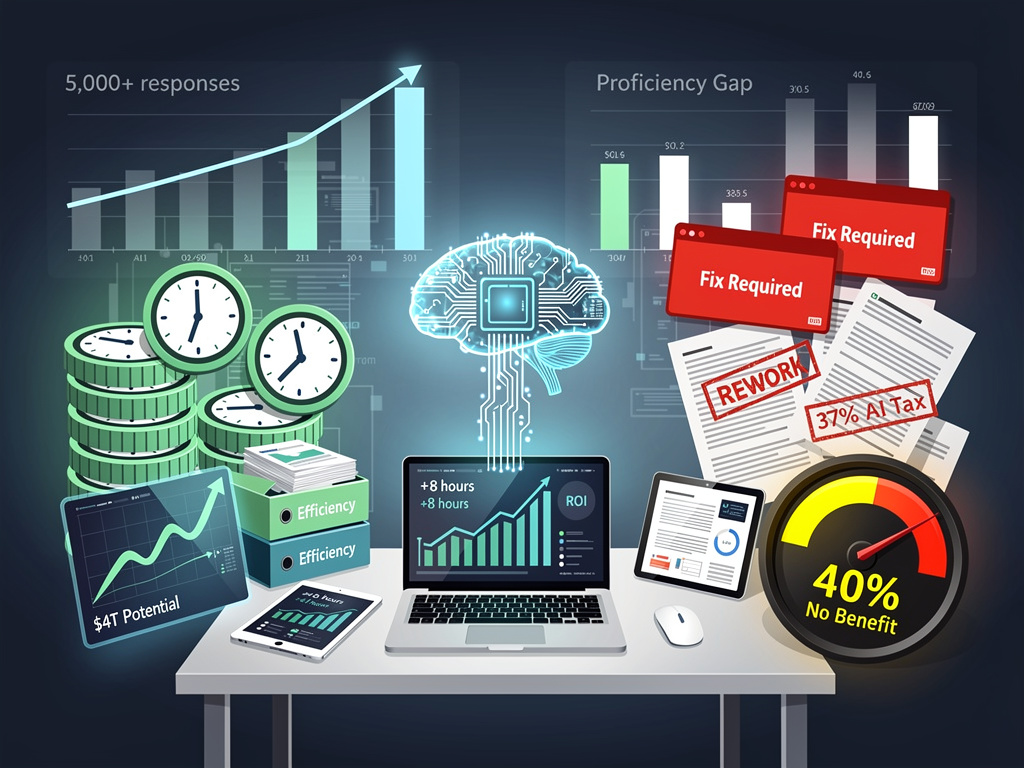
Corporate leaders are hailing artificial intelligence as a transformative force for efficiency, with many reporting weekly time savings equivalent to full workdays. Yet frontline employees paint a starkly different picture, citing minimal gains eroded by error corrections and workflow mismatches. This perception divide, laid bare in recent surveys of thousands of white-collar workers, underscores a critical tension in the $4 trillion AI investment surge gripping boardrooms worldwide.
A January 2026 report from AI consulting firm Section, based on a survey of 5,000 knowledge workers at companies with 1,000 or more employees across the U.S., U.K., and Canada conducted from September 26 to November 3, 2025, reveals the extent of the rift. More than 40% of executives said AI saved them over eight hours per week, including 24% claiming more than 12 hours and 33% reporting eight to 12 hours. In stark contrast, 40% of nonmanagement workers reported zero time savings, and two-thirds saved less than two hours or none at all, per the Wall Street Journal.
Section’s findings align with broader data showing executives’ optimism outpacing reality. The firm’s AI Proficiency Report notes that 57% of C-suite respondents use AI daily, with 94% expressing trust in the technology, while individual contributors—the bulk of the workforce—lag far behind, with only 70% classified as basic ‘experimenters’ handling tasks like email rewrites or note summaries. Just 3% qualify as proficient practitioners driving meaningful returns, and 40% of all respondents said they would be fine never using AI again, according to Section AI.
Survey Stats Expose the Divide
Drilling into Section’s breakdowns, executives’ time savings skewed heavily toward high-impact claims: only 2% reported no savings, compared to 40% of workers. Workers’ responses clustered at the low end—27% under two hours, 20% at two to four hours, and just 9% at four to eight hours. This 38-percentage-point gap on major savings highlights not just differing experiences but mismatched expectations, as noted in the report’s analysis of proficiency levels where practitioners are 20 times more likely than novices to save four-plus hours weekly.
Industry variations amplify the split. Tech, finance, and consulting lead in adoption, with strategies, policies, and tools in place, while retail, healthcare, and education trail, lacking even basic frameworks. Functions like engineering and marketing show promise but underutilization—54% of engineers avoid AI for code, 56% of marketers skip it for drafts—per Section. Meanwhile, a PwC survey of nearly 4,500 CEOs worldwide, presented at Davos, found only 12% reporting both cost and revenue benefits from AI, with over half seeing no financial upside yet, as covered by the Wall Street Journal.
Employee voices underscore the frustration. Steve McGarvey, a user-experience designer in Raleigh, N.C., told the Wall Street Journal, “Executives ‘automatically assume AI is going to be the savior,’ … ‘Unless you have some judgment or discernment in the field you’re in, you could really do harm to a consumer base—or do harm within a team—just by assuming’ that whatever an LLM says is factual.” Dan Hiester, a user-experience engineer in Seattle, added, “It’s done a complete reset of my understanding of how to estimate the time it takes to do something.”
The Hidden ‘AI Tax’ Drains Gains
Even where time savings occur, they often evaporate. Workday’s late-2025 global study of 3,200 leaders and employees, fielded by Hanover Research in November, dubs this the “AI tax on productivity.” While 85% of workers reported saving one to seven hours weekly, 37% of that time—nearly four hours per every 10 gained—went to fixing errors, rewriting content, or double-checking outputs. Among daily AI users, 77% scrutinize its work as rigorously as human output, per details in Yahoo Finance.
Workday officials explained, “AI has been layered onto roles that were never updated to accommodate it—forcing employees to use 2025 tools within 2015 job structures.” In 89% of organizations, fewer than half of roles incorporate AI capabilities, leaving workers to reconcile speed with unchanged accuracy demands. Andrew Kershaw, Workday’s group general manager for the office of the CFO, urged, “It should be about protecting ROI and managing risk by changing how the work is set up,” as quoted in the report covered by Yahoo Finance.
This rework compounds at scale, costing millions of hours yearly in large firms. Leaders allocate 39% of savings to tech infrastructure versus 30% for workforce development, prioritizing volume over skills, per Workday. A WSJ-NORC poll from last summer reinforces public skepticism, with six in 10 viewing AI as a threat to well-paid jobs over a productivity boon.
Macro Data Lags Micro Wins
Task-level gains exist—GitHub Copilot boosts coding 55% faster, BCG consultants finish 25% quicker with 40% higher quality—but aggregate metrics disappoint. U.S. Bureau of Labor Statistics shows 2.7% productivity growth in 2024 with no clear AI signal; only 5% of firms have meaningfully adopted it, per Forbes. Federal Reserve Bank of St. Louis research pegs average savings at 5.4% of work hours, or 2.2 hours weekly for a 40-hour employee.
McKinsey sizes the long-term corporate opportunity at $4.4 trillion in productivity from AI use cases, yet pilots fail 95% of the time. Microsoft notes 11 weeks minimum for gains, with 66% of developers citing near-miss fixes as top drags, as detailed in Forbes. World Economic Forum’s 2026 Future of Jobs report projects 92 million displacements by 2030 but 170 million new roles, netting 78 million gains.
Sector leaders like Klarna tested AI for customer service, replacing agents before rehiring humans for complexity. PwC’s 2025 Global AI Jobs Barometer shows AI-exposed sectors with 3x revenue-per-employee growth (27% vs. 9%), 56% wage premiums for skilled workers, and 38% job growth even in automatable roles.
Closing the Gap Through Proficiency
Section emphasizes raising the proficiency bar: training boosts scores 1.6x with strategies, 1.5x with tools, but averages remain low at 40/100. Tech adoption hits 85% beginner/no use cases; only 15% hit ROI thresholds. Executives must pivot from access to outcomes, enabling individual contributors who report anxiety over excitement.
Workday calls for redesigned roles clarifying AI’s role versus human judgment, measuring net productivity beyond raw hours. As enterprise AI spend climbs to $85,521 monthly in 2025 from $62,964 in 2024, the onus falls on leaders to bridge this chasm—or risk eroding trust amid hype.


 WebProNews is an iEntry Publication