
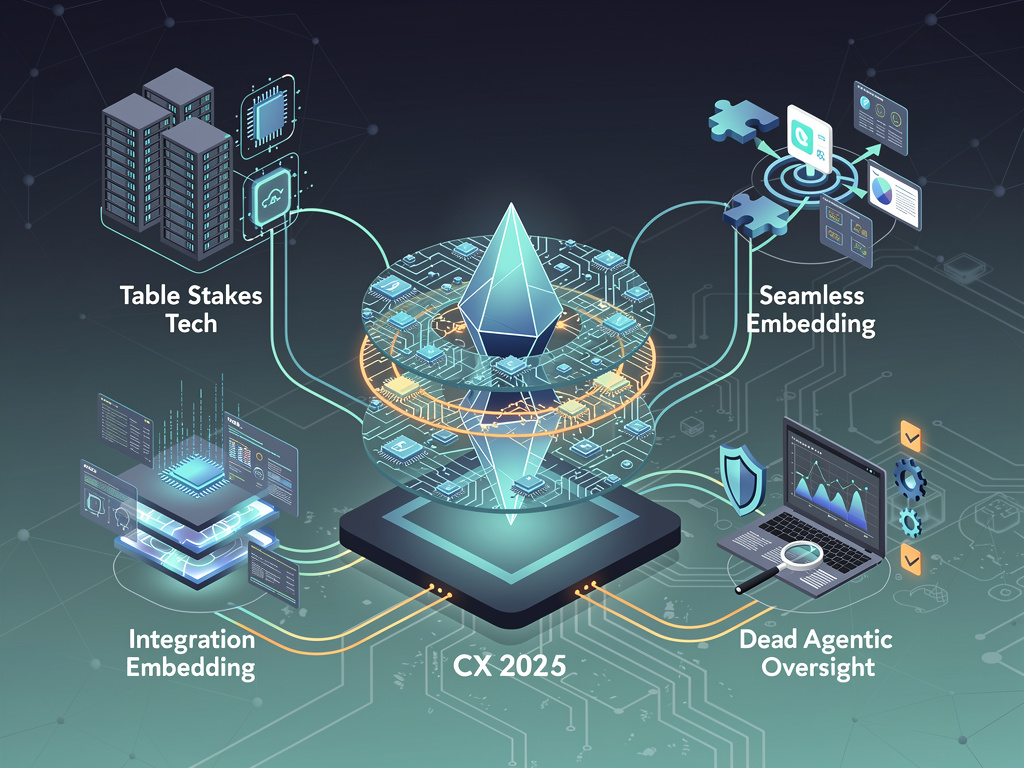
In the high-stakes arena of customer experience and marketing, artificial intelligence has transitioned from experimental novelty to indispensable baseline. Brands now compete not on AI adoption, but on masterful integration, disciplined judgment, and trust-building execution. As CMSWire outlines, four pivotal shifts define 2026: AI as mere entry requirement, seamless embedding over standalone tools, customer insight eclipsing raw velocity, and rigorous oversight for autonomous systems.
“The era of using customers as AI guinea pigs is over,” declares Sam Dorison, CEO of Reflex AI, in the CMSWire analysis. “People are no longer willing to be beta testers for clunky chatbots and unfinished automation. They’re paying for outcomes, not features.” This sentiment echoes across industry reports, with more than half of U.S. consumers already engaging generative AI, per Deloitte’s Connectivity Mobile Trends Survey, and 32% leveraging it for shopping assistance according to Adobe’s Holiday Shopping Report.
Shoppers arriving at retail sites via AI channels convert 30% higher than traditional paths, and 81% report enhanced experiences, Adobe data reveals. Yet, as CX Dive notes in its 2026 trends coverage, economic pressures persist, forcing leaders to balance AI efficiencies with genuine value amid consumer skepticism toward automated service.
AI Becomes Entry Ticket, Not Edge
Universal access to AI models has commoditized capabilities like copy generation, offer tailoring, and service automation. Differentiation hinges on strategic application. “The winners won’t be the companies with the most AI features,” Dorison adds. “They’ll be the ones that integrate intelligence deeply into the customer journey, so workflows feel natural and friction disappears.”
Forbes Communications Council echoes this in detailing five AI shifts reshaping marketing teams, where basic content creation via AI marks mere table stakes. Leaders must prioritize data specialists and AI trainers over prompt engineers, per Microsoft’s 2025 Work Trend Index cited therein.
CustomerThink’s 26 AI predictions for 2026 reinforce that over 80% of businesses plan AI chatbots by year-end, with pioneers like Bank of America’s Erica surpassing 3 billion interactions. Yet, BCG’s workforce study shows only half of frontline staff use AI regularly, underscoring the judgment gap.
Seamless Weaving Trumps Isolated Tools
Fragmented AI deployments breed disjointed journeys, eroding trust. Success demands holistic embedding, evolving from chat to visual, lifelike interactions. “AI is moving beyond chat and voice into truly lifelike, visual interaction,” says John Callery-Coyne, chief product and technology officer at Reflex AI. “In 2026, we’ll see the rise of video-based AI and avatars capable of holding natural, face-to-face conversations.”
CMSWire’s forward look for CX leaders in 2026 highlights ecosystem design as transactions shift to platforms like ChatGPT, demanding new support models beyond owned channels. CX Today warns of siloed pitfalls, advocating unified architectures integrating AI agents, data platforms, and security for frictionless delivery.
The Drum’s 2026 CX Trends Report, surveying 4,000 consumers and 600 leaders, identifies AI-curated experiences as transformative, yet stresses readiness gaps in brands. Zoom’s analyst predictions emphasize agentic AI and unified data for orchestrated journeys, moving from aspiration to mandate.
Insight Drives Relevance Beyond Speed
AI accelerates but superficial personalization falters without deep understanding. “AI has made businesses faster, but not smarter about individuals,” notes Nick Blasi, co-founder and COO of Personos. “The real advantage will shift to those that apply AI in ways that make their brand more human, connected and responsive.”
Liveops’ 2026 trends spotlight hyper-personalization via sentiment analysis and emotional intelligence, with customers expecting cross-channel memory. Zendesk’s CX Trends 2026 reveals 83% of leaders view memory-rich AI agents as key to personalization, while 95% of customers demand decision transparency—yet only 37% of firms provide it.
Acxiom’s report via The Drum confirms AI’s CX rewrite, with consumers surveyed favoring tailored yet transparent engagements. Forbes predicts marketing’s evolution to hyper-personalization at scale, demanding ethical data practices amid 45% consumer priority on visibility, per Adobe’s 2025 AI Trends.
Trust Anchors Agentic Autonomy
Agentic AI—autonomously managing tasks like refunds or purchases—amplifies stakes. “In 2026, we’ll see AI systems managing tasks, accessing accounts and taking meaningful action on behalf of customers,” Callery-Coyne forecasts. Leaders must enforce opt-ins, feedback loops, and human safeguards.
CX Dive predicts limited 2026 rollouts due to data and adoption hurdles, quoting Qualtrics’ Isabelle Zdatny. Transcom’s 2026 CX Trends identifies paradoxes like scaling AI responsibly without eroding trust, urging tension management across operations.
ASAPP’s CX leaders concur on execution over experimentation, with agentic shifts to outcomes and trust. McKinsey’s state of AI notes widespread use in marketing content and service automation, yielding innovation and satisfaction gains for high performers.
Ecosystem Orchestration Redefines Control
As AI engines mediate discovery, brands optimize for algorithmic journeys akin to SEO’s early days, per CX Dive. NRF’s retail predictions highlight Walmart’s in-store AI recommendations, with Gartner forecasting 40% of apps featuring task-specific agents by 2026.
DMG Consulting’s 2026 watchpoints via X posts emphasize agentic AI, journey redesign, and enterprise intelligence catalyzing enterprise shifts. Informatica’s insights stress IT-marketing alliances for standout AI-driven CX.
Shep Hyken in Forbes queries AI as customer proxy, demanding strategy overhauls. These dynamics propel leaders who blend AI prowess with human-centric discipline, forging enduring loyalty in an autonomous era.


 WebProNews is an iEntry Publication