
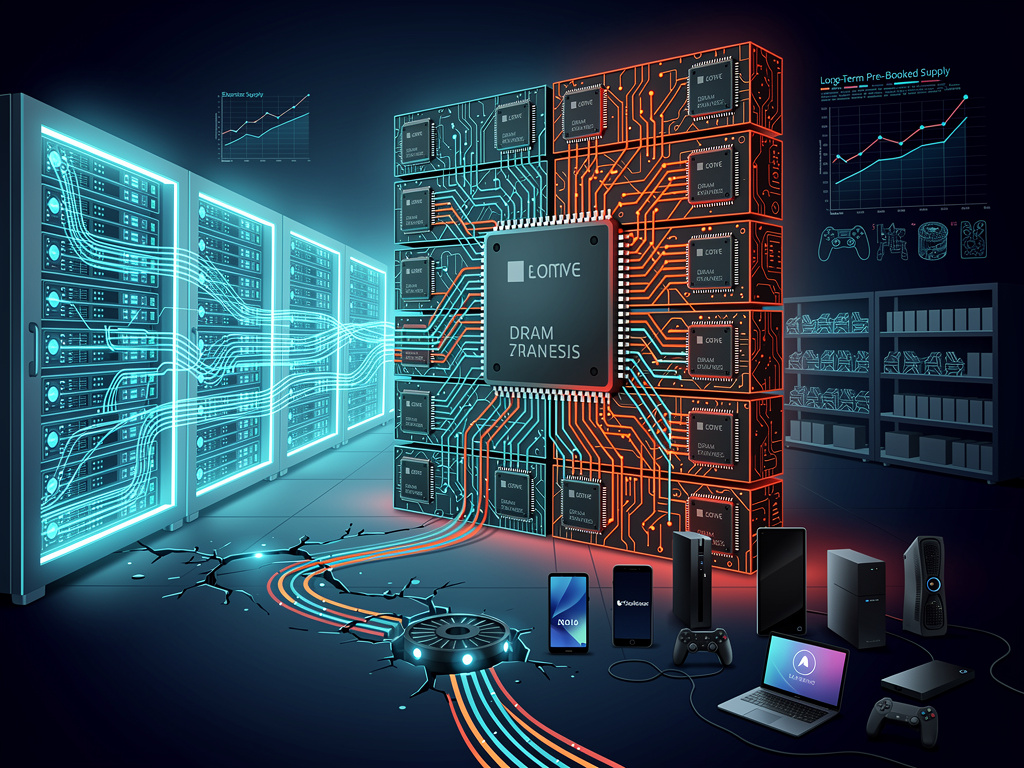
Samsung Electronics executives delivered stark news Thursday during an earnings call. The global memory shortage won’t ease. It will deepen in 2027. Customers already flood in with orders for next year. Supply can’t keep up. Kim Jaejune, head of the company’s memory chip business, put it bluntly: “Our supply falls far short of customer demand. Based solely on the demand currently received for 2027, the supply-to-demand gap for 2027 is set to widen even further than in 2026.” (The Verge)
And that’s no isolated view. Nikkei Asia reported hours earlier that Samsung foresees the crunch intensifying as anxious buyers lock in 2027 allocations, even while the firm’s ability to fulfill them hits historic lows. (Nikkei Asia) Demand from AI data centers drives this frenzy. Hyperscalers like those running OpenAI models snap up high-bandwidth memory, or HBM, leaving scraps for everyone else.
Short. Brutal. Producers prioritize profit.
Samsung, SK Hynix, and Micron command 90% of the DRAM market. They ramp production, sure. New fabs sprout in South Korea and the U.S. But full output? Not until 2027 or 2028 at best. Counterpoint Research crunches the numbers: To match demand, the industry needs 12% annual growth through 2027. Reality delivers 7.5%. By year’s end, suppliers meet just 60% of needs. (Nikkei Asia)
Take Samsung’s Pyeongtaek campus. The fourth fab comes online in 2026. Mass production? Delayed. Much of that capacity feeds HBM lines for AI accelerators, not the DDR5 in your laptop. SK Hynix builds in Cheongju. Micron expands stateside. Still, legacy DRAM—like DDR4 for servers or LPDDR for phones—gets deprioritized. Manufacturers cut those lines entirely, tightening supply further. (Wccftech)
Profits soar amid the pain. Samsung’s semiconductor division posted an eightfold Q1 jump, fueled by AI memory margins. Bloomberg calls it a 48-fold surge in chip profits. (Bloomberg) The Wall Street Journal projects Samsung outearning Apple, Microsoft, or Alphabet this year on memory alone. SK Hynix and Micron crack the top-10 profit ranks. “What we’re seeing today is the most severe memory shortage that the industry has ever experienced,” one analyst notes. (Wall Street Journal)
Consumers feel the squeeze first. RAM prices spiked 90-95% in Q1 contracts. Q2? Another 58-63% climb, per TrendForce. NAND flash jumps 70-75%. (Tom’s Hardware) Smartphones. Laptops. Gaming handhelds. All cost more. Ayaneo hiked prices across its lineup. Samsung Galaxy tabs and phones follow. Framework Laptop warns of DDR5 SO-DIMMs hitting $13-18 per gigabyte—third hike in three months. (Tom’s Hardware)
But wait. Labor unrest looms. Samsung’s South Korean union eyes an 18-day strike from May 21. Production halts could widen the gap. (The Verge)
Manufacturers scramble. Apple flags memory costs biting margins. Nintendo rejigs specs or absorbs hits. PC shipments could drop 11%. Phones, 9%. IDC sees the entry-level market vanishing by 2028 as costs balloon. Memory alone may claim 40% of a budget smartphone’s bill of materials by mid-2026, up from 20%. (Tom’s Hardware)
So what now? Chip giants police orders. They verify end-users, quantities, even demand legitimacy—to curb hoarding. Big clients like cloud providers ink multi-year deals, sometimes five years out to 2030. Smaller firms fight over scraps at hourly spot prices. Phison’s CEO warns NAND shortages could shutter consumer electronics lines outright. (Tom’s Hardware)
Relief? Analysts peg late 2027 earliest. SK Group chairman eyes 2030. New HUDIMM specs aim to cheapen DDR5. Samsung extends DDR4 output through 2027 for enterprise. Yet AI’s pull grows. Agentic models, bigger clusters—they devour more. Data centers already claim 70% of output.
This isn’t temporary. It’s structural. Three firms hold the keys. AI pays premium. Everyone else pays the price—higher, longer. Samsung’s Q1 windfall proves it. But as fabs lag and strikes threaten, 2027 orders roll in. The gap widens. Tech’s underbelly exposed.


 WebProNews is an iEntry Publication