
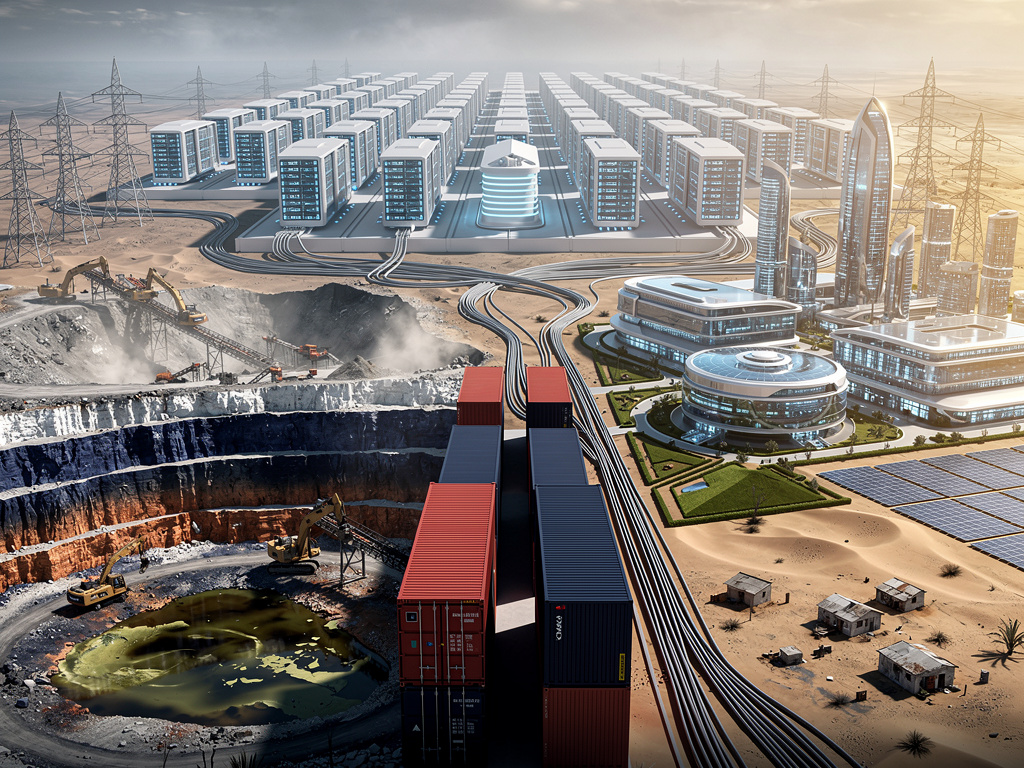
A troubling contradiction grips the tech world. AI data centers devour power and materials at unprecedented scale. Yet the minerals powering them—copper for wiring, cobalt for batteries, lithium for storage—come from places where communities face poisoned rivers and failing health. UN researchers lay it bare: the AI boom rests on exploited labor in Africa and fragile supply lines touching the Middle East.
This isn’t abstract. Global lithium production hit 456 billion liters of water in 2024 alone—enough for 62 million sub-Saharan Africans’ annual needs. In Chile’s Atacama, mining gulps 65% of regional water, shrinking lagoons and salting aquifers. But Africa bears the brunt. The Democratic Republic of Congo supplies 70% of world cobalt; Zambia ranks second in copper. These nations hold 30% of global critical mineral reserves, per Brookings Institution.
Communities pay. In Congo’s south, maternity wards near mines report birth defects far above national averages. Women suffer miscarriages, infertility from cobalt-tainted water. Chile’s Antofagasta logs lung cancer rates triple the norm. Fish die. Crops wither. Artisanal miners—often children—breathe dust without gear. Only one-third of Congolese have basic drinking water.
Copper demand surges. AI data centers need it for transmission lines, cooling systems. A single hyperscale facility pulls 500 megawatts, rivaling a midsize city. JPMorgan notes AI, alongside EVs and defense, drives the spike. Prices crossed $6 per pound recently, fueled by data center builds and Middle East tensions.
Africa’s Mineral Powerhouse Meets Global Hunger
And here’s the irony. Africa dominates output: 50% of cobalt, 76% of manganese. Congo and Zambia top copper reserves lists, per USGS data shared on X. Yet the continent grabs under 5% of refining value. Raw ore ships out—to China, mostly—returning as batteries for Nvidia chips in UAE servers.
Gulf states pivot fast. UAE’s G42 poured concrete for Berkeley-sized data centers in Abu Dhabi, powered by Nvidia and Oracle. Saudi Arabia eyes $5.3 billion AWS region, $10 billion Google-PIF hub. Microsoft expands 200 MW in UAE. These hubs need minerals. Sub-Saharan Africa holds 45% of lithium, 30% copper reserves, says JPMorgan. GCC funds chase them: ADQ with Orion, QIA with Ivanhoe Mines.
Water strains mount. UAE AI may gulp 61 billion liters yearly by 2030. Saudi data centers grow at 29% CAGR. Yet Gulf processing capacity hits $3 billion by 2040. They’re bridging Africa to factories.
Geopolitics sharpens the edge. U.S. State Department’s Pax Silica coalition—signed by UAE, Qatar—secures chains from minerals to chips. Atlantic Council calls it diplomacy plus exports. Trump pushes Zambia on minerals, tying to $1 billion PEPFAR aid, per X discussions. China controls 60% mining, 91% processing. Diversify or choke.
Health crises fester. Congo’s cobalt mines link to miscarriages, infant deaths. Zambia’s copper poisons rivers, collapsing fish stocks. UNU-INWEH’s Abraham Nunbogu and Kaveh Madani warn: without rules, tech repeats oil’s sins. Rare earths spew 2,000 tons waste per ton product. Leaching ponds leak acids into groundwater.
Food suffers too. Peru’s zinc taints watersheds. Bolivia’s lithium starves quinoa fields. Congo-Zambia pollution hits livestock. Local diets crumble as exports boom.
Gulf Hubs and the Push for Supply Security
So innovation beckons. Less-water mining tech. Binding treaties over voluntary nods. Local voices in governance. Recycling stretches supplies—extend device life, cut new digs.
U.S. eyes Africa hard. Vice President Vance, Secretary Rubio hosted minerals talks. Newsweek urges winning there for AI power. IEA’s Critical Minerals Security Programme flags AI data centers as vital. Ministers back diversification post-2026 declaration.
Middle East invests upstream. Saudi Ma’aden plans rare earth chains. UAE draws battery processing. PwC sees GCC as Africa-global linker. Yet China’s 2025 export curbs hit Gulf AI hard, per ORF.
Fast Company warns: AI data centers spike lithium, nickel, cobalt needs. U.S. imports 75% batteries foreign-sourced. Hormuz risks sulfur—key for leaching—spiking costs, idling Brazil’s phosphate.
Consumers rarely see it. Batteries charge ChatGPT servers. Wires hum in Abu Dhabi. But Congo kids dig cobalt bare-handed. Zambia negotiates aid for access. The chain binds tight.
Change demands action. Enforceable due diligence. Community shares. Tech firms fund monitoring. Without it, AI’s promise sours—polluted waters, sick kids, empty fields. The fourth industrial revolution can’t afford sacrifice zones.


 WebProNews is an iEntry Publication