
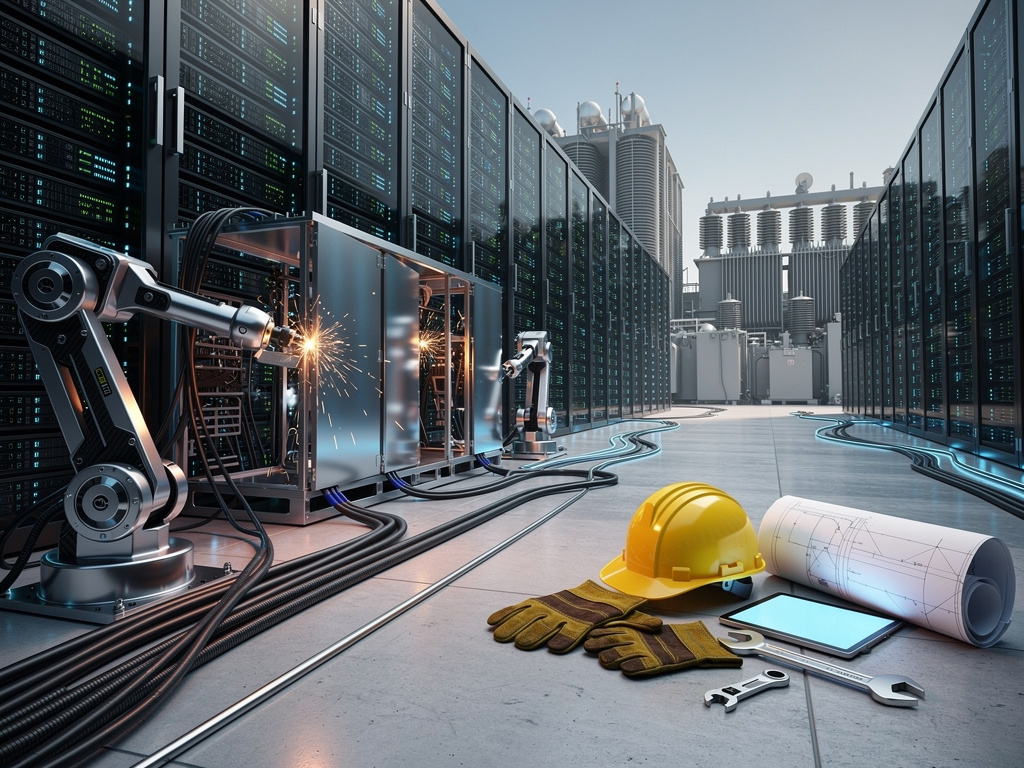
At the World Economic Forum in Davos, Nvidia CEO Jensen Huang delivered a stark message to white-collar workers: artificial intelligence is reshaping employment, but opportunity lies in the trades. “We’re talking about six-figure salaries for people who are building chip factories or computer factories or AI factories,” Huang declared, highlighting a surge in demand for plumbers, electricians and construction workers fueling the AI infrastructure buildout.
Huang’s comments, made during a session with BlackRock CEO Larry Fink, underscore a pivotal shift. As AI models demand ever-larger data centers, the industry requires massive physical expansion—power plants, cooling systems and specialized facilities that employ skilled labor. This comes amid warnings that AI could displace entry-level office roles, with Anthropic’s CEO Dario Amodei predicting up to 50% of such positions at risk.
AI Infrastructure Fuels Trade Renaissance
The scale of investment is staggering. Nvidia reported data center revenue exceeding $30 billion in its latest quarter, with global hyperscalers like Microsoft and Amazon committing hundreds of billions to new facilities. Each hyperscale data center, often spanning football fields, requires thousands of tradespeople for installation of high-voltage cabling, HVAC systems and structural reinforcements tailored for GPU clusters.
Huang emphasized this during his Davos appearance: “A lot of these jobs are going to be created in the skilled trades.” Leaders from energy giants echoed the call, noting AI’s power hunger—equivalent to small countries—drives need for grid upgrades and renewable integrations handled by electricians and welders.
White-Collar Squeeze Meets Blue-Collar Paychecks
Office jobs face headwinds. Recent reports detail AI automating routine tasks in coding, analysis and administration, with firms like Goldman Sachs forecasting 300 million global roles affected. Yet, trades offer stability: U.S. Bureau of Labor Statistics data shows median electrician pay at $60,000, but AI factory specialists command $100,000-plus amid shortages.
Fortune magazine detailed the trend, quoting Huang on construction roles: “The next wave of six-figure opportunities won’t be found in a Wall Street office.” Plumbing for liquid-cooled servers and electrical work for megawatt-scale power distribution are among the hottest fields, with unions reporting 20% wage hikes in data center hubs like Virginia and Texas.
Data Center Gold Rush Reshapes Labor Markets
Texas exemplifies the boom. The state hosts over 50 major data centers under construction, employing 15,000 tradesworkers. Local reports from the Dallas Morning News highlight plumbers earning $120,000 annually installing cooling loops for Nvidia H100 GPUs. Similar patterns emerge in Ireland, Singapore and Saudi Arabia, where sovereign funds pour billions into AI hubs.
In a Yahoo Finance analysis, experts predict 1 million U.S. trade jobs by 2030 tied to AI, outpacing software roles. Huang reinforced this at Davos: “AI is a five-layer cake,” spanning energy infrastructure to applications, each layer demanding hands-on expertise.
Six-Figure Salaries Beckon Non-Degree Holders
Vocational training programs are exploding. Community colleges in Ohio and Arizona report 40% enrollment spikes in welding and HVAC courses geared toward data centers. Nvidia itself partners with unions for certification, as noted in a Fortune feature. “No college degree needed,” Huang stressed, positioning trades as the AI era’s meritocracy.
Challenges persist: supply chain bottlenecks for copper wiring and skilled labor shortages could delay projects. Still, leaders like Fink predict acceleration, with BlackRock investing $50 billion in data center REITs. Posts on X from Nvidia’s official account amplify Huang’s view, describing AI as creating jobs “at every layer of the stack, from energy to applications.”
Global Echoes and Policy Shifts
Internationally, Taiwan’s Taipei Times reported Huang’s push for local electricians amid TSMC’s $100 billion U.S. expansion. India’s Financial Express cited six-figure prospects for builders sans degrees, driven by data center investments topping $10 billion. Governments respond: the U.S. CHIPS Act allocates $39 billion for fabs, mandating domestic labor training.
Europe faces acute needs, with Germany’s grid strained by AI loads. A CNBC report on Huang’s Davos talk, available here, notes EU commissioners pledging €100 billion for infrastructure, prioritizing trades apprenticeships. This convergence signals a structural pivot from knowledge work to physical mastery.
Training Pipelines Gear Up for Scale
Apex programs emerge. Microsoft’s Data Center Academy has trained 10,000 workers since 2023, focusing on fiber optics and safety for AI halls. Google’s partnerships with unions target 50,000 hires by 2027. Huang advocates sovereign AI stacks, per Nvidia’s X posts, implying localized trade demands worldwide.
Risks loom: geopolitical tensions could reroute builds, but demand endures. SFG Media highlighted Anthropic’s counterpoint—AI slashing white-collar entry points—juxtaposed against Nvidia’s optimism. Trades, Huang argues, remain irreplaceable for the “AI factories” powering the next computing era.
Investment Waves Hit Trade Unions
Unions capitalize. The International Brotherhood of Electrical Workers reports 30% membership growth in tech corridors, negotiating premiums for AI-specific skills like cryogenic cooling. Venture capital eyes training: startups like BuildOps raise $100 million for trade tech, blending AR with apprenticeships.
As Nvidia’s data center sales surge—up 150% year-over-year per earnings—Huang’s vision materializes. His Davos exchange with Fink crystallized the thesis: AI doesn’t destroy jobs; it relocates them to factories and fields, rewarding those who build the machines thinking for us.


 WebProNews is an iEntry Publication