
AI’s Hidden Bill: Why Private Clouds Are Reclaiming Workloads from the Giants
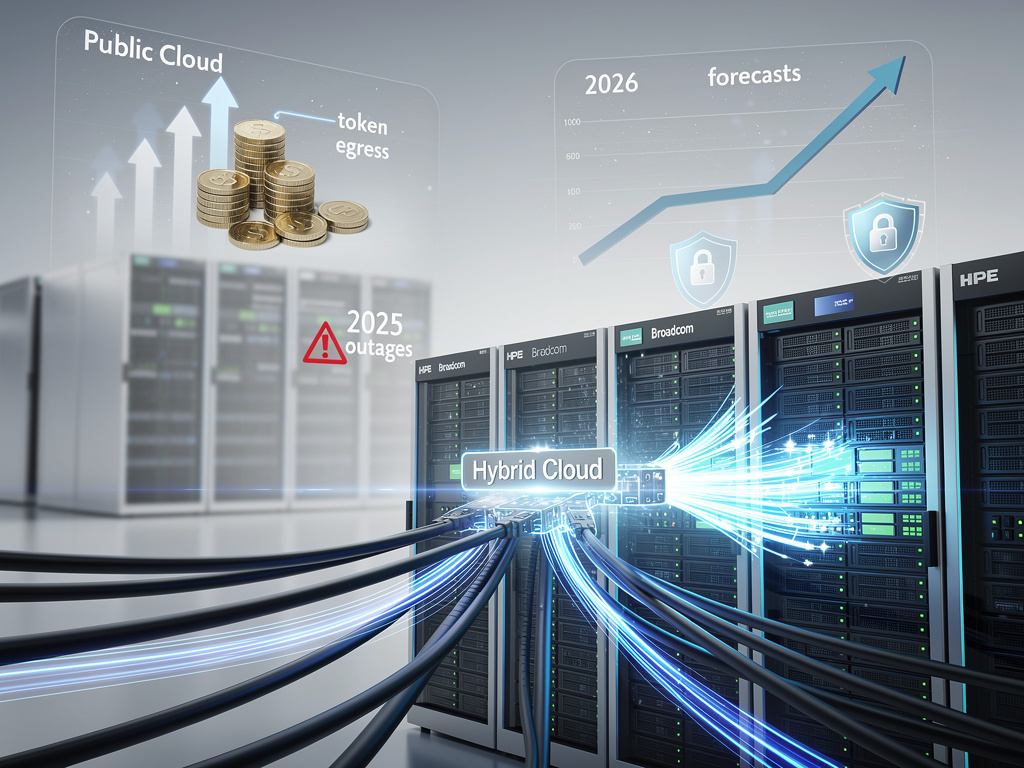
A North American manufacturer standardized on public cloud services for data lakes, analytics, CI/CD pipelines, and ERP integration through 2024 and early 2025, drawn by promises of simplification and cost savings. But when leadership mandated generative AI copilots across maintenance, procurement, call centers, and engineering change orders, the economics unraveled. A pilot using managed model endpoints and retrieval layers succeeded at first, only to explode with charges for token usage, vector storage, accelerated compute, data egress, premium logging, and guardrails. Cloud service disruptions compounded the pain, exposing risks in blast radius, dependency chains, and high availability.
The company didn’t abandon the cloud entirely. It shifted AI inference and retrieval to a private cloud near its factories, keeping public cloud for model training bursts. As David S. Linthicum wrote in InfoWorld, “It wasn’t a retreat. It was a rebalancing.” AI workloads, unlike traditional apps, are spiky, GPU-intensive, and multiply rapidly—from single assistants to department-wide ensembles. Public cloud elasticity promises flexibility but delivers persistent scaling costs once AI embeds in workflows.
The promise of elasticity is not the same thing as cost control, Linthicum noted. Private clouds enable predictable capacity, standardization on GPU platforms, local embedding caches, and avoidance of per-request fees, using public cloud only for bursts.
Cost Gaps Exposed by AI Scale
Public cloud pricing for AI includes hidden fees that create a chasm between expectations and invoices. Token usage, vector databases, accelerated compute, egress, logging, and guardrails add up quickly. Enterprises modeling costs per transaction or workflow find private setups cheaper for steady-state inference. A CIO.com report highlighted Home Depot and R&D lab Ofino partnering with HPE and CyrusOne for private cloud, slashing costs up to 90%. “AI is like the ultimate hybrid workload,” said Hang Tan, hybrid cloud COO of HPE.
Somerset Capital Group migrated ERP apps to private cloud to pave the way for generative AI, retaining public cloud for customer-facing workloads. IDC analyst Dave McCarthy told CIO.com that private platforms like Dell APEX and HPE GreenLake, plus colocation with Equinix, address AI’s resource needs while ensuring data integrity. Broadcom’s Private Cloud Outlook 2025 study of 1,800 IT leaders found private cloud re-emerging for AI/ML, with 69% considering repatriation from public cloud and over one-third already acting, per Broadcom News.
OpenMetal’s analysis in its blog noted data movement at AI scale reveals hyperscaler pricing pitfalls, advocating hybrid with private-first for sensitive, GPU-heavy tasks. “The future isn’t public versus private—it’s hybrid with a private-first anchor,” the post stated.
Resilience and Outage Realities
2025 outages in public cloud services—like identity management, model endpoints, vector databases, event streaming, and observability—revealed correlated failures. Private clouds shrink dependency surfaces, enable controlled upgrades, and isolate issues. Linthicum emphasized proximity for low-latency access to operational data, IoT, and edge integration, especially on constrained networks near factories.
Data gravity pulls harder as AI generates feedback loops, ratings, and audits, favoring local placement for frictionless accountability. Forrester’s Predictions 2026, covered in CDOTrends and Forbes, forecast at least two major hyperscaler outages in 2026 due to GPU prioritization, pushing 15% of enterprises to private AI on private clouds amid rising costs and lock-in.
Flexential’s State of AI Infrastructure Report 2025 revealed 60% of organizations use private cloud for AI, 48% hybrid, and 47% public, blending for performance, cost, and control amid power strains.
Vendors Fueling the Private AI Surge
HPE Private Cloud AI, co-engineered with NVIDIA, offers a turnkey workbench with unified data lakehouse and rapid model deployment, reducing data pipeline complexity per IDC, as detailed on HPE’s site. Rackspace Private Cloud AI emphasizes security, customization, and resource optimization for scalable ML. VMware Cloud Foundation from Broadcom supports VMs, containers, and AI/ML with compliance and governance.
Apple’s Private Cloud Compute ensures user data deletion post-request, unavailable even to staff, using custom silicon for secure LLM inference, per Apple Security Research. Google’s Private AI Compute mirrors this with Trillium TPUs and Titanium Enclaves for Gemini models, promising on-device-level privacy in the cloud, as reported by The Hacker News and Ars Technica.
Kubernetes drives AI-ready private clouds, with 96% of organizations adopting or evaluating it and 54% for AI/ML, enabling hybrid portability amid data sovereignty and cost concerns, according to InfoWorld.
Hybrid Strategies and Enterprise Shifts
Deloitte’s survey found over half of data center leaders plan to move AI workloads off-cloud when costs hit thresholds, favoring emerging AI clouds and edge over on-prem alone. GTT reported more than half of AI workloads in private/on-premises combos for security and compliance. Barclays CIO Survey, cited by Michael Dell, showed 83% of enterprises planning repatriation, amplified by AI costs.
IDC’s Dave McCarthy warned in CIO.com: “Enterprises need to ensure that private corporate data does not find itself inside a public AI model.” Rackspace’s 2026 trends predict inference shifting private for stable economics as AI productionizes. vCluster notes private clouds yield higher ROI via amortized GPUs over 3-5 years versus variable public pricing.
Cloudian guides highlight private clouds’ optimized performance, customization, and long-term savings for predictable AI demand. Equinix Blog contrasts public/private for AI: private hosts models near data for privacy, lineage control.
Implementation Roadmap and Challenges
Linthicum outlined five steps: model unit economics per workflow; design resilience with fallbacks; plan data locality; operationalize shared GPUs with quotas/chargebacks; secure with role-aligned identities. Challenges include retrofitting data centers for 50-100kW racks, per CIO.com, costing millions but yielding control.
Forrester predicts neoclouds capturing $20B in 2026 GPU revenues. Broadcom’s Krish Prasad called it the “Cloud Reset,” with workloads returning for security, performance, AI readiness. As AI that works but is unaffordable at scale remains “just a demo with better lighting,” per Linthicum, enterprises rebalance toward private for sustainable economics.


 WebProNews is an iEntry Publication