
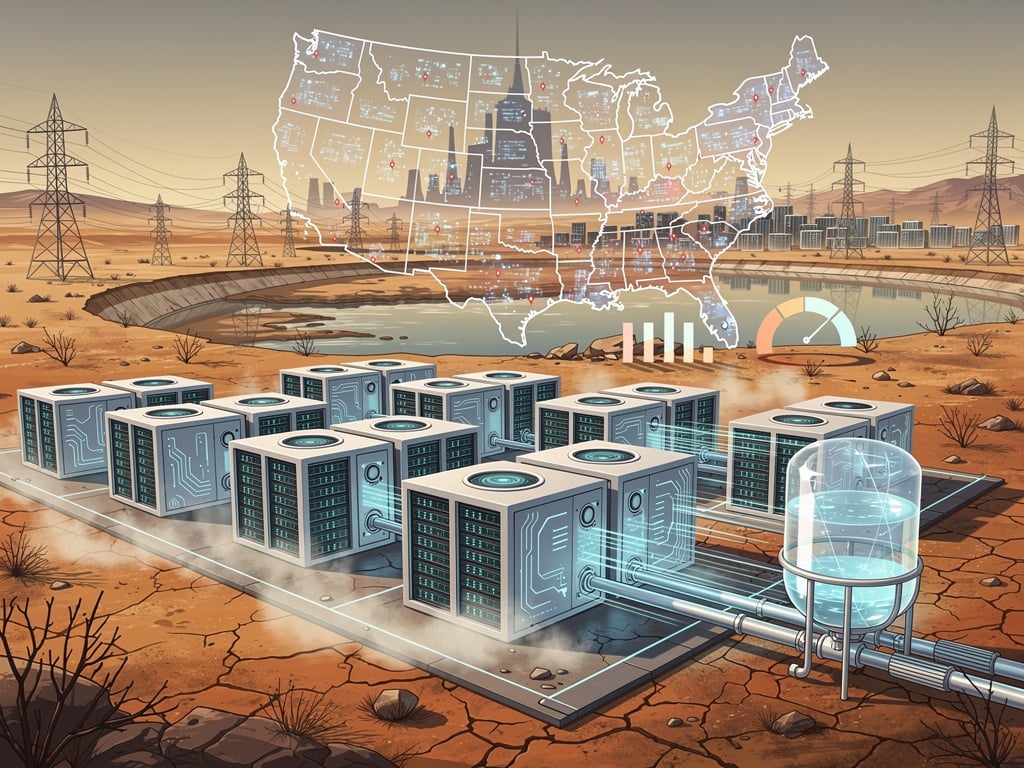
Two-thirds of the 809 data centers planned across the United States sit in counties that have endured drought over the past year. The figure comes from an analysis of federal drought maps and commercial project data. It highlights a stark tension. The same technology driving economic optimism now strains the basics of human settlement in some of the driest parts of the country.
More than 60 percent of the contiguous U.S. currently faces drought conditions. This marks the largest spring expanse in modern records. Scientists link the pattern to human-caused climate change that lengthens dry spells and sharpens their bite. Yet construction presses forward. Hyperscale facilities from Google, Meta, Microsoft and Amazon promise jobs and tax revenue. They also consume vast quantities of water for cooling and electricity for computation.
A single large data center can pull up to 5 million gallons of water daily. That volume matches the daily demand of a town of 50,000 people. Across the country, total data-center water demand could climb to 73 billion gallons a year by 2028. The jump comes from roughly 17 billion gallons in 2023, according to The Guardian. Each 100-word AI prompt draws the equivalent of one 500-milliliter bottle through the cooling systems that support the underlying models.
Texas offers a concrete example. State data centers are projected to use 49 billion gallons in 2025. The number rises to 399 billion gallons annually by 2030. That later figure would represent almost 6.6 percent of the state’s total water usage. The Houston Advanced Research Center produced the estimates. They arrived as parts of Texas remained under Stage 3 drought rules that limit lawn watering to once a week. A midsize facility draws about 300,000 gallons per day, the same as roughly 1,000 households. Larger ones reach 4.5 million gallons daily. Newsweek reported those numbers last August.
Power demand tells a parallel story. Data centers accounted for 1.5 percent of global electricity consumption in 2024. The total reached 415 terawatt-hours. Growth has run at 12 percent annually since 2017, more than four times the rate of overall electricity demand. The International Energy Agency expects the figure to exceed 945 terawatt-hours by 2030. That matches Japan’s current national consumption. The U.S. will drive much of the increase. American facilities already represent 45 percent of the global total. By decade’s end the country could consume more electricity for data centers than for all its aluminum, steel, cement, chemicals and other energy-intensive industries combined. A typical AI-focused center uses as much power as 100,000 households. The largest now under construction will draw 20 times that amount. The IEA laid out those projections in its recent analysis.
But. The concentration worries grid operators. Nearly half of U.S. data-center capacity clusters in five regional pockets. That focus amplifies local strain. In Virginia, data centers already account for almost 40 percent of electricity consumption. PJM Interconnection, the nation’s largest grid operator, saw data-center demand add more than $9.3 billion in costs over a recent 12-month period. Bloomberg tracked the rise and its effect on household bills.
Water use compounds the pressure. Cooling often relies on evaporative systems that consume fresh supplies. Closed-loop alternatives reduce direct water draw yet increase electricity needs. Those extra kilowatts frequently come from natural-gas plants that themselves require water for steam generation. The trade-off appears clearly at Meta’s proposed Hyperion project in Louisiana. The facility plans closed-loop cooling. It will still need ten gas-fired plants to meet its load. The Guardian detailed the case.
Christopher Dalbom studies water-resources law at Tulane University. He sees an approaching limit. “The AI industry is sprinting as fast as it can to gain market dominance, and the rest of us have to deal with a great increase in water demand in places already in drought,” he told The Guardian. “Even if there wasn’t climate change, we’d be feeling the effects of droughts more acutely… There isn’t enough water to go around. Now with this explosion of data centers, I think a crunch point is inevitable.”
Developers often choose arid sites. Land costs less. Tax incentives prove generous. Dry air supposedly reduces equipment corrosion. The Stratos Project in Utah’s Box Elder County spans 40,000 acres and could demand 9 gigawatts. County officials approved it despite persistent drought. Local ranchers objected. Andrew Coppin runs Ranchbot, which helps producers monitor water. He captured their frustration. “Ranchers are being told to be conservative with water, to not waste water, and now there’s a new competing interest able to get near unlimited access to water.”
Polling shows about 70 percent of residents in affected areas oppose new projects. Some states weigh tighter rules. Utah faces lawsuits over groundwater drawdown. Texas lacks statewide water regulation for data centers even as its water-development board forecasts rising demand and falling supply. The Houston Advanced Research Center warned that data centers’ unknown needs “are poised to place unprecedented stress on local water supplies.” Its report appeared earlier this year.
Industry representatives push back. They note that agriculture still dominates water consumption in most basins. Data-center operators invest in reclamation projects and work with local utilities. Dan Diorio, vice president of state policy at the Data Center Coalition, said operators “prioritize responsible water use through operational best practices and innovative development strategies.” Microsoft has piloted zero-water cooling designs for deployment in Phoenix and Wisconsin starting next year. Reuters covered the effort in January.
Still, indirect impacts matter. Power generation for these facilities can account for far more water than on-site cooling. A January study from Xylem and Global Water Intelligence found that data-center cooling represents only about 4 percent of AI’s total water footprint. Semiconductor fabrication takes 42 percent. Power generation claims 54 percent. Tom’s Hardware referenced the analysis while reporting on the Guardian findings.
Recent coverage sharpens the picture. The Brookings Institution examined how data centers affect municipal water systems already burdened by aging pipes and rising repair costs estimated at $744 billion over two decades. Local utilities face higher infrastructure expenses to extend lines to exurban sites. Rates climb. Residents pay. The report appeared late last year.
In Texas, the projected jump from 25 billion gallons today to as much as 161 billion by 2030 has prompted calls to treat AI developers like oil and gas operators, with stricter disclosure and planning requirements. The Texas Observer reported those discussions in February. Similar debates surface in Arizona, where Meta pledged to become water-positive by 2030, and in Northern Virginia, where power auctions have driven residential bills higher.
So the pattern holds. Companies chase speed to market and cheap land. Communities inherit the resource consequences. No single fix resolves every tension. Greater use of reclaimed wastewater helps. On-site generation with advanced cooling reduces transmission losses. Small modular reactors could deliver carbon-free baseload power, though deployment timelines stretch years. Regulators in some states now require detailed water budgets before permits issue.
The numbers keep rising. Global data-center electricity demand may reach 1,200 terawatt-hours by 2035 in the IEA’s base case. U.S. facilities could claim 6.7 to 12 percent of national electricity by 2028, according to Lawrence Berkeley National Laboratory models cited across multiple analyses. Water demand follows the same curve. A record-shattering drought already covers wide stretches of the country. The facilities meant to power the next wave of innovation are landing right in the middle of it.
Decisions made today will shape availability for decades. Farmers, residents, utilities and technology executives all watch the same aquifers and transmission lines. The AI race has reached the water table and the switchyard. Both are showing strain.


 WebProNews is an iEntry Publication