
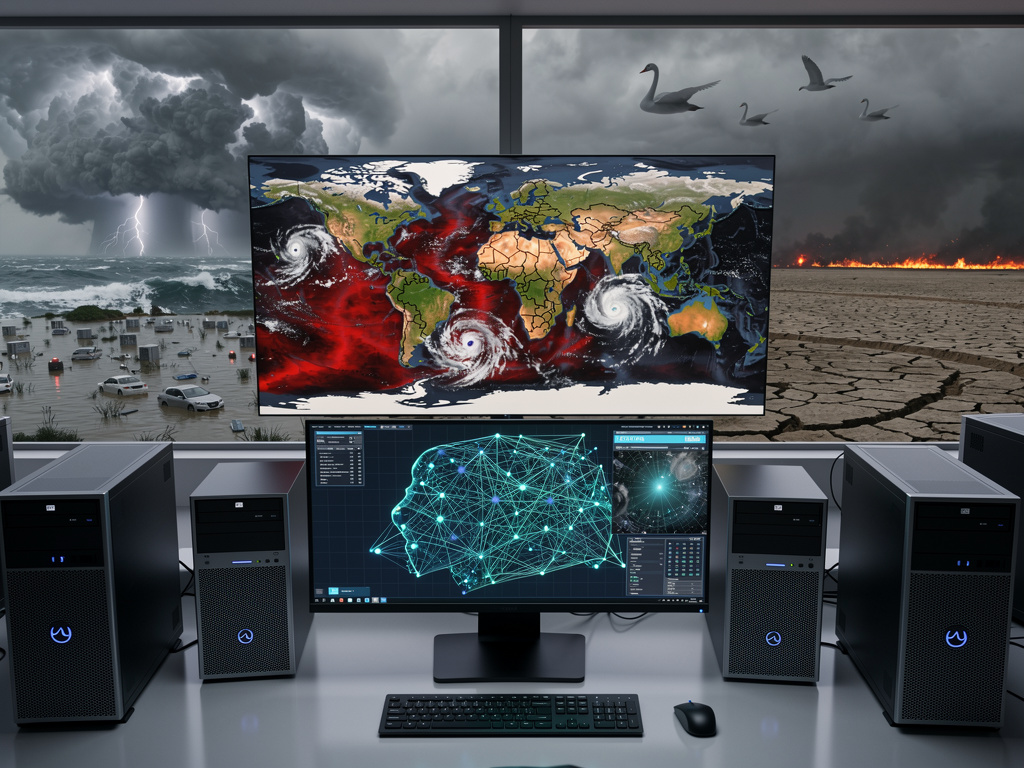
Picture the Bhola cyclone ripping through East Pakistan in 1970. Winds hit 130 miles per hour. A 35-foot storm surge followed. Death toll: 300,000 to 500,000. Better forecasts back then might have saved countless lives. Fast-forward to today. Artificial intelligence promises that edge—and more. Yet as climate volatility spikes, these models face tests they weren’t built for. Experts call them gray swans: rare events outside historical data, like the 2021 Pacific Northwest heat dome that baked the region to impossible highs without human-driven warming. AI struggles here. Badly. Gizmodo laid bare the tension last year.
AI weather tools race ahead on speed and cost. GraphCast from Google DeepMind. Pangu-Weather from Huawei. ECMWF’s AIFS. Since 2023, they’ve matched or beaten physics-based rivals on medium-range predictions. DeepMind’s model aced the 2025 Atlantic hurricane season, nailing storm tracks and intensity where traditional systems faltered. Farmers in India got four weeks’ monsoon warnings, reaching 38 million thanks to University of Chicago efforts. Developing nations, long shut out by supercomputer demands, now have access. ‘A lot of countries were left behind in that first revolution of weather forecasting,’ says Pedram Hassanzadeh, because it needed supercomputers, millions in funding, experts across fields. AI changes that. Gizmodo.
But here’s the peril. AI learns patterns from decades of data. Gray swans? Absent. Hassanzadeh’s team stripped Category 3-5 hurricanes from training sets, then tested on a Category 5. Models predicted Category 2 at best. Always underestimated. ‘They fail on gray swans,’ Hassanzadeh notes. Yongqiang Sun, co-author on a University of Chicago study in Proceedings of the National Academy of Sciences, adds: ‘It always underestimated the event. The model knows something is coming, but it always predicts it’ll only be a Category 2 hurricane.’ False negatives kill. Evacuations for overcalls annoy. Underestimates? Catastrophic. ScienceDaily covered the findings.
Silent failures compound the danger. Models spit confident normalcy amid records. Rose Yu warns: ‘The concern isn’t occasional misses. It’s that AI models can miss silently, producing confident forecasts of unremarkable weather while a record-breaking event is unfolding.’ They flout conservation laws subtly. Diagnosis? Tough in black boxes. Satellite networks strain under budget cuts. Over-reliance risks atrophy of physics infrastructure—the redundancy catching AI slips. ‘If we consolidate around AI too quickly and let physics-based infrastructure atrophy, we lose the redundancy that currently catches AI’s failures,’ Yu says. Gizmodo.
Recent deployments amplify worries. NOAA rolled out AIGFS, slashing compute needs by 99.7% for 16-day forecasts in 40 minutes. Impressive. Yet version 1.0 degrades on tropical cyclone intensity. Training energy? Massive upfront hit, uncounted in ops savings. ETC Journal. World Bank flags trust erosion: cheap AI floods warnings create confusion, spectacular flops cost lives. World Bank Blogs. Articsledge notes 2026 gaps: extremes like heavy rain, local nowcasting, climate shifts. Articsledge.
And verification lags. A ScienceDirect paper calls for new methods; standard metrics mask flaws. ‘We are just beginning to understand where and when these forecasts are useful and when they are not.’ ScienceDirect. MIT researchers found simpler physics models beat deep learning on local temps, rain amid natural variability. Cautionary. MIT News. X chatter echoes: AI slop erodes trust, fake severe maps numb publics to real threats. James Spann blasts engagement farms peddling unverified hype.
Calls grow for safeguards. AIRWIE protocol: withhold iconic events for blind tests. Hybrid physics-AI blends. ‘Relevant sampling’ for swans. Shruti Nath pushes organized protocols amid hype: ‘We need to be a bit more organized… robust safeguards… maintained by the community.’ Gizmodo; her Nature editorial Nature. UChicago snags funding for underserved forecasts, benchmarks. UChicago News.
Progress won’t stop. AI’s generational leap too potent. Andrew Charlton-Perez: machine learning accuracy grows ‘vastly exceeded’ physics’ day-per-decade. But in a warming world birthing more gray swans, blind faith invites disaster. Physics endures for extremes. Hybrids rule. Test rigorously. Or pay dearly when the unprecedented strikes.


 WebProNews is an iEntry Publication