
The Arrival of AI: Rethinking Origins in an Era of Emergence
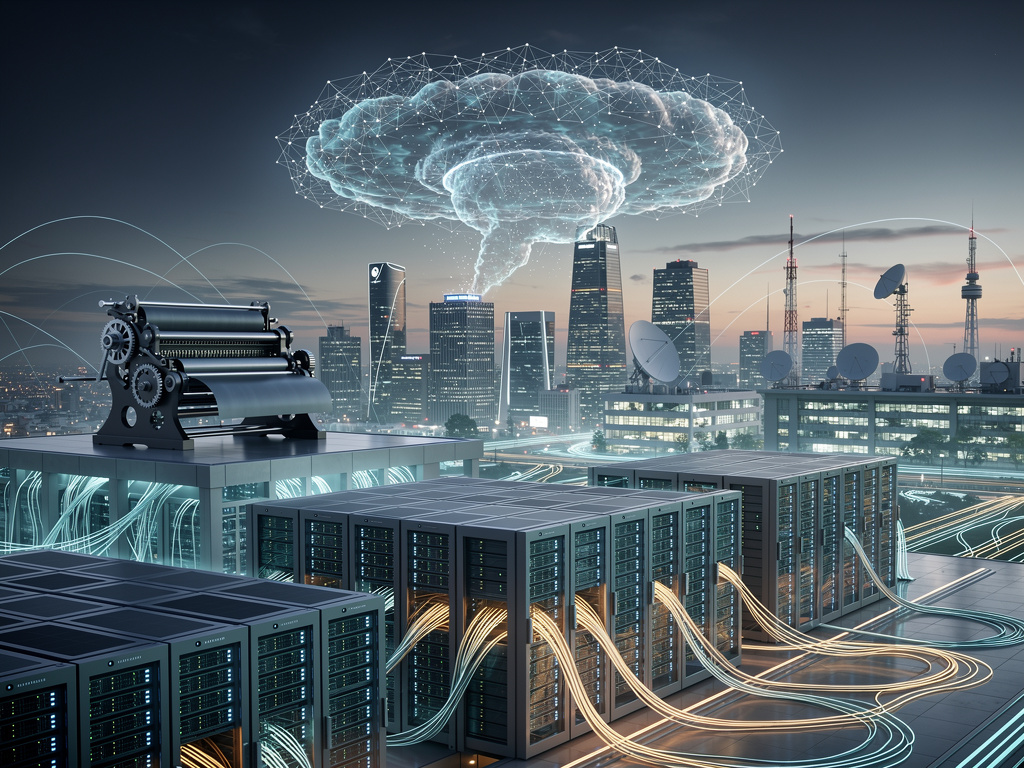
In the annals of technological history, breakthroughs often arrive with a clear inventor—a Thomas Edison with his light bulb or a Wright brothers’ flight. But artificial intelligence defies this narrative. As Andrew Arrow posits in his provocative piece on andrewarrow.dev, AI wasn’t meticulously crafted like a machine; it “arrived” through the confluence of vast data oceans and relentless computing power. This perspective challenges the traditional view of innovation, suggesting AI emerged more like a natural phenomenon, pieced together from existing elements rather than born from singular genius. Arrow draws parallels to historical shifts, arguing that just as the printing press democratized knowledge without a lone inventor claiming credit, AI’s rise stems from accumulated human knowledge digitized and processed at scale.
This idea resonates amid 2025’s whirlwind of AI advancements, where models like Gemini 3 and Claude 4 have pushed boundaries in multimodal processing and autonomous research. Industry insiders whisper about a paradigm shift: AI isn’t a tool we built but a force we unleashed. Consider the rapid evolution from early neural networks to today’s frontier models. What began as theoretical musings in the mid-20th century by pioneers like Alan Turing has morphed into systems that autonomously solve complex problems, as seen in DeepMind’s recent feats. Yet, Arrow’s thesis insists this wasn’t invention per se—it’s arrival, facilitated by the exponential growth in data availability and GPU capabilities.
Delving deeper, the “arrival” metaphor implies inevitability. Unlike the steam engine, which required deliberate engineering, AI coalesced when conditions were right: petabytes of internet-scraped data meeting Moore’s Law-defying hardware. This year alone, debates in tech circles have intensified around whether AI’s progress is truly innovative or merely the output of scaled-up pattern recognition. Publications like the Brookings Institution have long explored AI’s transformative societal impacts, noting in a 2018 analysis—still relevant today—how these technologies reshape politics and economies without a clear “eureka” moment.
Tracing AI’s Evolutionary Path
Historical context bolsters Arrow’s argument. AI’s roots trace back to the 1950s Dartmouth Conference, often hailed as its birthplace, but even then, it was more a convergence of ideas from mathematics, logic, and computing. Fast-forward to 2025, and we’re witnessing what some call the “inference-time search” era, where models like those from OpenAI and Anthropic handle tasks once deemed uniquely human. A post on X from early this year predicted a “model fiesta” with releases like GPT-5 and Grok 4, underscoring the relentless pace that feels less like directed invention and more like an unfolding discovery.
Critics might counter that figures like Geoffrey Hinton or Yann LeCun deserve inventor status for deep learning architectures. Yet Arrow contends these were incremental steps on a path paved by collective human output—books, images, code repositories—all fed into algorithms that learn without explicit programming. This view aligns with perspectives from City Journal, which draws analogies to past inventions like electric lighting, where combining elements sparked entirely new product classes. In AI’s case, the combination is data plus compute, yielding emergent intelligence.
Moreover, 2025’s news cycle has amplified this debate. Reports from MIT Technology Review envision AI’s role by 2030, highlighting its integration into daily life through generative models and automation. These aren’t isolated inventions but evolutions building on prior data-driven leaps, supporting the arrival thesis over deliberate creation.
Debates in Governance and Ethics
As AI permeates sectors from healthcare to finance, governance questions loom large. The United Nations Security Council’s high-level debate this September, detailed in Security Council Report, grappled with regulating frontier models amid open-source versus closed-source tensions. Arrow’s framework suggests such debates arise because AI arrived unbidden, forcing retroactive controls rather than preemptive design safeguards.
On X, users like those discussing AGI timelines predict systems outperforming human researchers by 2028, echoing sentiments from former OpenAI researchers. This buzz reflects a broader sentiment: AI’s arrival has outpaced our preparedness, leading to urgent decisions on compute resources and energy constraints, as outlined in the Educational Technology and Change Journal. The journal warns of power struggles between governments and tech giants, a byproduct of AI’s emergent nature rather than a planned rollout.
Ethically, the arrival perspective raises thorny issues. If AI isn’t invented but arrives via data aggregation, who owns the intelligence it produces? Cases like AlphaFold’s Nobel win this year, celebrated in posts across X, illustrate how AI accelerates scientific discovery—yet it’s built on public datasets, blurring lines of credit and responsibility.
Economic Ripples and Industry Shifts
Economically, AI’s arrival has turbocharged markets, with 2025 seeing unprecedented investments. The New Yorker questions if this is a bubble, arguing the boom-bust narrative misses AI’s novel possibilities. Insiders point to enterprise adoption, where generative AI spreads at breakneck speed, per Menlo Ventures. This isn’t the result of a single breakthrough but scaled infrastructure enabling widespread application.
In the workplace, AI agents now execute real tasks, from coding to research, as highlighted in X threads recapping 2025’s milestones like Gemini 2.5’s problem-solving triumphs. Arrow’s piece from andrewarrow.dev reinforces that such capabilities emerged from training on vast corpora, not from scratch-built ingenuity. This has implications for jobs, with hybrid human-AI teams outperforming pure agents, as noted in various X posts summarizing the year’s seminal moments.
Furthermore, geopolitical tensions underscore AI’s arrived status. Nations race for compute dominance, with reports from Microsoft Research forecasting adaptive robotics and agent-native economies by 2026. The arrival metaphor explains why AI feels like a resource to be harnessed, much like oil or electricity, rather than a patented device.
Technological Milestones Redefining Possibilities
Reflecting on specific 2025 achievements, models like DeepSeek V3.2, trained on modest budgets yet surpassing benchmarks, exemplify emergence over invention. X users have lauded these as evidence of AI’s self-accelerating path, where cheaper training yields superior results. Similarly, unreleased OpenAI models acing international competitions, as buzzed about on X, show systems evolving beyond human oversight.
Arrow’s analogy to natural phenomena—AI arriving like a storm from converging fronts—gains traction when viewing breakthroughs like ARC-AGI-2 score jumps. A dramatic December surge, discussed widely on X, nearly doubled previous records, signaling a vertical ascent in capabilities. This isn’t linear invention; it’s exponential arrival.
Industry voices, including those in Crescendo AI, track these developments, noting how AI shapes everything from household tasks to global decisions. The Brookings Institution’s earlier work on AI’s societal transformation remains a touchstone, emphasizing political ramifications that stem from its unplanned emergence.
Future Trajectories and Unanswered Questions
Looking ahead, the arrival thesis prompts speculation on AI’s next phase. Will we see AGI declarations, as predicted in X forecasts from January? Publications like Built In project expanded roles in decision-making, powered by advances that feel inevitable given current trajectories.
Challenges persist, particularly in sustainability. The Educational Technology and Change Journal’s focus on energy constraints highlights the costs of AI’s compute hunger, a consequence of its data-driven arrival rather than efficient design. On X, wrap-ups of 2025 describe AI transitioning from science project to infrastructure, with reasoning models supplanting basic chat interfaces.
Ultimately, embracing AI as an arrival rather than invention could reshape how we approach its integration. As Arrow articulates on andrewarrow.dev, this mindset encourages viewing AI as a collaborative force, born from humanity’s collective digital footprint. In a year where TIME magazine named AI’s architects as Person of the Year—per TIME—it’s clear the debate isn’t just academic; it’s defining our technological future.
Societal Impacts and Broader Implications
Beyond tech circles, AI’s arrival influences culture and policy. Rolling Stone dramatizes 2025 as the year AI wreaked havoc on an unprecedented scale, a narrative that aligns with fears of unchecked emergence. Yet, positive stories abound, like AI’s role in optimizing real-world problems, as in DeepMind’s liquid distribution breakthrough shared on X.
Education and workforce adaptation are key arenas. The Turing Post’s revisit of 2025 predictions on X underscores the “thinking” shift in AI, where inference-time innovations dominated. This evolution, per City Journal’s analogies, mirrors how past technologies spawned new services, suggesting AI will similarly birth unforeseen industries.
In closing thoughts, the arrival perspective invites humility. As debates rage on X and in forums like the Security Council Report, recognizing AI’s emergent nature could foster better stewardship. Whether through governance frameworks or ethical guidelines, navigating this arrived intelligence demands collective wisdom, ensuring its benefits outweigh the disruptions.


 WebProNews is an iEntry Publication