
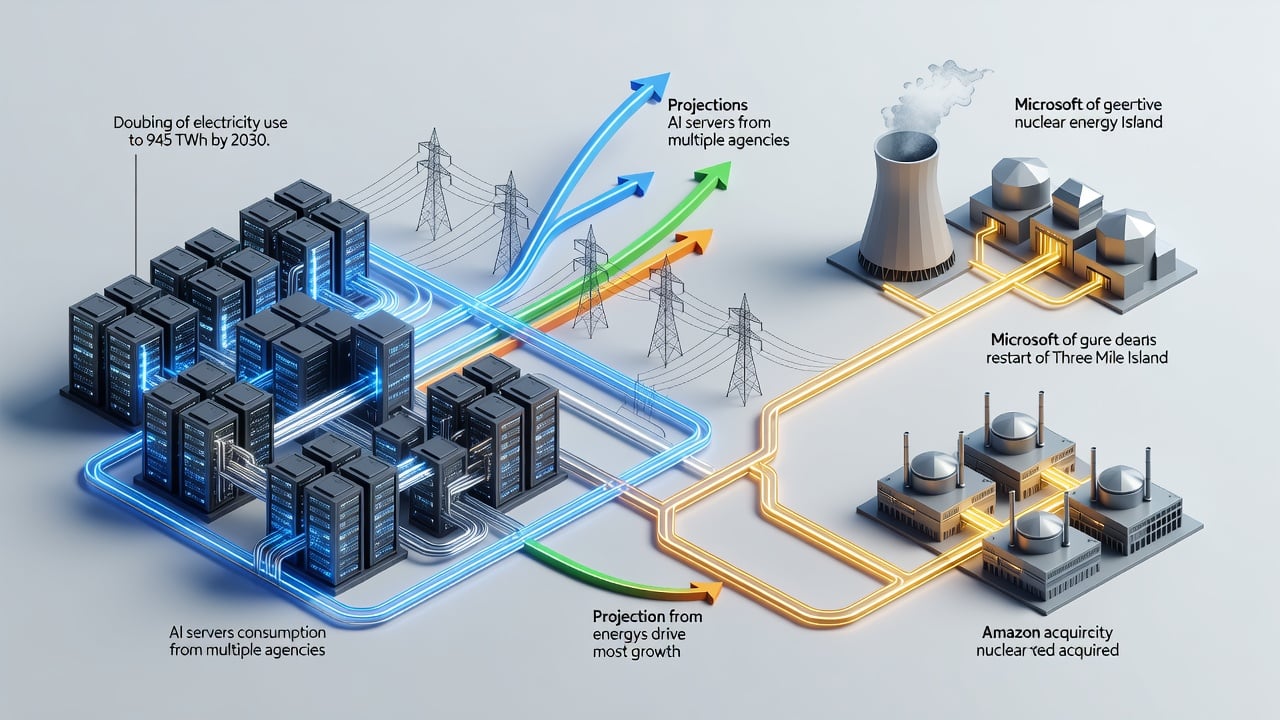
Tech executives once dismissed power as a background concern. No longer. Data centers built to train and run ever-larger artificial intelligence models now consume electricity on a scale that strains entire regions. Projections show global data center usage doubling or more by 2030. The numbers come from sober analysis, not hype.
The International Energy Agency put global data center electricity consumption at roughly 460 terawatt-hours in 2024. Its base case sees that figure climbing to 945 TWh by 2030 and 1,300 TWh by 2035. IEA Energy and AI report. Accelerated servers tied to AI account for nearly half the net increase. Conventional servers contribute far less. Growth in AI-related demand runs at 30 percent annually. The rest of the electricity economy expands at a fraction of that pace.
Inside the United States the pressure feels more immediate. Data centers already took 4.4 percent of national electricity in 2023. The Lawrence Berkeley National Laboratory sees that share reaching 6.7 to 12 percent by 2028. Absolute consumption could jump from 176 TWh to between 325 and 580 TWh. Brookings Institution analysis. Goldman Sachs Research expects power demand from data centers to rise 160 to 165 percent by 2030 compared with 2023 levels.
Gartner forecasts worldwide data center power demand will hit 132 gigawatts in 2026, up 27 percent from 2025. AI-optimized servers will represent 31 percent of that total. By 2027 their consumption should exceed conventional servers. Gartner press release. These shifts arrive as U.S. overall power use sets fresh records. The Energy Information Administration predicts consumption will climb from 4,195 billion kWh in 2025 to 4,271 billion in 2026 and 4,397 billion in 2027. Data centers and electrification drive most of the acceleration. Reuters report on EIA outlook.
But. The grid was never designed for this pace. Transmission lines fill up. New plants take years to approve and build. In parts of Virginia, Georgia and the Midwest, utilities have delayed or denied data center hookups. Hyperscalers respond by signing direct deals for power. Some buy entire adjacent power plants. Others bank on technologies that once seemed futuristic.
Nuclear stands out. It offers steady, carbon-free baseload without the intermittency of wind or solar. Tech companies have moved from talk to contracts. Microsoft reached a 20-year agreement with Constellation Energy to restart Three Mile Island Unit 1. The plant will supply electricity exclusively for Microsoft data centers. Amazon purchased a data center campus next to Talen Energy’s Susquehanna nuclear station, gaining nearly 2 GW of access. Google partners with Kairos Power on small modular reactors. Meta issued requests for proposals seeking up to 4 GW of new nuclear capacity. Utility Dive coverage of tech nuclear deals.
These moves mark a departure. For years big tech chased renewable power purchase agreements to meet carbon goals. Renewables now supply about 24 percent of data center electricity in the U.S. Natural gas still dominates at over 40 percent. Nuclear provides around 20 percent today but gains favor for its reliability. The IEA expects nuclear’s role to expand after 2030 once small modular reactors reach commercial scale. IEA energy supply for AI analysis.
Executives speak plainly. Former Google CEO Eric Schmidt told Congress that data centers will need 29 GW of additional power by 2027 and another 67 GW by 2030. Anthropic projects the U.S. AI sector alone could require 50 GW of new capacity by 2028. That equals roughly twice New York City’s peak demand. Brookings report citing executive testimony.
Challenges remain. New nuclear plants face regulatory delays, high upfront costs and public skepticism. Small modular reactors promise faster deployment and factory construction. Yet none operate at commercial scale yet in the United States. Natural gas plants fill the gap in the near term. They can be built quicker. They also lock in fossil fuel use for decades. BloombergNEF sees U.S. data center power demand more than doubling by 2035, reaching 78 GW. Average hourly electricity draw nearly triples. BloombergNEF analysis.
Water adds another constraint. Training and inference generate heat. Cooling systems consume millions of gallons daily. In drought-prone areas this creates tension with agriculture and municipal needs. Some operators explore advanced cooling or even immersion techniques. Efficiency gains help at the chip level. New generations of processors deliver more computation per watt. Still, the sheer volume of new workloads outruns those improvements.
Policy makers take notice. The White House promotes nuclear expansion, including both traditional reactors and modular designs. Bipartisan support for nuclear has grown since 2020. States compete to attract data centers with tax breaks and expedited permitting, yet they also worry about higher electricity rates for residents. In Ireland data centers already consume 21 percent of national electricity. That share could reach 32 percent by 2026. Similar debates play out across Europe and Asia.
So the industry finds itself at a crossroads. Hyperscalers invest in energy infrastructure as never before. Amazon backs X-energy to develop advanced reactors and aims for 5 GW of new nuclear by 2039. Microsoft, Google and others follow parallel paths. They act less like customers of the grid and more like energy companies themselves. Some explore microgrids, on-site generation and long-term fuel contracts.
Analysts caution against overstatement. Not every projection will materialize. Efficiency breakthroughs or slower AI adoption could temper demand. Yet the trend holds. Electricity consumption for AI servers grows faster than almost any other slice of the economy. From 2024 to 2030 data center power use expands more than four times quicker than the rest of the global electricity sector combined.
Recent updates reinforce the picture. As of mid-2026 forecasts point to U.S. data center consumption between 400 and 600 TWh by 2030 in credible scenarios. AI-specific servers accounted for 53 to 76 TWh in 2024 and could reach 165 to 326 TWh by 2028. Dev Sustainability review of multiple forecasts. Goldman Sachs notes nuclear will form part of the solution but cannot meet every need on its own. Natural gas, renewables and storage must contribute. Goldman Sachs Research on nuclear for AI.
The conversation has shifted from whether power will constrain AI to how quickly new supply can come online. Tech leaders once measured progress in model parameters and benchmark scores. They now track gigawatts secured and megawatts delivered. The next phase of artificial intelligence depends as much on electrons as on algorithms. And the race to supply those electrons has only begun.


 WebProNews is an iEntry Publication