
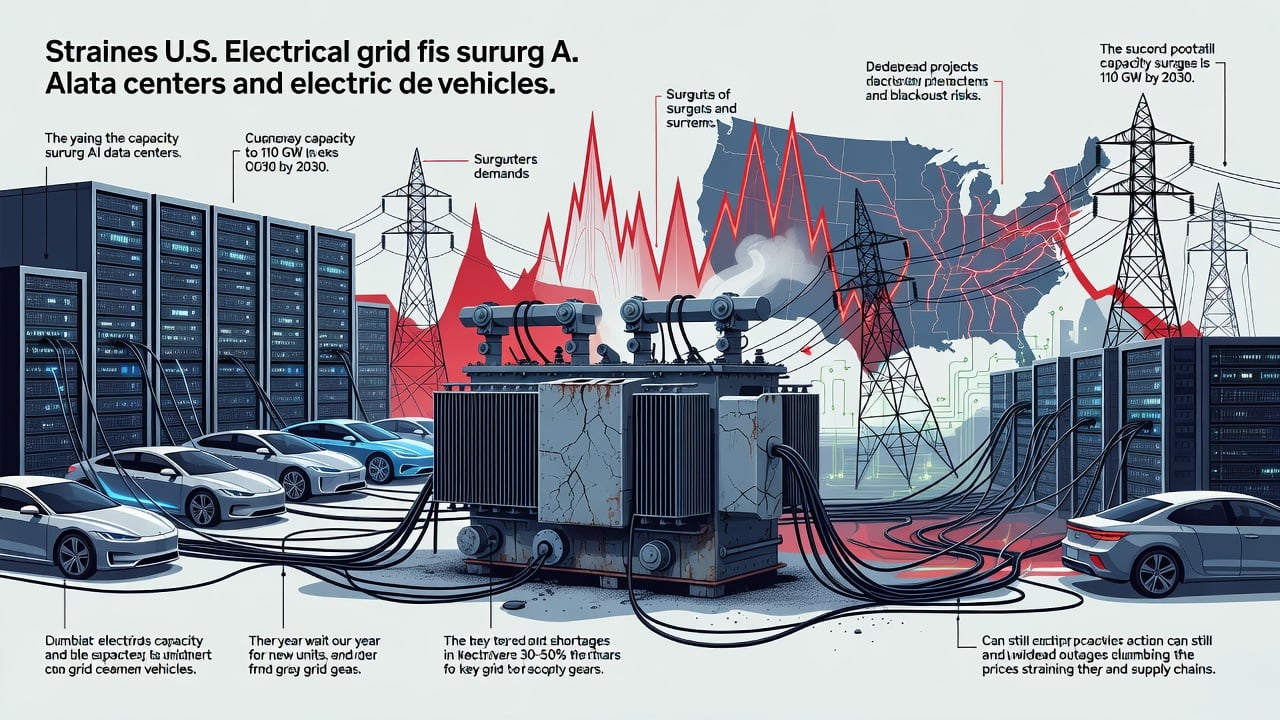
Power shortages loom. Factories sit idle. And entire regions risk going dark. The surge in artificial intelligence has unleashed demands on electricity systems not seen in decades. Data centers built to train and run advanced models now compete fiercely with electric vehicles, renewable projects and aging infrastructure replacements for the same scarce resources.
Delivery times for power transformers have ballooned. What once took six to 12 months now stretches to 24 to 48 months. Larger units above 100 megavolt-amperes and 230 kilovolts that shipped in 12 to 18 months before 2020 require more than 36 months today. Smaller units for residential and commercial use face waits of 12 to 20 months. Prices have jumped 50 to 80 percent above pre-2020 levels. These figures come straight from a detailed examination by TechRadar.
But the problem runs deeper. Grain-oriented electrical steel, essential for transformer cores, remains in tight supply. No alternative grades meet the strict efficiency standards set by regulators in the European Union and the U.S. Department of Energy. Copper prices stay elevated. Skilled labor shortages persist. Testing facilities at factories operate at capacity limits. The result? A structural mismatch that utilities and developers cannot easily fix.
Across the United States, power companies scramble to secure equipment. Skyrocketing demand from AI data centers exacerbates shortages of critical grid components like transformers. Wait times lengthen. Costs rise. Utilities and developers lock in orders years in advance. Large power transformers show the most pronounced market shortage. Data centers could claim up to 40 percent of the U.S. electrical equipment market. These details emerged in a July 9 report covered by Reuters.
U.S. data center capacity stands at around 24 gigawatts now. It could reach 110 gigawatts by 2030. That expansion means data centers will consume eight times more electricity than electric vehicles over the period, according to analysis from Wood Mackenzie cited in the same Reuters article. Generator step-up transformer lead times surpassed 160 weeks in early 2026. That compares with an average of 143 weeks in 2024. High-voltage circuit breakers climbed to 125 weeks in the second half of last year from 77 weeks in 2023.
Europe faces parallel pressures. Grids built decades ago strain under new loads. A single AI data center can draw several hundred megawatts. Enough to power a mid-sized city. Electric vehicles add charging infrastructure demands. Wind farms, solar installations and battery storage projects compete for the same transformer supply. Private developers bid against utility companies for limited factory slots. The scramble leaves new electricity connections delayed for years.
Wood Mackenzie warned of a 30 percent deficit in power transformers and a 10 percent deficit in distribution transformers expected in 2025. Demand across nearly every major category of electrical infrastructure has surged since 2019. Growth ranges from 35 percent to 274 percent depending on equipment type. Generation step-up transformers appear most stressed. High-voltage switchgear and medium-voltage circuit breakers run short too. A September 2025 report co-authored by Wood Mackenzie and American Clean Power laid out these trends. POWER Magazine summarized the findings in January 2026.
Aging infrastructure compounds the issue. Roughly 55 percent of in-service distribution transformers are more than 33 years old. They approach end of life. Replacement demand piles on top of new construction for data centers, manufacturing facilities and EV charging. Tariffs add upward pressure on both imported and domestically produced equipment. Even with nearly $1.8 billion in announced North American manufacturing expansions, deficits may ease only in some areas. The pad-mount three-phase transformer shortage is likely to worsen due to surging industrial demand.
More than half of the U.S. data centers planned for this year now face delays or cancellations. Not for lack of money or land. The specialized gear needed to step down grid power sits in critically short supply. Bloomberg’s April 1, 2026 newsletter first highlighted the scale. Energy News Beat reported on those projections recently. Raw materials such as grain-oriented electrical steel, copper and insulating fluids stay constrained. Global demand from EVs, renewables and data centers has tightened supply chains further.
Discussions on X reflect growing alarm. One recent post noted utilities remain unprepared for the demand surge. Power costs skyrocket. Grid capacity falls short. Another highlighted proposals for orbital data centers to bypass terrestrial limits. Elon Musk’s SpaceX has filed with the FCC to launch up to one million solar-powered satellites for AI compute. The concept aims to harness continuous sunlight and vacuum cooling. Yet experts remain skeptical about costs and hardware durability. These conversations, captured in real time, underscore the urgency.
Lead times for high-voltage transformers have stretched to two to four years. New high-voltage transmission lines can take over a decade to permit and build. Grid interconnection queues lengthen. In some markets more than half of planned projects sit at risk. A severe long-term shortage of high-voltage transformers threatens grid modernization efforts. One analysis put 30 to 50 percent of planned U.S. data centers for 2026 at risk. The post on X from @soicfinance pointed to a Bloomberg report detailing those figures.
So what drives this convergence? AI workloads demand exponential energy. Training a single large model can consume electricity equivalent to hundreds of households over months. Inference at scale multiplies that further. Electric vehicles, meanwhile, push charging networks into new territories. Manufacturing reshoring adds industrial loads. Renewables integration requires grid upgrades. All draw from the same finite pool of equipment and expertise.
Utilities treat early transformer procurement as a competitive lever. Engineering, procurement and construction firms redesign schedules. They reorder work sequences. Access to scarce grid components now determines which projects advance and which slide into multi-year limbo. Extended lead times and elevated costs risk becoming the new normal. Without intervention they could derail broader grid modernization.
Some companies diversify supply chains. Others explore alternatives. Yet core constraints on materials and labor limit quick fixes. Factory capacity for these heavy industrial products cannot ramp overnight. Testing bays, winding machines and specialized steel production all represent bottlenecks.
In Europe the picture mirrors the U.S. but with added regulatory layers. Efficiency standards limit material substitutions. Public opposition to new transmission lines slows progress. Data center developers in Ireland, the Netherlands and Germany report connection delays stretching into 2030. Similar stories emerge in Virginia and Texas, American hotspots for hyperscale facilities.
Nuclear power enters the conversation as one potential relief. Small modular reactors could provide dedicated power to data centers. Yet licensing and construction timelines stretch years. Natural gas plants offer faster deployment but clash with decarbonization goals. Renewables paired with storage help at the margin. They cannot address the immediate transformer crunch.
Recent coverage reinforces the trend. A July 2026 analysis described the data center power crisis as peaking now. Grid scarcity, not hardware, ranks as the top supply chain risk. Enki AI outlined strategies for securing power amid these constraints. The piece noted that while IT hardware scales in 12 to 24 months, grid upgrades involve multi-year or decadal timelines.
Financial implications grow. Higher equipment costs flow through to electricity rates. Data center operators sign power purchase agreements at premiums. Some hyperscalers explore co-location with power plants or direct connections to avoid grid queues. Others invest in behind-the-meter generation. These moves ease pressure on individual projects but do little for the broader system.
Regional risks vary. PJM Interconnection, serving 13 states and 67 million people, has warned of reliability issues. The Department of Energy holds authority to direct large data centers over 50 megawatts to switch to backup power within 15 minutes during emergencies. Rolling blackouts remain a last resort. Yet the mere discussion signals how close some systems operate to the edge.
Experts call for coordinated planning. Advance ordering, diversified suppliers and policy support for domestic manufacturing could help. Investments in transformer production announced so far total billions. They fall short of projected needs through 2030. Wood Mackenzie projects sustained capacity additions will be required before conditions ease.
The AI boom shows no signs of slowing. Model sizes increase. Adoption spreads across industries. Electricity demand follows. Electric vehicle sales continue upward. Infrastructure must catch up. Until it does, the four-year wait for transformers will dictate the pace of progress. Factories will wait. Homes and businesses may face higher prices and reliability questions. The grid, built for a different era, now bends under the weight of new technology.
Industry insiders watch closely. Decisions made today on equipment procurement, siting and energy policy will shape outcomes for years. The darkness that looms is not inevitable. But avoiding it demands action beyond business as usual. Shortages have exposed vulnerabilities long ignored. Addressing them will test utilities, tech companies, regulators and manufacturers alike.


 WebProNews is an iEntry Publication