
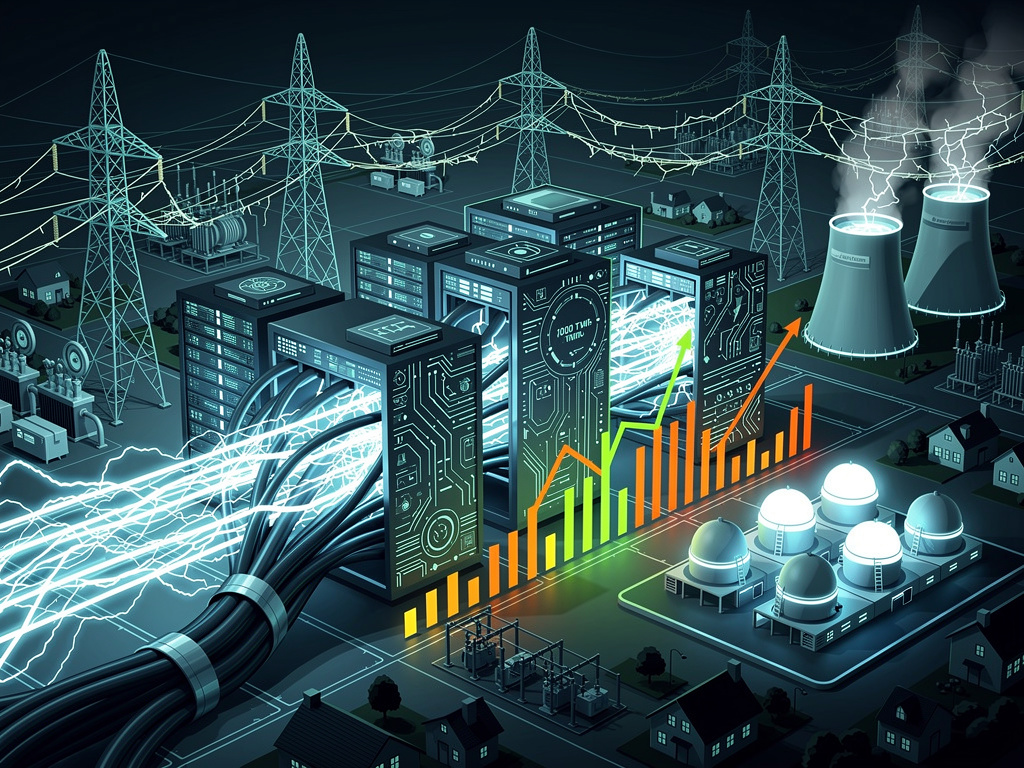
The numbers don’t lie. Global data center electricity use hit roughly 415 terawatt-hours in 2024. Projections show it doubling to around 945 TWh by 2030. That’s according to the International Energy Agency. Accelerated servers tied to AI account for nearly half the added consumption. They grow 30% annually in the base case. Conventional servers lag at 9%.
But the figures keep climbing in newer forecasts. Some estimates put data center demand near 1,050 TWh already by 2026. If treated as a single country, that would rank fifth worldwide for electricity use. Between Japan and Russia. The U.S. feels it first. American data centers consumed 4.4% of national electricity in 2023. The Lawrence Berkeley National Laboratory sees that share hitting 6.7% to 12% by 2028. Absolute consumption jumps from 176 TWh to as much as 580 TWh.
Power Shortages Meet Unrelenting Demand
Grids buckle under the load. In Texas, the Electric Reliability Council of Texas projects peak summer demand could reach 145 GW by 2031. Up from 85 GW in 2024. That’s no modest uptick. It’s a sharp acceleration after years of 1-2% annual growth. PJM Interconnection, the nation’s largest grid operator, has warned of tightening supply. Construction of new generation simply lags.
Tech giants respond with direct deals. Microsoft signed a 20-year power purchase agreement with Constellation Energy to restart the dormant Three Mile Island Unit 1 reactor. The deal, reported across outlets including Utility Dive, supplies clean, reliable baseload for its AI data centers in the mid-Atlantic. Amazon secured nearly 2 GW of nuclear capacity through Talen Energy. Google partners with Kairos Power on small modular reactors. The first unit targets completion by 2030. Meta issued requests for proposals seeking up to 4 GW of new nuclear output.
Eric Schmidt, former Google CEO, testified before Congress. Data centers will need 29 GW of extra power by 2027. Another 67 GW by 2030. Anthropic projects the U.S. AI sector alone could require 50 GW of new capacity by 2028. That’s twice New York City’s peak demand. The statements carry weight. They come from executives who built the systems now driving the surge.
Yet nuclear won’t arrive fast enough for everyone. Small modular reactors promise flexibility. They still face years of regulatory review, supply chain bottlenecks and construction timelines. Natural gas fills the gap in the short term. It supplied over 40% of U.S. data center electricity in 2024 per the IEA. Renewables contributed 24%. Nuclear 20%. Coal 15%. The mix shifts slowly. Even as companies tout sustainability goals.
Opposition grows on the ground. In Festus, Missouri, a $6 billion AI data center project approved quietly by city council triggered backlash. Voter turnout spiked 129% in the next election. Every council member who voted yes lost. A recall petition targets the mayor. A lawsuit follows. Similar resistance appears elsewhere. A recent poll found 70% of Americans oppose data centers near their homes. Now less popular than nuclear plants themselves. Local concerns center on noise, water use for cooling and added strain on infrastructure. The New York Times documented parallel tensions from Mexico to Ireland. In Ireland data centers already take more than 20% of national electricity.
Hardware improvements offer some relief. Power consumption per AI task falls rapidly. At least an order of magnitude each year in some cases. The IEA noted in its April 2026 findings that AI-focused data center electricity soared 50% in 2025. Still outpacing overall global electricity growth of 3%. Total data center consumption may double by 2030. AI-specific use could triple to 465 TWh. Efficiency gains help. They don’t offset the explosion in query volume and model scale.
Supply chain realities complicate matters. The U.S. relies heavily on Chinese-made electrical equipment. Transformers, switchgear and batteries. A Bloomberg investigation from April detailed how this dependence delays projects. One massive Abilene, Texas campus for OpenAI will draw 1.2 GW when finished. Enough for nearly one million homes. Yet equipment shortages persist.
The Reuters reported just two days ago that U.S. power consumption will set new records in 2026 and 2027. Driven largely by data centers for AI and cryptocurrency plus broader electrification. The Energy Information Administration forecasts demand rising from 4,195 billion kWh in 2025 to 4,379 billion kWh in 2027. Data centers now represent one of the most concentrated surges in electricity demand in modern history.
Wood Mackenzie sees U.S. data center capacity expanding from 24 GW to 110 GW between 2026 and 2030. The electrical equipment market tied to it swells from $20 billion to $65 billion. Data centers could claim 68% of total load growth. Six hundred GW of projects still hunt for firm power. Only 183 GW have agreements in place. The gap is real.
Goldman Sachs Research earlier projected a 160-165% rise in data center power demand by 2030 versus 2023. BloombergNEF forecasts U.S. data center demand more than doubling to 78 GW by 2035. Average hourly consumption nearly triples. These aren’t abstract models. They reflect contracts already signed and chips already shipping.
So utilities scramble. Some data center developers turn to on-site generation. Reciprocating engines running on natural gas. Not ideal for emissions targets. Others eye co-location with power plants or direct connections to new reactors. The revival of nuclear enjoys bipartisan support now. Polling from Pew Research shows increased favor for expansion in both parties since 2020.
Challenges remain. Public skepticism. Regulatory delays. The sheer volume of water needed for cooling. Grid interconnection queues stretch for years in many regions. Training one frontier model could soon demand five gigawatts. A single large data center often needs 500 MW or more. Multiply by thousands of facilities planned worldwide.
The industry adapts. Or tries to. Hyperscalers pursue every option. Restarted reactors. New modular designs. Long-term power purchase agreements. Efficiency at the chip and software level. Yet the math is unforgiving. AI adoption accelerates. Model sizes grow. Inference scales with users. Demand doesn’t pause for infrastructure to catch up.
By 2030 the U.S. alone could see data centers consuming electricity equivalent to several large states. Globally the sector may rival major national economies in energy use. Nuclear offers a path to reliable, low-carbon supply. But only if construction timelines compress and costs stabilize. Gas buys time. Renewables add volume yet struggle with intermittency for always-on computing loads.
Executives at the highest levels acknowledge the stakes. Schmidt’s testimony. Anthropic’s projections. Deals by Microsoft, Google, Amazon and Meta speak louder than words. They bet billions on energy infrastructure alongside their AI bets. The outcome will shape not just tech profits but national competitiveness, electricity prices for households and progress toward decarbonization goals.
Local communities feel the tension first. Higher rates in some regions. Construction traffic. Concerns over reliability when grids strain. The Festus example shows voters can push back hard. Similar stories emerge in Virginia, Georgia and parts of Europe. Balancing national AI ambitions against neighborhood impacts grows harder.
Hardware and software engineers race to improve performance per watt. Their gains buy breathing room. But the volume effect dominates. A ChatGPT query already uses nearly 10 times the electricity of a traditional Google search. Scale that to billions of interactions daily. Add training runs for ever-larger models. The curve bends upward sharply.
Policy makers watch closely. The Department of Energy, IEA, BloombergNEF and others publish updated analyses almost monthly. Consensus forms around massive growth. Disagreement lingers on exact numbers and the speed of supply response. One point unites them. Data centers driven by AI now represent a primary variable in electricity planning. Not a niche concern.
The coming years test whether innovation in energy can match innovation in artificial intelligence. Reactors under construction in Tennessee and Wyoming signal momentum. Deals to revive retired plants show pragmatism. Yet the pipeline of unpowered projects reveals the gap. Resolution won’t come quietly. It will reshape utility economics, reshape regulatory priorities and reshape where and how society builds computing capacity.
And the servers keep humming. Twenty-four hours a day. Training, inferring, scaling. Each watt counted. Each gigawatt fought over. The electric bill for progress has arrived.


 WebProNews is an iEntry Publication