
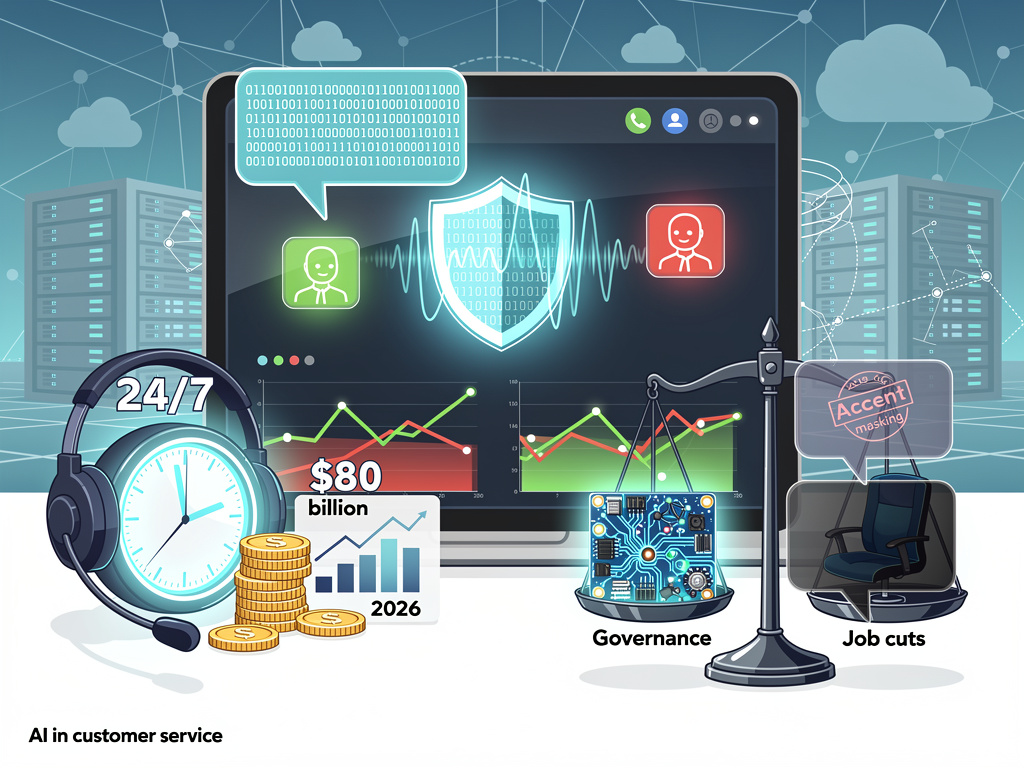
Artificial intelligence is reshaping customer service, delivering round-the-clock support and slashing costs, but ethical dilemmas and deployment hurdles temper its promise. A Bain & Company survey reveals 32% of AI projects in customer service have advanced beyond pilots, the second-highest rate among business functions, signaling strong viability for scaled operations. Yet, as companies race to automate, questions persist about handling emotional nuance and vulnerable users.
Andrew Leal, CEO of pet insurer Waggel, highlights AI chatbots’ edge: “The advantages of using AI chatbots are that you can offer customers 24/7 assistance and the speed of AI chatbots when surfacing information.” Such tools now apply sentiment analysis to nearly every interaction, boosting quality assurance from 1-3% in traditional audits to 100% coverage, according to Anshuman Singh, CEO at HGS UK.
Singh adds, “Quality assurance represents the strongest business case.” This capability flags frustration in real time, enabling proactive interventions and consistent experiences across channels.
Sentiment Tools Power Smarter Interactions
Machine learning advancements extend to voice, with accent neutralization technologies adapting agents’ speech for familiarity. Call Center Studio describes real-time accent neutralization as using advanced speech recognition to modify accents on the fly, enhancing comprehension. However, Rohan Whitehead, data training specialist at the Institute of Analytics, warns, “Accent and identity masking technologies are now moving from prediction to reality. From a data and ethics standpoint, this is highly sensitive.”
Singh echoes concerns: “Voice is integral to both personal and professional identity. Requiring employees to alter theirs – especially without genuine consent – sends a damaging message: that their natural speech is inadequate. This can erode confidence and sense of belonging.” The EU AI Act mandates disclosure of AI use, prohibiting deception in interactions.
These tools promise efficiency but risk alienating diverse workforces and customers if mishandled, underscoring the need for transparent governance.
Ethical Edges of Voice AI
Gartner’s 2025 prediction looms large: By 2029, agentic AI will autonomously resolve 80% of common issues, cutting operational costs 30%, says analyst Daniel O’Sullivan. “Agentic AI has emerged as a game-changer for customer service, paving the way for autonomous and low-effort customer experiences,” he states in a Gartner release.
Conversational AI projections amplify the shift: By 2026, it will reduce contact center labor costs by $80 billion, per multiple reports including Desk365 and Master of Code Global. Crescendo.ai notes 72% of leaders believe AI outperforms humans, with 86% of adopters achieving effortless scaling.
Retailers and banks lead adoption, using AI for claims processing and fraud detection, but Forrester’s Kate Leggett cautions 2026 demands “gritty, foundational work” like data cleanup, not flashy overhauls, as detailed in her Forrester blog.
Agentic AI’s Cost-Cutting Surge
Job impacts are stark: A BSI poll of over 850 leaders found 41% reporting headcount reductions from AI, with 39% cutting entry-level roles, as covered in their press release. Laura Bishop, BSI’s digital sector lead, urges a “socio-technical approach” balancing AI speed with human empathy for complex cases.
Paul Dongha, NatWest Group’s head of responsible AI, lists top risks: empathy failures in emotional queries, data privacy breaches, algorithmic bias, high integration costs, and eroding trust. Mitigations include escalation paths, bias audits, and privacy-by-design, per the ITPro analysis.
Regulators like the FCA enforce accountability under Consumer Duty, protecting vulnerable groups amid divides, warns BSI’s Kate Field: “There is a huge risk of widening divides by companies assuming everyone understands how to engage with AI.”
Navigating Job Shifts and Risks
Sprout Social outlines eight 2026 strategies, from AI case management predicting spikes to sentiment-categorized inboxes, as in their guide. Multimodal AI handles text, voice, images seamlessly, per Crescendo.ai’s 2026 trends, replacing fragmented omnichannel setups.
Human-AI hybrids prevail: AI as “copilot” for routines, humans for empathy, says Singh. Whitehead envisions “AI-first with a human safety net” by late 2020s. Livia Bernardini of Future Platforms predicts agent-to-agent talks, shifting to “Know Your Agent” transparency.
Simon James at Publicis Sapient adds, “Organizations that optimise for agent experience (AX) alongside traditional customer experience (CX) will capture exponentially more value.”
Hybrid Models for Resilience
Training gaps loom: 63% of firms invest in AI literacy, but Field stresses critical thinking to validate outputs. Desk365 compiles stats showing AI boosts agent inquiries by 13.8% hourly, with 80% positive customer experiences reported by Tidio.
Forrester predicts agent workloads drop one hour daily via FAQ automation, but service quality may dip without change management. 2026 demands parallel AI teams for coaching agents, per Leggett.
ROI shines: $3.50 return per $1 invested, says People Matters Global, with Lyft cutting resolution times 87% via Anthropic tie-up.
Training and ROI Realities
Viability hinges on strategic deployment: High-volume, low-complexity tasks first for quick wins. Publicis Sapient’s James notes, “The opportunities are immense and organizations that approach AI deployment strategically will capture significant competitive advantages.”
As agentic systems mature, service leaders must revise models for AI-to-AI flows, per Gartner. Desk365 stats project 95% interactions AI-handled by 2025, evolving into full autonomy.
Balanced adoption promises efficiency without erosion of trust or equity, positioning AI as enduring infrastructure rather than fleeting tool.


 WebProNews is an iEntry Publication