
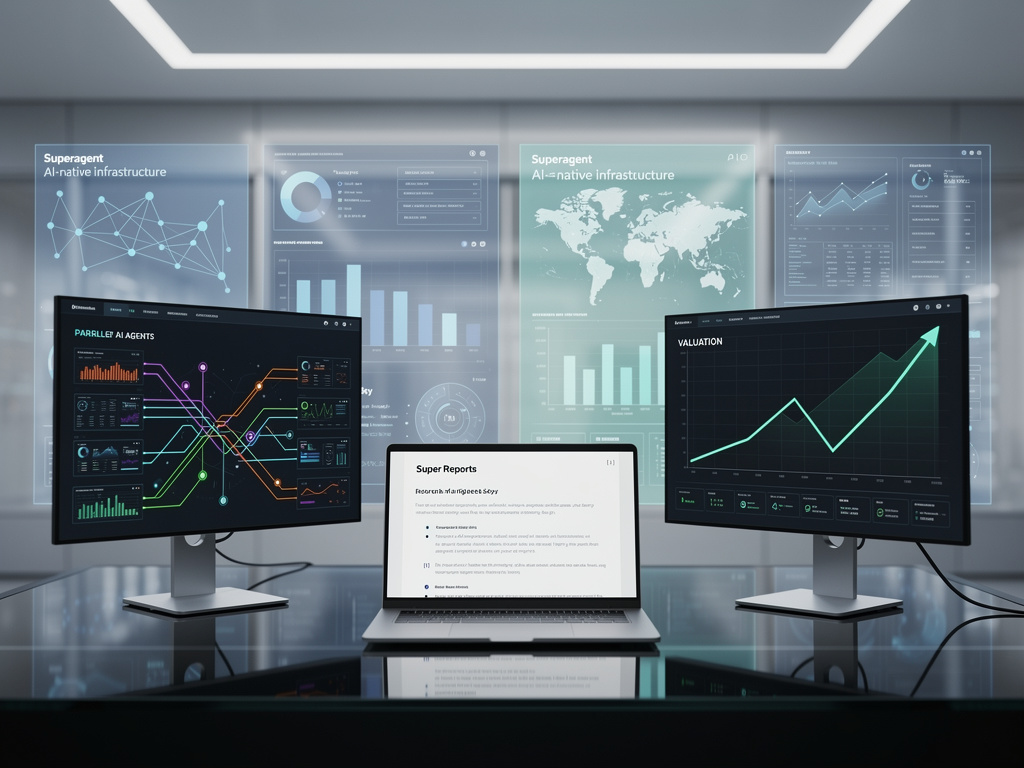
Airtable, the no-code platform powering custom apps for over 500,000 organizations including 80% of the Fortune 100, has launched Superagent, its first standalone product in 13 years. Unveiled on January 27, 2026, Superagent deploys teams of specialized AI agents to tackle complex business queries, delivering interactive reports rather than static text. The move, built on the October 2025 acquisition of DeepSky, signals Airtable’s pivot to an AI-native future amid a valuation reset from $11.7 billion in 2021 to about $4 billion on secondary markets.
CEO Howie Liu frames the launch as a bet on multi-agent coordination. “The breakthrough isn’t a smarter single agent; it’s multiple agents working together,” Liu stated in Airtable’s announcement. A central orchestrator builds a research plan, dispatches parallel agents for tasks like financial analysis or competitive review, and synthesizes outputs into “Super Reports”—interactive webpages with visualizations, citations from sources like FactSet and SEC filings, and filterable elements.
This architecture addresses limitations of single-threaded AI chatbots. Agents leverage multiple frontier models from OpenAI, Anthropic, and Google, with full execution visibility to adapt and avoid errors, as detailed in VentureBeat. “We found that the hardest part to get right was not actually the agent harness, but most of the special sauce had more to do with massaging the data semantics,” Liu told VentureBeat.
From DeepSky Roots to Standalone Powerhouse
Superagent evolved from DeepSky, formerly Gradient, which raised $40 million before Airtable’s acquisition. DeepSky’s founding team—Chris Chang, Mark Kim-Huang, and Forrest Moret—runs the product semi-independently, reporting to Liu, per Upstarts Media. The deal accelerates Airtable’s AI push, complemented by hiring David Azose, ex-OpenAI ChatGPT business lead, as CTO.
Liu envisions bidirectional benefits: Superagent agents updating Airtable bases automatically, reducing manual entry. “Existing Airtable customers will benefit from the ability to have agents pull in more research or regularly update the tables and apps they’ve built in Airtable,” Upstarts Media reported. With $700 million in cash reserves and positive free cash flow, Airtable funds this without new capital.
The product launched live at superagent.com, emphasizing “exhaustive research” for founders, finance, sales, product, and marketing. Early demos show outputs like demographic maps for market entry or investment theses on Google, complete with risk factors and earnings citations.
Parallel Agents in Action
Ask Superagent where a U.S. athleisure brand should expand in Europe, and it generates an interactive analysis: country breakdowns, visual competitive maps, filterable timelines. For Wells Fargo’s AI strategy, it covers regulatory posture, investments, and pain points. “You’re not prompting an AI. You’re orchestrating a team,” Liu said in TechCrunch.
Unlike rigid workflows, Superagent’s flexible harness allows backtracking and adaptation. Rohan Paul highlighted in his blog its shift from chat to asynchronous execution, deploying up to 20 sub-agents for Super Reports with charts and citations. X users echoed this: Kunal Kushwaha called it “the best AI tool I have seen so far this year,” praising interactive visuals over text walls.
Antonio Grasso tested geopolitics’ impact on European tech decisions, yielding structured scenarios with sources. “The result wasn’t just more text, but an interactive, verifiable deliverable,” he posted on X. Eli Schwartz analyzed LLM rankings for brand visibility, getting a consulting-grade report in 15 minutes.
Valuation Reset Fuels Bold Bets
Airtable’s valuation drop hasn’t slowed ambition. Liu recasts it as a hiring edge: “equity that’s actually much more attractively priced than the $11 billion valuation,” he told TechCrunch. The company, with 700+ employees, generates cash while serving enterprises. “Airtable will probably be larger for at least the near term than any new products that we do, including Superagent,” Liu noted, but optionality matters.
TipRanks described it as “wartime leadership” for adaptation, with reserves enabling scale against rivals like Anthropic’s Claude. Liu prioritizes adoption over margins: “We’re not trying to optimize for profit margin right now.” Pricing follows AI norms—$20/user/month entry to $200 for power users with credits—though exacts remain fluid post-launch.
X buzz shows real-world traction. SARAH marveled at agents collaborating on reports; Ben Meer used it for decision-making like job negotiations. Marina Mogilko got a 6-month growth strategy in 25 minutes. Sponsored trials offer two free months via codes like KUNAL2FREE.
Enterprise Edge and Road Ahead
Superagent complements Airtable’s structured data with unstructured intelligence. Future integrations: invoking from bases, pipeline research, insights flowing back as data. Premium sources expand soon. “The general-purpose, highly usable multi-agent system is becoming a fundamental primitive for knowledge work,” Liu said in Airtable’s newsroom.
For insiders, the play is clear: data semantics and orchestration trump model speed. As Liu told VentureBeat, “A lot of it comes down to having a really good planning and execution orchestration layer.” With DeepSky’s talent, Azose’s expertise, and cash firepower, Airtable positions Superagent as trustworthy infrastructure amid agent hype.
Early X reactions affirm utility—from market research to strategy—without hype overload. As enterprises demand verifiable AI, Superagent’s cited, visual outputs stand out. Airtable’s bet: winners build reliable multi-agent systems, not just faster models.


 WebProNews is an iEntry Publication