
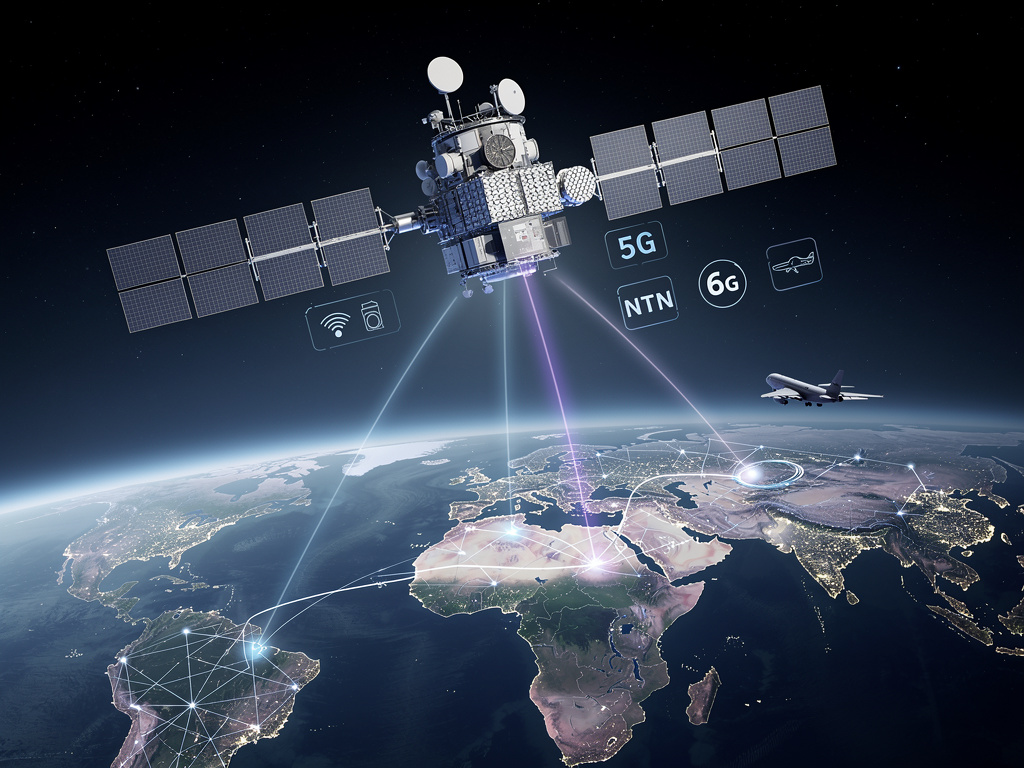
Airbus UpNext, the innovation arm of the European aerospace giant, has launched a groundbreaking demonstrator called SpaceRAN—short for Space Radio Access Network—to pioneer standardized 5G services from low-Earth orbit. Announced on January 14, 2026, the project deploys a regenerative payload that processes 5G signals directly in space, moving beyond traditional ‘bent-pipe’ satellites that merely relay data to ground stations. This onboard computing promises lower latency, higher throughput, and seamless integration with terrestrial networks, targeting applications in aviation, defense, and government sectors.
The initiative builds on a successful 5G NTN trial in February 2025 involving Airbus, Eutelsat, MediaTek, the Industrial Technology Research Institute (ITRI), and the European Space Agency (ESA), which tested connectivity over Eutelsat’s OneWeb LEO constellation—satellites built by Airbus itself. SpaceRAN advances this by introducing software-defined satellites reprogrammable from the ground, optimizing routing and reducing end-to-end delays. Initial results from the demonstrator are expected by 2028, with ground tests simulating LEO behaviors already underway.
Regenerative Tech Transforms Satellite Role
Unlike bent-pipe systems, SpaceRAN’s payload acts as a full 5G non-terrestrial base station (gNodeB) in orbit, handling beam handovers, gateway switches, and mobility management between space and earth assets. “The successful exploration of this technology will unlock advantages across various sectors. For commercial aviation, it holds the potential to boost operational efficiency and simplify interoperability, all while enabling enhanced passenger experiences. Similarly, for the military and government sectors, it aims to provide more resilient and secure communications,” said Michael Augello, CEO of Airbus UpNext, in a statement to Airbus.
The demonstrator operates on two platforms: a ground-based testbed emulating a two-satellite LEO constellation for inter-satellite routing, and an in-orbit phase launching in 2027 aboard an Airbus LEO satellite. This setup will connect aircraft directly to ground users, supporting broadband and direct-to-handheld 5G NTN capabilities. Developed under the French government’s France 2030 investment plan via the Air!5G project, it aligns with Europe’s push for 6G and cost-effective orbital data transmission.
Consortium Powers Open Standards Push
Airbus has rallied a formidable alliance including Aalyria, AccelerComm, CesiumAstro, Deutsche Telekom, Eutelsat, ITRI, Keysight Technologies, Onati, Radisys, Sener, and ST Engineering iDirect. These partners contribute specialized tools: Keysight’s PROPSIM for channel emulation and UeSim for user segment testing validate handovers; AccelerComm’s 5G PHY layer enables onboard processing within space constraints, promising up to 10x higher throughput; Aalyria’s Spacetime RIC provides real-time orchestration.
“Standardized 5G connectivity from space is a critical next step for scaling Non-Terrestrial Networks globally. The Airbus UpNext SpaceRAN demonstrator provides an important opportunity to validate how intelligent, software-driven control can optimize NTN performance in orbit,” stated Chris Taylor, CEO of Aalyria, per a BusinessWire release. Eric Taylor, Keysight’s VP of aerospace solutions, added: “Participating in the Airbus UpNext SpaceRAN demonstrator is a testament to our commitment to advancing the future of satellite-enabled 5G,” as quoted by BusinessWire.
Aviation and Defense Applications Take Flight
For commercial aviation, SpaceRAN enables high-speed in-flight connectivity without proprietary silos, allowing passengers seamless 5G access mid-flight. The in-orbit payload will link aircraft to ground networks directly, enhancing real-time operations like predictive maintenance and air traffic management. Defense users stand to gain resilient comms for situational awareness, with secure, low-latency links immune to ground disruptions.
The project counters proprietary satellite systems by championing open, 3GPP-compliant standards, fostering an interoperable ecosystem. As Airbus deploys its Arrow platform—seen in OneWeb—SpaceRAN positions Europe as a leader in sovereign NTN tech, reducing reliance on non-European providers. Ground demos already mimic LEO dynamics, including inter-satellite links critical for constellation-scale coverage.
Technical Hurdles and Path Forward
Challenges include managing Doppler shifts, power constraints, and dynamic beamforming in fast-moving LEO orbits. Partners like Keysight address these via emulation, testing mobility between terrestrial and NTN segments. AccelerComm’s flight-proven PHY ensures compliance while fitting satellite size, weight, and power limits. The 2027 orbital launch will deploy the regenerative payload, functioning as a space-based gNodeB communicating with diverse assets.
By 2028, results will inform 3GPP Release 18+ standards, paving for 6G NTN. “By actively developing and standardising 5G NTN capabilities, Airbus, together with some key 5G players, is leading the development of an open and non-proprietary standard for satellite communications,” Airbus noted in its newsroom story. Coverage extends to remote maritime, aeronautical, and underserved regions, amplifying 5G’s global reach.
Strategic Stakes in Orbital Connectivity Race
SpaceRAN arrives amid intensifying competition from Starlink, Kuiper, and AST SpaceMobile, but differentiates via standardization over closed ecosystems. France’s backing underscores geopolitical priorities for tech sovereignty. Initial coverage in Data Center Dynamics highlighted the 5G radio unit’s orbit entry, while Via Satellite detailed the consortium’s role in open standards. As tests progress, Airbus eyes commercialization, potentially slashing orbital transmission costs and unlocking new revenue in connected skies.


 WebProNews is an iEntry Publication