
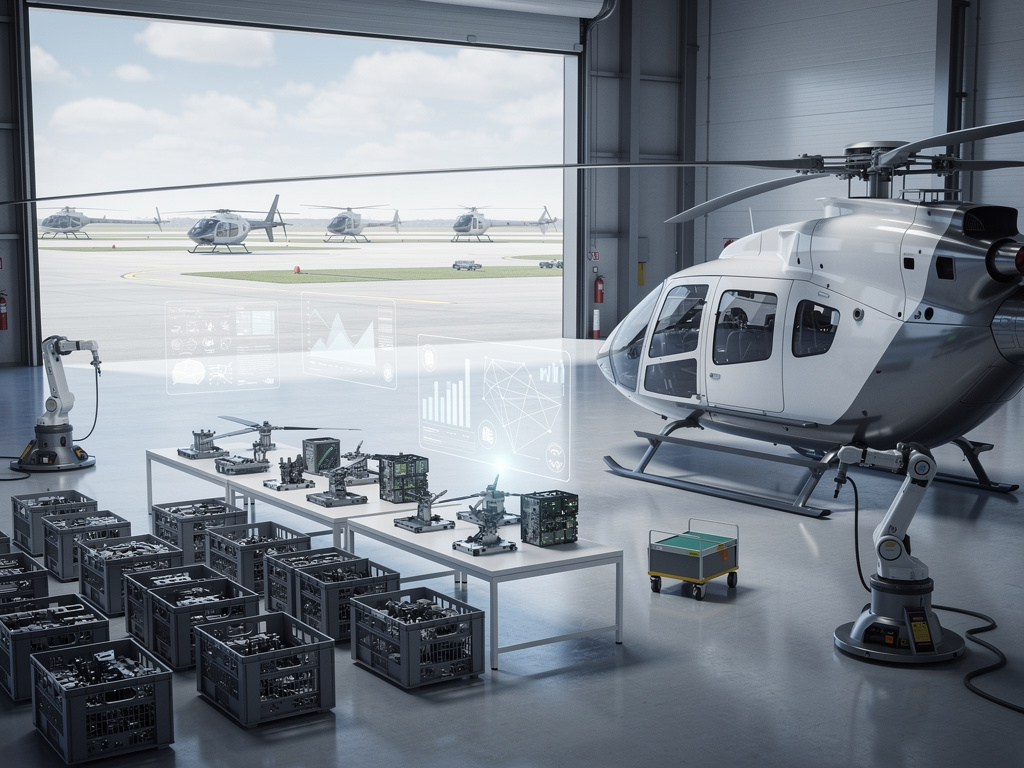
Two years into his tenure, Romain Trapp, executive vice-president of customer support and services at Airbus Helicopters, confronts a stark reality: “We are not known for offering the best service.” Appointed in September 2023 after leading the North American operations, Trapp has launched a sweeping overhaul to position Airbus as the industry leader by 2028. The effort centers on a “back to basics” strategy, prioritizing reliable parts delivery, technical documentation, and training amid persistent customer complaints about delays and complexity.
Airbus Helicopters rebounded in the latest Vertical Mag OEM Survey, climbing from prior declines driven by supply-chain disruptions. Customers cited parts shortages, unmet commitments, and convoluted interfaces as pain points. Trapp acknowledges, “We were not sticking to our commitment.” Now, support and services generate nearly 50% of revenue, up from a third a decade ago, underscoring a pivot toward sustained partnerships over one-off sales.
The shift emphasizes operational availability over raw performance, reflecting operator priorities. “Ten years ago, the number one criteria for selecting a helicopter was performance. Today… is, ‘I need the helicopter to be available when I need to fly,’” Trapp told Vertical Mag. With 23,000 employees globally and over 6,000 in support, Airbus is instilling customer-centricity through training and process redesigns.
Revamping Metrics and Forecasting
Traditional metrics tracked delivery against promises; now Airbus measures against customer needs. “One of the metrics which we have been using is our ability to deliver parts when our customer needs it, not when we say we will deliver,” Trapp explained. An AI-driven global forecasting tool replaces outdated backward-looking models, paired with updated stocking policies and better inventory balancing.
Supply-chain fortifications include in-house production for critical items, dual sourcing, and a 20-person supplier optimization team. The 2023 Phoenix reconditioned parts program has acquired over 30 used aircraft, yielding 1,500 certified parts at 30% below new prices, targeting 3,000 annually. Focus models: EC120, AS365 Dolphin, AS332/H225 Super Puma, EC135, and H135, where dynamic component delays persist despite used-parts buys.
“Our forecasting tool was too backward-thinking… We have completely overhauled it, using AI… to be more accurate,” Trapp noted. Repair turnaround times are shrinking via global investments, with 6,000+ staff enhancing capabilities.
Regional Expansions Fuel Availability
In Australia, a new Perth logistics platform supports H175 oil-and-gas fleets, scaling from zero to dozens in 18 months. North America’s Grand Prairie, Texas facility tripled its repair team and expanded workshops 50%, slashing large-component turnaround by 25% and smaller by 45%. These moves address regional demands amid rising global activity.
Customer feedback from Trapp’s worldwide visits shows progress: “We see that you have heard us. We see that you are working on the right things to improve. Now, it’s all about speed — and you are not fast enough. But [they say] ‘You are on the right path… and we are seeing more and more that you care.'” The cultural shift ranks as Trapp’s top achievement, with payoffs expected in 24 months.
HCare, Airbus’s comprehensive suite covering material management, MRO, technical support, training, and connected services, underpins these efforts. Upgrades like Air Center Helicopters’ H225 fleet extension highlight trust, as Trapp stated in a Vertical Mag release: “We are proud to support ACHI’s critical missions.”
Training Innovations Boost Readiness
Digitalization drives training proximity. Partnerships with Loft Dynamics deployed 15 VR simulators worldwide. Recent commitments include H160/H175 Level D simulators for Brazil in 2028 and an H175 FFS in Malaysia by late 2026, as Trapp affirmed: “This investment underscores our dedication to delivering world-class training solutions.” The Malaysian academy has logged 21,000 hours for 2,600 pilots.
Grand Prairie’s 2024 multi-purpose dynamic component repair bench cuts wait times. Over 1,200 helicopters connect for data-driven insights, enabling predictive maintenance. “The goal of digitalization… is to allow operators to fly more and safer,” Trapp told Vertical Mag in 2023.
Public-sector wins reinforce momentum. Airbus supports France’s Sécurité Civile and Gendarmerie’s full H145 fleet via a 10-year deal with Babcock, per Vertical Mag: “Airbus Helicopters is proud to strengthen its partnership.” Similar pacts cover GDAT’s 10 H225s and Indamer’s India MRO authorization.
Global Contracts Signal Confidence
In a Vertical MRO Podcast, Trapp discussed supporting 12,000+ helicopters, emphasizing innovation and partnerships. H135 issues show “light at the end of the tunnel” via targeted investments. Regional hubs like Texas and Perth exemplify proximity, vital as fleets grow in energy, EMS, and public services.
Trapp’s North American roots—15 years including AHI presidency—inform his approach. From pandemic resilience with no flight-hour drop in 2020 to H135 dominance in EMS, Airbus holds strong positions. Yet, “It is going to take a lot of time, because we are not where we need to be,” he admits.
Operators demand acceleration, but metrics and feedback indicate trajectory. By 2028, Airbus aims to redefine rotorcraft support through reliability and innovation.


 WebProNews is an iEntry Publication