
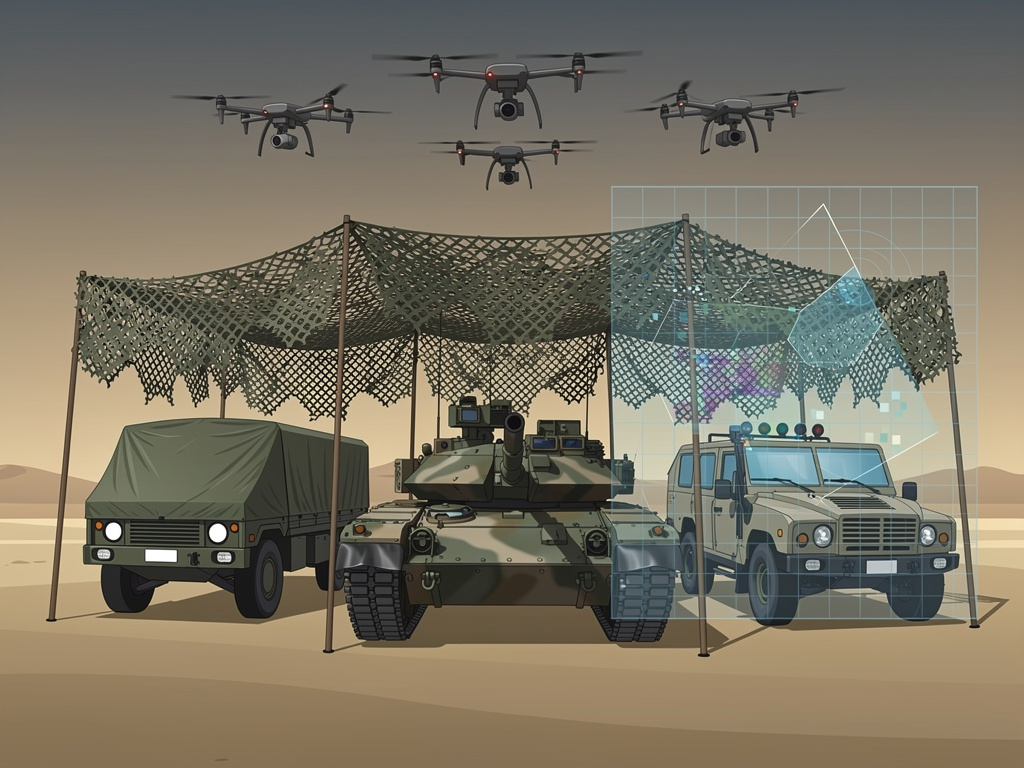
Drones see heat. They spot engines cooling after a drive, soldiers huddled in foxholes, vehicles idling under cover. The U.S. Air Force now wants nets to fight back. A pre-solicitation notice posted last week on the government’s contracting site signals plans to buy 30 large camouflage nets, each big enough to drape over a Joint Light Tactical Vehicle—the military’s Humvee successor. These aren’t ordinary tarps. They must block mid-wave and long-wave infrared signatures using nanotechnology or advanced composites, while blending into green or woodland surroundings to fool visual and other sensors too. Business Insider first detailed the move, tying it to drone threats exploding in Ukraine and recent attacks on U.S. forces in the Middle East, like the March strike in Kuwait that killed six soldiers.
Picture a JLTV at Spangdahlem Air Base in Germany, as in the accompanying photo. Nets would conceal it from overhead thermal scans. Air Force planners demand lightweight designs—easy to carry, quick to deploy. Reversible patterns for different terrains. The clock ticks toward a full contract. Why now? Drones changed everything. Cheap, everywhere, armed with infrared cameras, they’ve turned battlefields transparent. Ukraine’s war shows it daily: thermal spots mean strikes follow seconds later.
But. The Air Force isn’t alone. The Army committed $480 million over a decade for similar ultralight nets from Fibrotex, awarded back in 2018 after testing against night vision and thermal devices. “Today more than ever, military forces and opposition groups are using night vision sensors and thermal devices against our troops, but by using Fibrotex’s camouflage, concealment and deception solutions, we make them undetectable again,” said Eyal Malleron, then-CEO of Fibrotex USA, in a Fox Business interview. Holes in the weave disperse heat. Patterns break outlines. Multispectral magic.
Marines push harder on personal gear. Their Multispectral Camouflage Overgarment aims to cloak individual fighters across visual, near-infrared, short-wave infrared, mid-wave infrared, and long-wave infrared bands. A March sources-sought notice called for 13,000 by 2027, scaling to 61,000 by 2030. “MCO will serve as the individual signature management solution for all Marines in training and on deployment,” the notice stated, per Military Times. Nets for vehicles, cloaks for troops. Layered defense.
Industry races ahead. Alaska Structures offers Alaska TRACS, a thermal-radar-aerial concealment system for ULCANS specs, tested against FLIR SkyRanger drones with LWIR imagers. Saab’s Mobile Camouflage System adapts to background radiation via convection, reflection, even insulation—beating mid- and long-wave cameras. BCB International rigs FLIR cameras from short- to long-wave to vet their fire-resistant nets, hiding heat in any environment, as detailed by Teledyne FLIR. Market analysts see multispectral nets hitting $262 million by 2033, fueled by army, navy, air force demand across 3D and 2D types. Market Report Analytics.
Even the Pentagon urges basics against small drones: nets, walls, fishing line, camouflage for infrastructure. Low-tech stops recon and strikes, per January guidance in Forbes. Army snipers now train in drone camouflage, masking human movement under nets phased out years ago but revived for the aerial threat, reports Sandboxx. Natick Labs burns uniforms, freezes gear to -72°F, simulates high altitude—brewing anti-drone camo amid pizza MREs that stay crisp.
Challenges remain. Nets tangle. Weight matters in rapid ops. Enemies adapt—Chinese ‘invisibility cloaks’ already headline. Pakistan flaunts radar-evading tents welded from IR-blocking PVC. Ukraine weaves civilian nets amid shortages. X chatter echoes it: one user notes thermal drones from hundreds of feet spot everything at night; another pushes donations for front-line concealment.
So the Air Force steps up. Thirty nets first. Then more. In Europe’s tense skies, where bases like Spangdahlem host F-16s amid Russia worries, hiding heat buys time. Time to maneuver. Time to strike back. Drones hunt signatures. These nets erase them.


 WebProNews is an iEntry Publication