
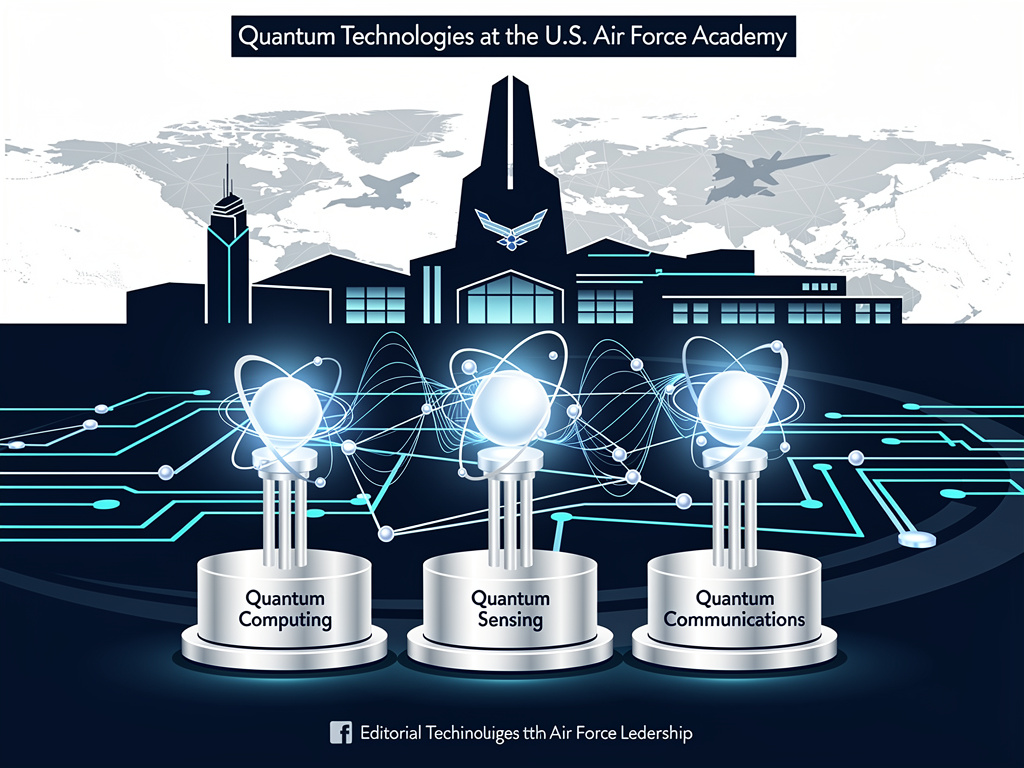
In the high-stakes race for technological supremacy, the U.S. Air Force Academy has launched a Quantum Technologies minor, positioning future officers at the vanguard of quantum information science. Announced amid intensifying great-power competition, the program integrates physics, computer science, and engineering to train cadets in quantum computing, sensing, networking, and timing—fields poised to redefine military operations from secure communications to precision navigation.
The interdisciplinary curriculum, open to cadets from any major, demands foundational physics with labs, introductory quantum courses, computer science-based quantum computing classes, and a customizable track linking quantum principles to cyber, engineering, or strategy. Hands-on work at the Laser and Optics Research Center includes aligning optical tracks for laser power maximization and handling radioactive samples in the Atom Trap Trace Analysis system, as detailed in a January 2026 U.S. Air Force Academy release.
“Quantum technologies will make significant impacts in timing, sensors, communication and computers in the very near future,” said Dr. Monte Anderson, assistant professor of physics and co-developer of the minor. “We want to teach fundamentals in a way that’s accessible to students so we can train quantum leaders for the Air Force and Space Force.”
Hands-On Forging of Quantum Leaders
Cadets like 1st Class Gracelynn Olinger, a physics major, are already reaping benefits. “Being able to harness quantum technologies like faster computing and secure communications will give us a leg up against our adversaries,” Olinger said. “Understanding even the basics helps future officers make better decisions in an increasingly technical battlespace.” Fellow physics major Cadet 1st Class Emma Williams added, “This program challenged me to develop critical thinking and decision-making skills that directly translate to leadership.”
Cadet 2nd Class Jacob Grayson emphasized the program’s rigor: “The difficulty is part of what makes this program so rewarding. It pushes you to build resilience, find mentorship and gain hands-on experience with cutting-edge technology.” These experiences extend to national labs and operational units, preparing graduates to lead research, development, and acquisition in quantum domains critical to Air Force and Space Force missions.
The minor aligns with broader Department of Defense imperatives, where quantum edges in cryptography, sensing, and computing are seen as vital for national security. A 2024 GAO report highlighted DOD labs’ quantum workforce gaps, underscoring programs like USAFA’s role in building proficiency.
Strategic Edge in Quantum Arms Race
Dr. Anderson noted quantum mechanics’ counterintuitive nature: “Quantum mechanics is counterintuitive and requires deliberate effort to develop intuition. By introducing rigorous quantum concepts earlier, cadets are able to engage in meaningful research across science, engineering and strategic disciplines.” This approach ensures officers can evaluate emerging systems, from aircraft sensors to spacecraft networks, without years of specialized physics training.
The Academy’s push dovetails with Air Force Research Laboratory efforts, including a 2023 broad agency announcement seeking quantum advancements for command, control, communications, computers, and intelligence, per The Quantum Insider. Recent contracts, like Qunnect’s October 2025 deal for quantum networking over fiber optics, signal accelerating integration, as reported by Breaking Defense.
Capt. Scott Alsid and Dr. Anderson co-authored “Foundations of Quantum Technology,” a text supporting the curriculum, celebrated in a January 2025 LinkedIn post by USAFA’s Physics and Meteorology Department. This complements facilities like the Madera Cyber Innovation Center, where quantum minors pair with cyber studies for multi-domain operations.
Broader Military Quantum Momentum
Beyond USAFA, DOD initiatives proliferate. DARPA’s Quantum Benchmarking Initiative identified fault-tolerant quantum computer developers in April 2025, per the National Quantum Coordination Office. The Army designated ARL as a Quantum Information Science Research Center in 2023, focusing on sensors and clocks, according to an Army article.
USAFA’s program positions graduates as the first quantum-proficient officers, meeting mandates for a skilled workforce amid China’s advances. The Academy’s January 26, 2026, X post from @af_academy highlighted: “The Quantum Technologies minor at #USAFA equips cadets from any major to lead in emerging quantum fields.”
As quantum threats like ‘harvest now, decrypt later’ loom, initiatives like Qrypt’s 2024 Air Force grant for quantum-secure encryption underscore urgency, detailed by The Quantum Insider. USAFA cadets, through this minor, are primed to operationalize these breakthroughs.
Interdisciplinary Bridges to Battlefields
The minor’s flexibility—tailored tracks in cyber applications or strategic impact—ensures relevance across services. It supports Air Force needs for informed decisions on quantum-enhanced systems, from secure networks to advanced timing, as cadets engage in lab research mimicking operational challenges.
In a January 2026 photo album from the Quantum Technologies Lab, cadets manipulate optical devices, visualizing the pathway from classroom to deployment. This practical foundation, combined with national efforts like DARPA’s QuANET for quantum-classical interoperability per Nextgov, equips officers for hybrid environments.
USAFA’s 2025 review affirmed its trajectory as America’s premier military academy, with quantum education as a cornerstone amid new curricula like data science, per official news. Graduates will lead multidisciplinary teams, sustaining U.S. dominance in quantum warfare.


 WebProNews is an iEntry Publication