
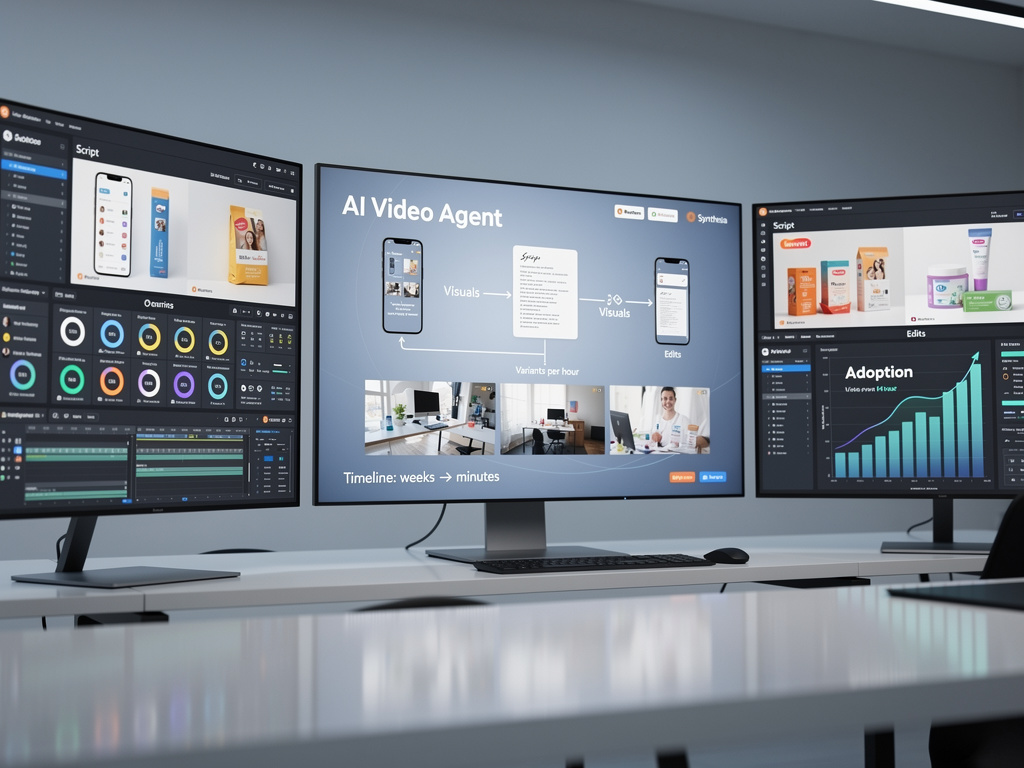
In the high-stakes arena of product marketing, where first impressions can make or break campaigns, a new breed of AI video agents is compressing weeks of production into mere minutes. These autonomous systems ingest product details, generate scripts, assemble footage, and output polished videos ready for social media blitzes. At the forefront is a tool highlighted by World Business Outlook, which promises to transform ideas into viral content instantaneously, slashing costs and accelerating time-to-market for brands worldwide.
Traditional video production demands teams of editors, animators, and directors, often costing thousands per minute of footage. AI agents disrupt this model by leveraging generative models like Google’s Veo and OpenAI’s Sora to create hyper-realistic scenes from text prompts. Posts on X reveal marketers deploying these agents to produce dozens of variants in hours, testing hooks and visuals at scale. For instance, one campaign generated 87 videos and 390 images in 60 minutes using a single platform, as shared by users like Hasan Toor.
The Mechanics of Instant Creation
These agents operate through multi-step pipelines: natural language processing parses product specs and target audience data, followed by script generation via large language models. Visual synthesis engines then render B-roll, avatars, and product integrations. Voice synthesis adds narration in multiple languages, while auto-editing ensures pacing aligns with platform algorithms. Entrepreneur notes that this flood of content has shifted competition from production volume to capturing fleeting attention spans.
Reuters is pushing boundaries with agentic AI in its newsroom, hiring its first AI TV producer to automate video workflows, according to Digiday. The system handles sourcing, editing, and packaging, freeing humans for oversight. In marketing, similar agents from startups like Visla enable teams to collaborate on storyboards and subtitles in real time, as detailed on their platform site.
Enterprise Adoption Accelerates
By early 2026, brands are scaling these tools for personalized campaigns. A post on X from Julian Goldie SEO describes replacing an entire marketing team with one agent that auto-generates ideas using ChatGPT, crafts scenes via Veo 3 and FAL API, and deploys 24/7 lead-gen videos. Lifeinside.io reports AI agents enabling real-time engagement, where videos adapt to viewer interactions mid-stream.
Financial Times covers Synthesia’s pivot from dubbing to broad AI video tools, appealing across industries with wide-angle generation capabilities. This evolution addresses early limitations like unnatural motion, now mitigated by diffusion models trained on vast datasets. Marketers report 10x faster iteration, with A/B testing across TikTok, Instagram, and YouTube yielding higher engagement rates.
Challenges in the Pixel Rush
Yet, authenticity concerns loom large. Entrepreneur warns that oversaturation risks viewer fatigue, urging brands to infuse human creativity into AI outputs. Quality control remains critical; early agents struggled with physics-accurate interactions, but 2026 advancements like Higgsfield’s Product-to-Video—allowing actors to manipulate real products in virtual environments—bridge the gap, as buzzed on X.
Regulatory scrutiny intensifies as deepfakes blur lines. Platforms demand disclosure labels, and FTC guidelines evolve for AI-generated ads. Despite this, ROI metrics shine: one X account detailed a launch campaign producing 157 videos, 390 images, and 50 ad sets via VERV AI in one hour, dwarfing manual efforts.
Monetization and Scale Strategies
Toolmakers are monetizing via tiered subscriptions, with enterprise plans offering custom training data. Visla.us emphasizes business-grade features like asset libraries and review workflows. Advids.co analyzes 30 real-world AI marketing videos, showcasing transformations in campaigns for tech and consumer goods.
Performance Marketing World tracks video ad trends, noting AI’s role in challenging low-CPM myths through precision targeting. X sentiment echoes this, with creators like el.cine hailing free product commercials via Higgsfield as a game-changer for indie brands.
Future Trajectories
Looking to mid-2026, multimodal agents integrating AR/VR promise immersive product demos. Reuters’ experiments foreshadow news-to-marketing crossovers, where agentic workflows standardize. Digiday highlights speed gains, with videos produced in fractions of prior times.
Brands must adapt strategies, per Entrepreneur: prioritize narrative depth over volume. X innovators like Francisco Cordoba demo agents scraping comments for psychology-driven concepts, thumbnails, and hooks—fully closing the feedback loop.


 WebProNews is an iEntry Publication