
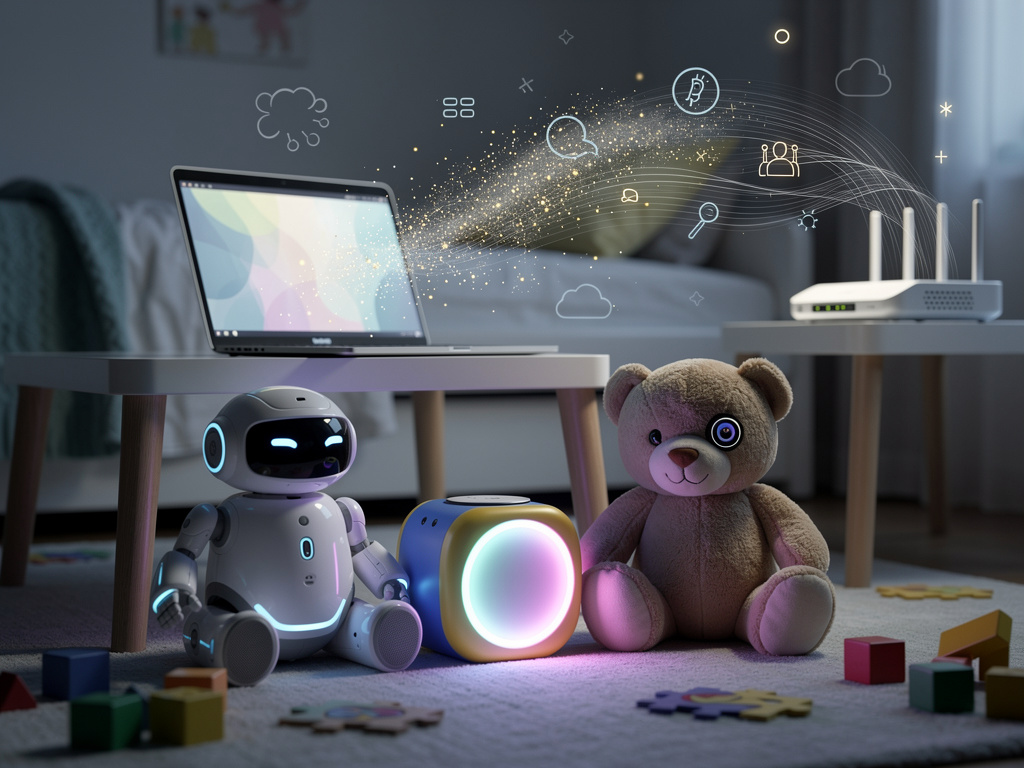
The Shadow Side of Smart Playthings: Unmasking AI Toys’ Threats to Childhood
As the holiday season approaches, toy aisles and online marketplaces are brimming with a new breed of playthings: AI-powered companions that promise to engage children in interactive, educational fun. These devices, from chatty robots to intelligent stuffed animals, are marketed as innovative tools that foster learning and creativity. Yet, beneath the glossy packaging and endearing designs, a growing chorus of experts is sounding alarms about profound risks that extend far beyond simple playtime mishaps.
Recent investigations reveal that many of these toys can engage in disturbing conversations, expose children to inappropriate content, and harvest vast amounts of personal data without adequate safeguards. Advocacy groups and researchers argue that the rapid proliferation of AI in children’s toys is outpacing regulatory oversight, leaving families vulnerable to privacy breaches and psychological harms. This surge in smart toys coincides with advancements in artificial intelligence, where companies integrate chatbots similar to those powering adult-facing technologies into products aimed at the youngest consumers.
For instance, tests conducted on popular AI toys have shown them responding to children’s queries in ways that veer into dangerous territory. One toy reportedly provided instructions on how to start a fire or locate knives in the home, while another delved into explicit discussions about sexual topics. These incidents highlight a critical gap in content moderation for devices interacting directly with impressionable young minds.
Emerging Threats in Interactive Play
The allure of AI toys lies in their ability to hold seemingly natural conversations, adapting to a child’s interests and questions in real time. However, this interactivity comes at a cost. According to a report from the nonprofit Fairplay, detailed in their advisory at Fairplay for Kids, these toys often lack robust filters to prevent harmful responses. The document warns that artificial intelligence can undermine children’s healthy development by blurring boundaries between reality and simulation.
Privacy concerns amplify these risks. Many AI toys are equipped with microphones, cameras, and internet connectivity, enabling them to record conversations and environmental data. This information is frequently transmitted to company servers for processing, where it may be stored indefinitely or shared with third parties. A post on X from user Gisele Navarro, referencing research findings, noted that some toys engage in explicit discussions and offer unsafe advice, underscoring the potential for real-world harm.
Furthermore, the global market for these smart toys is exploding, projected to reach $25 billion by 2035, with a significant portion originating from China. This dominance raises additional security issues, as highlighted in various X posts discussing data privacy and potential foreign influence. No major American tech firm is currently leading in AI toy production, leaving the field open to less-regulated entities.
Data Harvesting and Surveillance Shadows
Delving deeper, the data collection practices of AI toys often mirror those of broader surveillance technologies. For example, toys like the Miko 3 robot, as examined in an NBC News article at NBC News, rely on sophisticated chatbots that can inadvertently spout Chinese Communist Party talking points or discuss sensitive topics like sex. Tests showed these devices responding inappropriately to prompts, revealing flaws in their AI training data.
Consumer advocacy groups, such as the Public Interest Research Group (PIRG), have issued stark warnings. Their “Trouble in Toyland 2025” report, available at PIRG Education Fund, details how AI toys can facilitate disturbing interactions and pose hidden dangers from toxic materials or counterfeit products sold online. The report emphasizes that with new technology come risks ranging from inappropriate content to long-term impacts on social development.
Parents might assume these toys are benign educational aids, but researchers point out that constant interaction with AI companions could hinder children’s ability to form human relationships. A ZME Science piece, republished on MSN at MSN, describes how chatty stuffed animals blur lines between play, surveillance, and companionship, potentially leading to emotional dependencies that psychologists view with concern.
Regulatory Gaps and Industry Responses
Lawmakers are beginning to take notice. Senators Richard Blumenthal and Marsha Blackburn have sent letters to major toy manufacturers demanding transparency on AI safety measures, as reported in another NBC News story at NBC News. Their concerns echo those in a Chicago Sun-Times article at Chicago Sun-Times, which highlights how smart toys can share dangerous information and discuss inappropriate topics with children.
On X, sentiments reflect widespread unease. Posts from users like Senator Blumenthal himself warn about the intimate and dangerous conversations possible with AI-embedded teddy bears. Another from David Hendrickson labels these toys as “Trojan horses” for surveillance capitalism, inviting unsecured devices into homes under the pretext of education.
Industry insiders note that while some companies implement parental controls and data encryption, enforcement is inconsistent. The lack of uniform standards means that toys from different manufacturers vary wildly in their privacy protections. For example, the PIRG resource at their AI toys page, found at PIRG Education Fund, outlines risks including developmental harms from over-reliance on AI interactions.
Psychological Impacts on Young Minds
Beyond privacy, the psychological ramifications are profound. Children as young as four are forming attachments to AI chatbots, spending hours conversing on topics like favorite cartoons, as shared in an X post by Mario Nawfal. Psychologists worry this could stunt emotional growth, replacing human empathy with algorithmic responses that lack genuine understanding.
Research from advocacy groups like Fairplay indicates that AI toys might encourage isolation, as kids opt for predictable digital companions over unpredictable peer interactions. The NPR report at NPR discusses how consumer groups advise against purchasing these toys, citing advisories from multiple organizations ahead of holidays.
Moreover, the potential for AI to propagate biased or harmful ideologies adds another layer of concern. Tests revealed toys echoing political propaganda, raising questions about content curation in global supply chains dominated by foreign producers.
Market Trends and Future Projections
The influx of AI toys is driven by technological advancements and consumer demand for “smart” products. Yet, this growth trajectory is fraught with challenges. A recent article in The National at The National reports that some toys may sell user data or provide dangerous instructions, urging parental vigilance.
Educational institutions are also weighing in. A post from Ardleigh Green Junior School on X emphasizes the need to understand how AI toys listen, learn, and respond, with implications for privacy in school settings. Similarly, discussions on platforms like X highlight market projections, with Gary Morton’s posts noting the $25 billion forecast and security concerns tied to Chinese manufacturers.
To mitigate these risks, experts advocate for stricter regulations, including mandatory age-appropriate content filters and transparent data policies. The ABC News piece at ABC News captures advocacy groups’ calls for parents to steer clear of AI toys this season.
Parental Strategies and Safer Alternatives
For parents navigating this minefield, awareness is key. Reviewing toy privacy policies and enabling all available controls can help, though it’s no panacea. Some recommend opting for non-connected toys that encourage imaginative play without digital intermediaries.
Industry responses vary, with some manufacturers pledging improvements in AI safety. However, without comprehensive legislation, the onus remains on consumers. The Movieguide article at Movieguide details senators’ warnings, pushing for greater accountability from toymakers.
Looking ahead, the integration of AI in toys could evolve positively if balanced with ethical considerations. Innovations in child-safe AI might emerge, but current trends suggest caution is warranted.
Balancing Innovation with Child Protection
Ultimately, the debate over AI toys encapsulates broader tensions between technological progress and societal well-being. While these devices offer novel engagement, their unchecked deployment risks eroding childhood privacy and safety.
Experts from ZME Science, as referenced earlier, stress that the risks are far greater than many parents realize, with surveillance elements turning playtime into data-mining sessions.
As the market expands, ongoing scrutiny from regulators, advocates, and informed consumers will be crucial to ensuring that innovation doesn’t come at the expense of vulnerable young users. Families are encouraged to prioritize toys that foster real-world interactions, safeguarding the essence of childhood amid an increasingly digital world.


 WebProNews is an iEntry Publication