
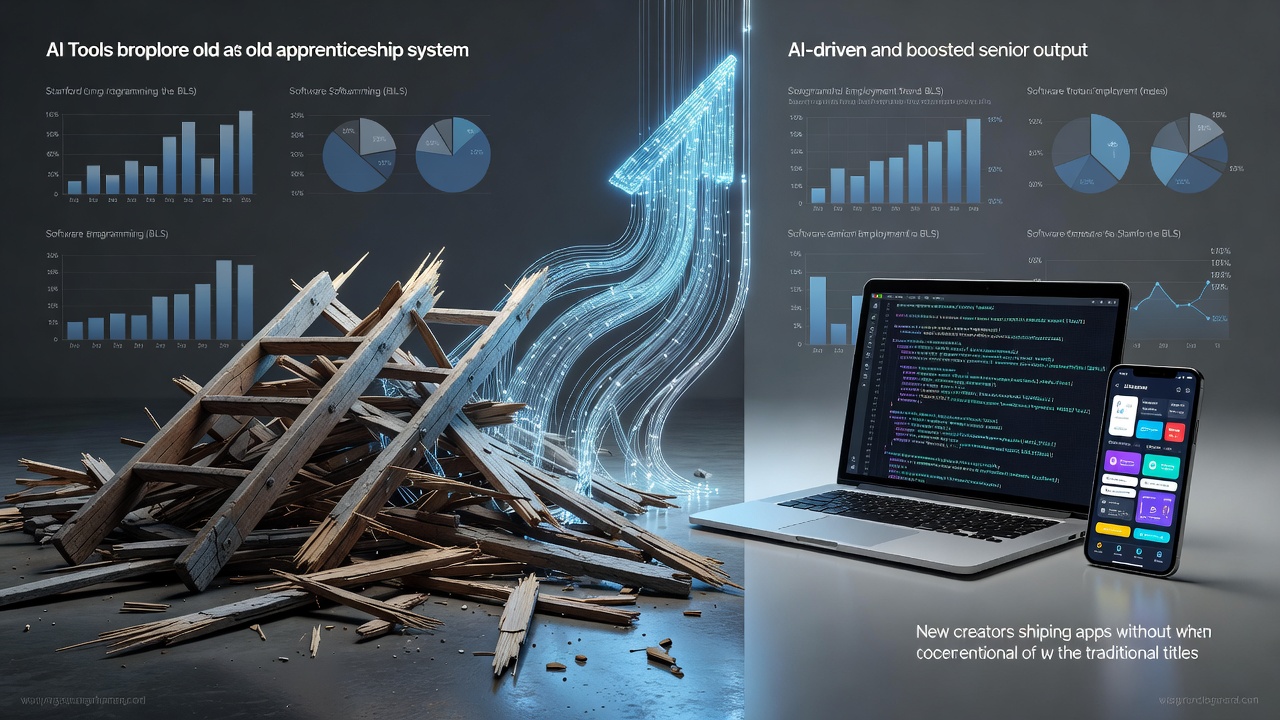
Software engineering hiring patterns shifted sharply after generative AI tools reached widespread adoption. Entry-level positions in programming contracted markedly. Experienced developers saw their output multiply. The change hit hardest among those just starting out.
Data from Stanford’s Digital Economy Lab tells the story in stark terms. Employment for software developers aged 22 to 25 dropped nearly 20 percent from its late-2022 peak by July 2025. Older cohorts grew. Workers aged 41 to 49 rose 14 percent over the same stretch. The pattern held even after researchers controlled for company-specific shocks and interest-rate effects. Young workers in occupations exposed to AI automation saw a 16 percent relative employment decline compared with those in less exposed roles.
Seldo.com laid out the numbers last week. The collapse did not arrive with ChatGPT’s debut. It accelerated in 2024 and 2025 as coding assistants evolved from autocomplete to agents that could finish entire tickets. Entry-level software job postings fell 28 percent from 2022 highs. Computer science graduates now face a 6.1 percent unemployment rate. That figure exceeds the rate for liberal arts majors. A reversal from only a few years earlier.
Yet aggregate software developer employment rose. The U.S. Bureau of Labor Statistics recorded an increase from 1.53 million in May 2022 to 1.69 million in May 2025. Total computer and mathematical occupations grew faster than the overall economy. The apparent contradiction dissolves when age bands receive proper weight. Juniors represent roughly 8 percent of the developer workforce. Their losses barely register in headline figures. Seniors kept expanding. So the averages looked stable.
But look closer at job titles. The BLS category for “computer programmers” — people who write code to someone else’s specification — plunged 16 percent in a single year. Web developers dropped 11 percent. Quality assurance testers fell 6.5 percent. Data scientists, systems analysts and the broader software developer category posted gains. AI ate the jobs that produced code on command. It spared, even boosted, the roles that decide what code should exist.
A recent Understanding AI analysis reached similar conclusions in August 2025. Young workers fell behind in AI-exposed fields. The evidence aligned with claims that generative tools undercut demand for early-career programmers. Nicholas Bergson-Shilcock, CEO of the Recurse Center, described the hiring market for engineers as the worst since 2011 starting in late 2022. Companies hired fewer people because each could accomplish more with AI assistance.
Surveys reinforce the trend. A 2024 poll of hiring managers found 70 percent believe AI can handle intern duties. Fifty-seven percent trust the technology’s output more than that of recent graduates. Entry-level tech hiring across 15 major firms declined 25 percent year-over-year in 2024, according to SignalFire. Internships in technology fell 30 percent since 2023. Overall internships dropped 11 percent across industries.
Stack Overflow Blog reported in December 2025 that AI tool usage among developers reached 84 percent. The figure climbed 14 percentage points from the previous year. Students leaned on the same systems. Ninety-seven percent of surveyed high school and college students used AI for education. Two-thirds applied it to studying. The result? Many miss the struggle of wrestling with problems on their own. Critical thinking skills atrophy. Foundational debugging instincts weaken.
One head of data and AI put it bluntly. “Being good isn’t good enough.” The sentiment echoes across tech teams. A senior engineer once reviewed reams of junior code. That repetition built judgment. Now AI generates the first draft. Fewer juniors means fewer opportunities to absorb hard-won expertise. The apprenticeship model that fed the senior pipeline for decades broke.
Yet new builders flooded in under different banners. GitHub recorded its fastest growth ever in the latest Octoverse report. Thirty-six million new accounts joined. One hundred twenty-one million fresh repositories appeared. Eighty percent of newcomers tried Copilot in their first week. These arrivals did not list “programmer” on their business cards. Many were marketers, analysts, founders and teachers. They solved their own problems with AI assistance. They shipped software without traditional credentials.
App Store submissions offer concrete proof. New iOS apps declined for eight straight years after 2016. Submissions grew 24 percent in 2025. They surged another 80 percent year-over-year in the first quarter of 2026. Apple’s review queues stretched from days to weeks. The new apps clustered in productivity, utilities and lifestyle categories. Exactly the sort of personal tools non-professional developers would create. Platforms such as Vercel and Lovable report that 60 percent or more of their “vibe coding” users come from outside traditional developer ranks. Replit claims 50 million users have touched its tools.
The long tail of software creation arrived. It simply refused the old label. A marketing manager who builds her own analytics dashboard counts as a developer in practice. Labor statistics record her as a marketing manager. The credentialed junior programmer market collapsed. The activity of writing software boomed.
That boom carries risks. A Veracode study found 45 percent of AI-generated code fails basic security tests. Audits of AI-assisted apps uncovered critical vulnerabilities in 10 percent of cases. Review capacity lags production. The judgment layer that once formed through years of guided practice does not scale automatically with output.
Some companies see opportunity. IBM began tripling its entry-level hiring. The firm redesigned those roles around customer interaction, specification writing and AI orchestration rather than rote coding. Other organizations froze junior hiring entirely. Salesforce added zero engineers in its last fiscal year. Two futures compete. One rebuilds the on-ramp with new expectations. The other gambles that seniors plus AI can carry the load indefinitely.
Recent signals hint at correction. Indeed job postings data bottomed in May 2025. They rose for 13 consecutive months afterward, up 10 percent year-over-year. If the Stanford age-employment line turns upward in coming releases, the market may have found balance. But the data remains early.
IEEE Spectrum explored the shift in June 2026. Programmer employment fell 27.5 percent between 2023 and 2025 while software developers, a category that emphasizes design, dropped only 0.3 percent. Hugo Malan of Kelly Services observed that programmers suffer most because their work is solitary and structured. “AI is not going to take your job,” he said. “The person who uses AI is going to take your job.”
Roles evolve toward higher-order thinking. Collaboration. Systems judgment. Architecture. Employers now list familiarity with tools like GitHub Copilot, Cursor and Claude in more than 60,000 job descriptions analyzed by Draup. Expectations for early-career candidates rose fastest. Routine tasks that once trained juniors vanished first. New hires must demonstrate productivity with AI from day one.
AWS CEO Adam Selipsky called replacing young employees with AI “one of the dumbest things I’ve ever heard.” The remark, reported by Fortune six days ago, underscores a business reality. Juniors cost less. They learn on the job. Removing them to save money today risks senior shortages tomorrow. Anthropic CEO Dario Amodei warned AI could eliminate half of entry-level white-collar positions. His own head of economics has seen no material unemployment difference yet between heavy AI users and others.
Nvidia CEO Jensen Huang rejected the replacement narrative outright. With agentic AI, his engineers stay busier than ever. TechCrunch noted in June that engineers now comprise a larger share of new hires at many firms despite the layoff headlines.
The industry faces a choice. Rebuild the ladder with apprenticeships that emphasize review, security, architecture and AI orchestration. Or accept a thinner pipeline of senior talent years from now. Some organizations experiment with structured mentorship programs that pair juniors with AI tools under close supervision. Others push universities to integrate AI fluency and hands-on debugging into curricula.
Programming did not die. It stopped being a gated job title and became a broadly distributed capability. Typists once held specialized roles. Then everyone learned to type. A similar diffusion happened here. The transition benefits the economy. It punishes those caught at the exact moment the old path burned. They deserve a new one. Without it the boom in software creation could sour into a bust of unmaintainable, insecure systems.
Recent discussions on X echo the tension. One post noted that AI lets a single engineer accomplish what once required months of junior labor. Another highlighted payroll data showing weak June job growth. Economists pointed to AI absorbing entry-level knowledge work including junior coding. The conversation continues. Data accumulates. Companies adjust. The next few quarters will reveal whether the scorched junior market regrows or remains barren.


 WebProNews is an iEntry Publication