
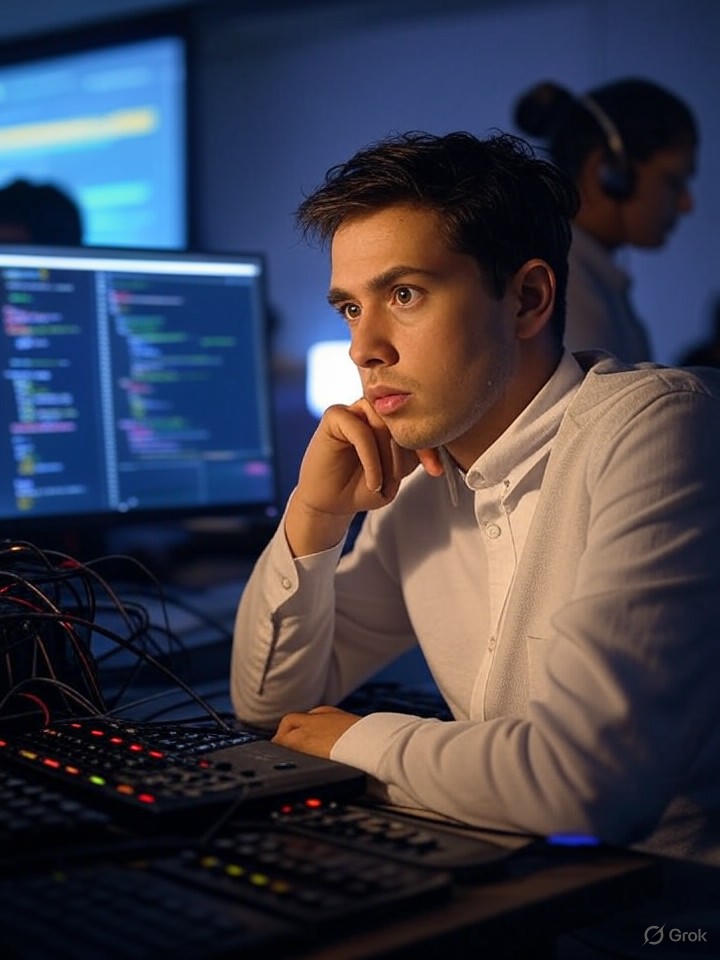
In the heart of San Francisco’s Duboce Triangle neighborhood, a nondescript coworking space recently transformed into a battleground for one of the tech industry’s most intriguing experiments. Over a single weekend, more than 100 coders descended upon the venue, shedding their shoes at the door as per house rules, to participate in the “Man vs. Machine” hackathon. Organized by the AI nonprofit METR and co-hosted by Luma, the event aimed to rigorously test a pressing question: Does artificial intelligence truly accelerate and enhance human coding capabilities, or is it merely hype?
Participants were randomly divided into two categories—purely human teams and those augmented with AI tools like coding agents. The stakes were high, with a $12,500 cash prize on the line, judged on criteria including creativity, functionality, completeness, and polish. As reported in a detailed account by Wired, several coders opted out upon being assigned to the human-only side, underscoring a growing reliance on AI in development workflows.
The Setup and Stakes of Human-AI Collaboration
The hackathon drew inspiration from METR’s recent evaluations paper, which scrutinized the real-world efficacy of AI coding agents. Teams had just hours to build functional projects, with AI-supported groups leveraging tools to generate code snippets, debug errors, and iterate designs rapidly. Human teams, conversely, relied solely on manual coding, collaboration, and traditional problem-solving. Organizers noted a palpable energy in the room, with caffeine-fueled coders huddled over laptops amid a sea of discarded footwear.
Insights from posts on X, including those from tech influencers, highlighted the event’s buzz, with one user describing it as a “showdown that could redefine developer productivity.” The competition wasn’t just about speed; it probed deeper implications for the software engineering field, where AI integration is increasingly seen as a competitive edge.
Outcomes and Surprising Revelations
When the dust settled, the results were telling. An AI-supported team clinched the top prize, as noted in updates from Stacker News, which echoed Wired’s coverage of the event. Their project, a sophisticated app blending creativity and technical finesse, outperformed human-only entries in completeness and innovation. However, not all metrics favored machines—some human teams excelled in originality, suggesting AI’s strengths lie more in efficiency than in groundbreaking ideas.
Judges, including industry experts, evaluated submissions blind to team composition, ensuring fairness. This methodology revealed that while AI boosted output volume, it sometimes led to generic solutions lacking the nuanced touch of human intuition. As one participant shared in a post on X, “AI helps you build faster, but humans still own the spark.”
Broader Implications for Tech Innovation
The hackathon’s findings align with ongoing debates in the AI community. A related event previewed on Luma’s site emphasized testing AI’s “real-world impact,” a theme echoed here. For industry insiders, this underscores a shift: AI isn’t replacing coders but augmenting them, potentially reshaping hiring practices and skill requirements in Silicon Valley firms.
Yet challenges persist. Concerns about over-reliance on AI surfaced, with some teams reporting tool-induced errors that required human fixes. Drawing from Medial’s summary, the event highlighted ethical questions, such as ensuring AI doesn’t homogenize creativity in tech development.
Looking Ahead in AI-Driven Development
As San Francisco continues to host such experiments—building on past AI-focused hackathons like those covered by Mission Local in 2023—the “Man vs. Machine” model could become a benchmark for evaluating emerging models. Recent X posts from figures like those at Cognition Labs tease even larger prizes and judges, signaling escalating interest. For tech leaders, the takeaway is clear: embracing AI collaboration isn’t optional; it’s the new standard, but only when paired with human oversight.
This event, fresh off its September 2025 run, may well influence how companies like OpenAI and Google refine their tools, pushing for agents that complement rather than compete with human ingenuity. As the lines between man and machine blur, the real winners are those who master the synergy.


 WebProNews is an iEntry Publication