
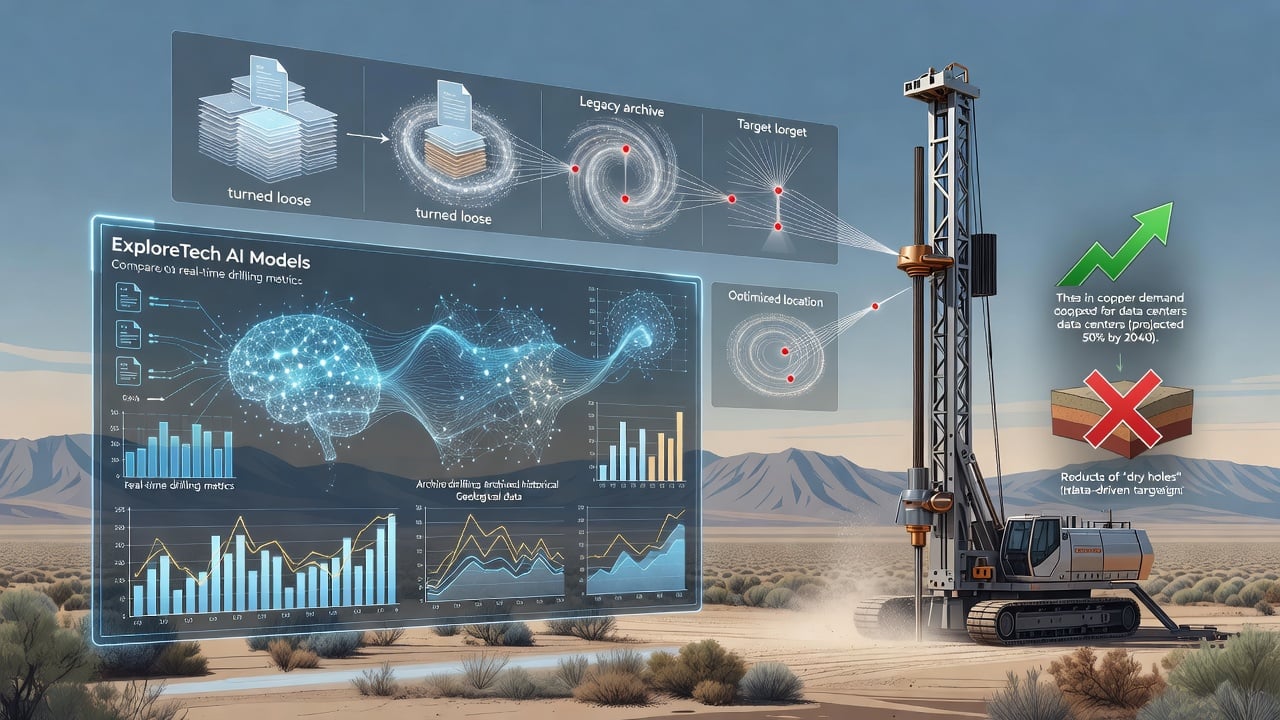
Copper One Resources has started drilling the first diamond core hole shaped by artificial intelligence at its Majuba Hill project in Pershing County, Nevada. The target sits roughly 2,500 feet down. Partners chose it after feeding historical drilling logs, geophysical readings and surface maps into ExploreTech’s platform.
Copper Demand Collides With Exploration Reality
Data centers, power lines and electric vehicles chew through the red metal at rates few predicted even five years ago. S&P Global forecasts copper demand climbing from 28 million metric tons in 2025 to 42 million by 2040. Yet major discoveries remain scarce. Between 2019 and 2023 the industry recorded only four new deposits totaling about 4.2 million metric tons of contained copper, according to recent market analysis.
But. Traditional methods waste holes. Geologists guess. Budgets shrink. So junior explorers now hand their data stacks to algorithms that generate thousands of virtual subsurface models in hours instead of months. Copper One’s 10,000-foot 2026 campaign at Majuba Hill tests whether those models actually hit.
The property spreads across 9,684 acres. It lies 113 road kilometers southwest of Winnemucca and 251 kilometers northeast of Reno. Past work intersected copper, silver and gold. The new hole follows up on those hits while probing fresh AI-flagged zones. Success here would sharpen the company’s geological model. Failure would still feed the algorithm fresh data. Either outcome sharpens the next round.
David Greenway, president and CEO of Copper One, put the stakes plainly. “As artificial intelligence accelerates the buildout of data centres, electrification infrastructure and next-generation power systems, the need for secure domestic copper supply continues to grow. At Majuba Hill, we are applying advanced AI-driven exploration tools to help refine targeting, improve geological confidence and guide a disciplined drill programme focused on expanding known mineralisation.” (Mining Technology, June 29, 2026)
His words echo across the sector. KoBold Metals, backed by billionaires and backed by $3 billion in valuation, used machine learning to identify what may be the largest copper deposit found in Zambia in the last decade. The company broke ground there in April 2026. Its success has Silicon Valley money pouring into geoscience startups. (Berkeleyside, June 23, 2026)
BHP meanwhile claims its own AI models helped uncover a 1.3 billion tonne copper-gold deposit near Olympic Dam. The mining giant now treats artificial intelligence as core exploration technology rather than experimental side project. (Enki AI, recent analysis)
Smaller players move faster. Mineural joined BHP’s Xplor accelerator in 2026 to advance its IRIS system, which blends geoscience-aware AI with copper-specific datasets. The Canadian firm received $500,000 in non-dilutive funding and direct collaboration with BHP technical teams. Early results suggest the tools reduce dry holes and environmental footprint alike.
Yet the hype meets hard geology. No one promises instant resources. Copper One cautions that further drilling, studies and analysis must come before any maiden resource estimate. Regulators require proof. Markets demand delivery. Algorithms still need ground truth.
Researchers tracking the field count hundreds of papers on AI applications from data mining to grade estimation. A 2024 review in Earth-Science Reviews laid out ten distinct tasks where machine learning now contributes, from anomaly detection to resource tonnage modeling. Success rates vary. Data quality matters most. Garbage in, misleading targets out. (ScienceDirect)
At Majuba Hill the technical team spent weeks on site readiness, contractor alignment and target review before the rig turned. They cross-checked ExploreTech outputs against legacy models. The first hole serves as proof of concept. Later holes will test step-out potential and continuity. Information from this campaign loops straight back into the AI system. Iterative. Ruthless. Faster than old-school iteration.
Broader forces amplify every meter drilled. The U.S. designated copper a critical mineral in late 2025. Domestic supply suddenly carries strategic weight. Power grids strain under AI loads. One hyperscale data center can require as much copper as a small city. Substitution options shrink inside dense server halls where thermal performance and space trump cost.
Supply gaps loom. Existing projects cover only part of projected needs. By 2035 analysts see a 30 percent shortfall for copper even before full AI acceleration. Lithium faces worse at 40 percent. Explorers who cut discovery time gain advantage. Those who don’t risk funding drought.
Copper One’s move fits a pattern. Juniors with legacy databases now partner with AI shops instead of pure geologists. The databases themselves become assets worth more than the ground. Historical assays, downhole geophysics, alteration maps—all fuel the models. Majuba’s archive apparently proved rich enough to interest ExploreTech.
Watch the assays. If the hole intersects meaningful widths and grades, share prices will jump. If it misses but the data refines the model, insiders will still call it progress. Markets rarely reward incremental learning. They reward intercepts.
Other efforts advance in parallel. The Department of Energy backed an AI tool that identified America’s largest known rare-earth deposit in unconventional rock at Wyoming’s Brook Mine. The same platform now scans for copper. NETL’s prospectivity models combine multisource data to flag targets systematically rather than by intuition. (U.S. Department of Energy, June 2025)
Academic work keeps pace. A 2026 systematic review examined 349 papers on deep learning for multisource geoscience data between 2018 and 2025. Convolutional neural nets, random forests and gradient boosting dominate. Porphyry copper models often integrate ASTER satellite alteration maps with magnetic and gravity data. Results improve when training data matches deposit style.
Still, skeptics abound. Some deposits resist prediction. Others fool the algorithms with similar geophysical signatures but no metal. False positives waste capital. False negatives bury opportunities. The technology reduces risk. It does not eliminate it.
Copper One holds no illusion of overnight success. Its release stresses the need for more holes, more studies, more time. The AI hole marks a beginning, not an ending. Yet the timing feels urgent. Data centers rise faster than mines. Power demand outruns permitting. Nations scramble for domestic sources while China controls processing.
So the drill spins. Sensors gather data. Models update. Somewhere beneath the Nevada hills either copper waits or the next lesson does. Either feeds the hunger for more secure supply in an age that runs on electrons and ambition.
The industry has begun to treat artificial intelligence as standard equipment, like diamond bits or downhole cameras. Early adopters gain edge. Laggards watch their ground get smarter without them. Majuba Hill tests one small piece of that shift. Its results will echo far beyond Pershing County.


 WebProNews is an iEntry Publication