
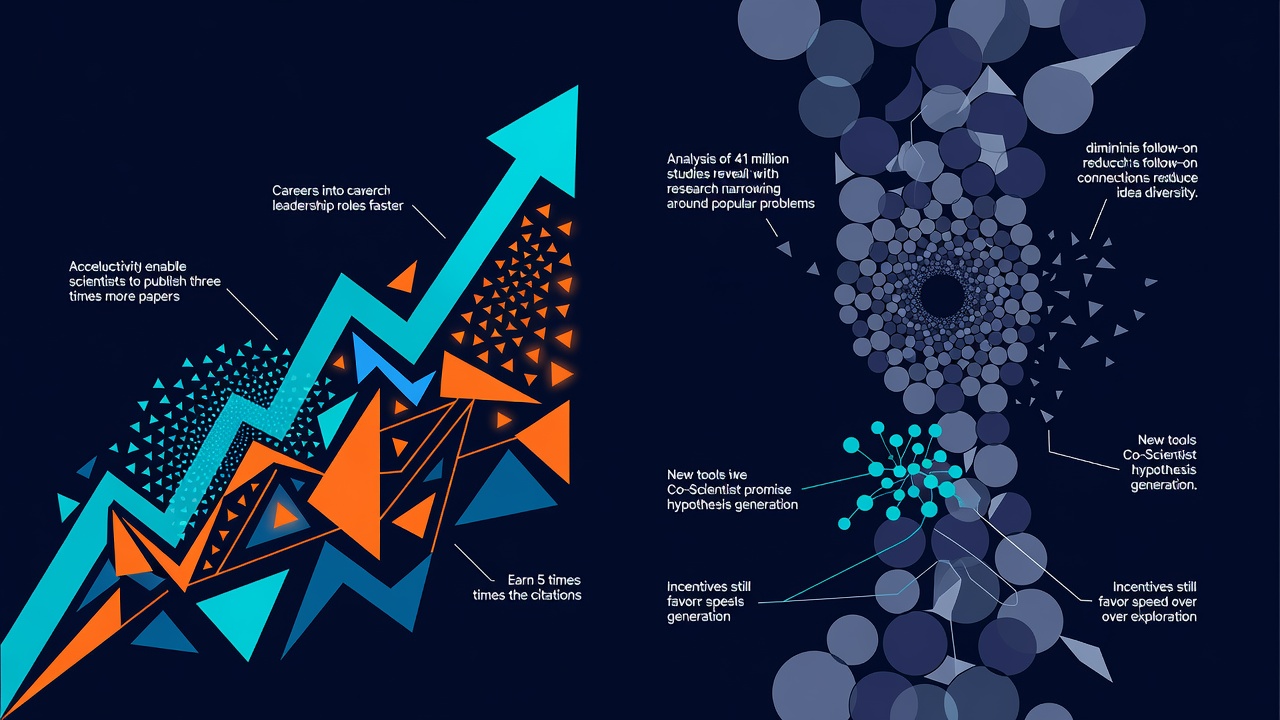
Scientists who turn to artificial intelligence tools race ahead in their careers. They publish at triple the rate of their peers. Their work draws nearly five times the citations. Many land leadership positions years earlier than colleagues who stick to traditional methods.
Yet the collective enterprise of science pays a price. Research clusters around familiar, data-rich questions. The span of ideas explored contracts. Follow-on studies connect less often and less deeply. The result looks less like a broad frontier advancing and more like many groups converging on the same well-trodden ground.
The Productivity Paradox
James Evans saw this tension coming. The University of Chicago sociologist has spent years mapping how ideas spread through the literature. His latest study, published in Nature in January 2026, examined 41.3 million papers published from 1980 to 2025 across biology, chemistry, physics, medicine, materials science and geology. Roughly 311,000 of those papers showed clear signs of AI assistance through neural networks, large language models or related techniques.
The patterns stood out immediately. AI adopters generate far more output. Their papers sit in a tighter cluster when mapped in a high-dimensional knowledge space. They spark fewer bridges to distant subfields. “You have this conflict between individual incentives and science as a whole,” Evans told IEEE Spectrum.
Luís Nunes Amaral, a physicist at Northwestern University, put it more bluntly. “This is very problematic.” He has watched the flood of AI-generated papers strain journals and conferences. Many submissions arrive low in quality or outright fraudulent, produced at industrial scale. “We’ve become so obsessed with the number of papers that scientists publish that we are not thinking about what it is that we are researching,” Amaral said in the same IEEE Spectrum report.
The narrowing shows up across waves of technology. Early machine learning, deep learning, and now generative systems all intensify the effect. Models trained on abundant data naturally optimize around problems that already have lots of examples. Protein structure prediction. Image classification. Pattern extraction from large datasets. These tasks yield quick, publishable wins. Messier questions in data-scarce domains receive less attention.
Catherine Shea, a social psychologist at Carnegie Mellon University, calls the paper “really scary” when considering second- and third-order effects. Certain questions simply suit AI tools better. Academics respond to incentives. Papers equal currency. The loop reinforces itself. Researchers gravitate toward tractable problems that algorithms can process efficiently.
But recent months have brought counterexamples that complicate the picture. In early 2026 Google DeepMind and Google researchers released Co-Scientist, a multi-agent system built on Gemini. It generates hypotheses, proposes experiments, and iterates through a tournament-style evolution process.
The system identified new drug-repurposing candidates for acute myeloid leukemia. It suggested targets for liver fibrosis. It even hypothesized how certain phage-inducible chromosomal islands interact with diverse phage tails to expand host range, a proposal that matched unpublished experimental findings from independent researchers. “These real-world validations demonstrate the potential of Co-Scientist to accelerate scientific discovery and usher in an era of AI-empowered scientists,” the team wrote in their Nature paper.
OpenAI has shown similar early signals. Mathematician Ernest Ryu used GPT-5 to help prove that Nesterov’s accelerated gradient method always converges, a result in optimization theory that had resisted clean resolution. The process took 12 hours of back-and-forth. “ChatGPT astonished me with the weird things it would try,” Ryu recalled in Science News. He has since joined OpenAI.
Physicist Alex Lupsasca turned to the same model and uncovered new symmetries in black hole physics. Kevin Weil, who leads OpenAI for Science, described the moment as part of “early days” but predicted rapid progress. “Fast forward three, six months, and it’s going to be meaningful,” he told Science News in February 2026.
Insilico Medicine used AI to pinpoint a protein involved in idiopathic pulmonary fibrosis and design the drug rentosertib, which entered phase 2a trials. The work appeared in Nature Medicine in June 2025. Microsoft screened millions of candidates to identify better battery materials and environmentally friendly coolants.
These cases show AI moving beyond pattern matching. Yet Sebastian Musslick, a computational neuroscientist at Osnabrück University, cautions that genuine breakthroughs remain rare. A year earlier he would have dismissed much of the talk as hype. “Now, there are actually real discoveries,” he said in the same Science News article.
Gary Marcus, the cognitive scientist and frequent AI skeptic, remains unconvinced that fundamental change has arrived. “A meaningful change in how we do science is not really happening yet. I think a lot of it is just marketing.” His view echoes concerns that many outputs stay inside well-defined data boxes without the conceptual leaps that reshaped fields in the past.
Jennifer Listgarten, a computer scientist, points to a deeper bottleneck. “In order to probe the limits of current scientific knowledge we need data that we don’t already have.” AI systems trained on existing literature cannot generate the novel experimental results required for true validation. Mengdi Wang at Princeton adds that physical lab work remains essential. Predictive power, she notes, does not equal deep understanding.
So the tension persists. Individual scientists gain speed and visibility. Fields risk greater homogeneity. Bowen Zhou and colleagues at the Shanghai Artificial Intelligence Laboratory argued in a recent paper that AI applications in science often remain fragmented. Data tools, computation, and hypothesis generators operate in silos. When integrated, they can broaden discovery. Zhou previously served as chief scientist of the IBM Watson Group.
Evans agrees the architecture itself is not the villain. “It’s not about the architecture per se. It’s about the incentives.” He describes himself as “an AI optimist” and hopes his findings serve as a provocation. The real value of these systems may lie in tackling questions scientists have not asked before. “In some sense, we haven’t fundamentally invested in the real value proposition of AI for science, which is asking what it might allow us to do that we haven’t done before.”
Google’s Gemini for Science announcement in mid-2026 introduced experimental tools aimed at exactly that. Built around Co-Scientist for hypothesis generation, AlphaEvolve for model discovery, empirical research assistance, and NotebookLM for synthesis, the collection targets core steps of the scientific method. Pushmeet Kohli and colleagues positioned the effort as expanding the scale and precision of exploration.
Whether these tools shift the balance remains an open question. X discussions throughout 2026 reflect the divide. One recent thread asked if an LLM given every paper before 1905 could have invented general relativity. The consensus leaned no. Induction from data and deduction from axioms differ from the conceptual jump that creates new frames. LLMs excel at hill-climbing within existing knowledge. The leap that reorganizes a field still appears to require human insight.
Autonomous labs and AI agents continue to advance in biology, materials, and climate modeling. Conferences such as Stanford HAI’s AI+Science: Accelerating Discovery in May 2026 and UCLA’s AI for Science Kickoff brought together Nobel laureates, Fields medalists, and industry leaders to wrestle with these exact issues. Google.org launched a $30 million Impact Challenge focused on AI for health and climate resilience.
The data from Evans’s team suggests caution. Speed without diversity produces more papers, not necessarily more knowledge. Yet the latest systems hint at a different path if deployed thoughtfully. Scientists could use AI to venture into sparse data regions, generate unconventional hypotheses, and test ideas that once seemed too risky or too vague.
The choice sits with incentives, funding priorities, and how the next generation of researchers frames their questions. Optimize for career metrics alone and the flattening will continue. Redirect the tools toward unexplored territory and the horizon might expand once more. The technology itself stands ready. The question is whether the institutions and individuals wielding it choose breadth alongside the obvious gains in depth and pace.
Recent coverage reinforces the stakes. A June 2026 post on Failfast.ai noted that by mid-year generative AI had begun proposing hypotheses and designing experiments at scale. LinkedIn conversations in July 2026 described 2026 as the year AI in science mirrors 2025’s impact on software engineering. Optimism runs high in those circles. The empirical record from 41 million papers urges careful steering.


 WebProNews is an iEntry Publication