
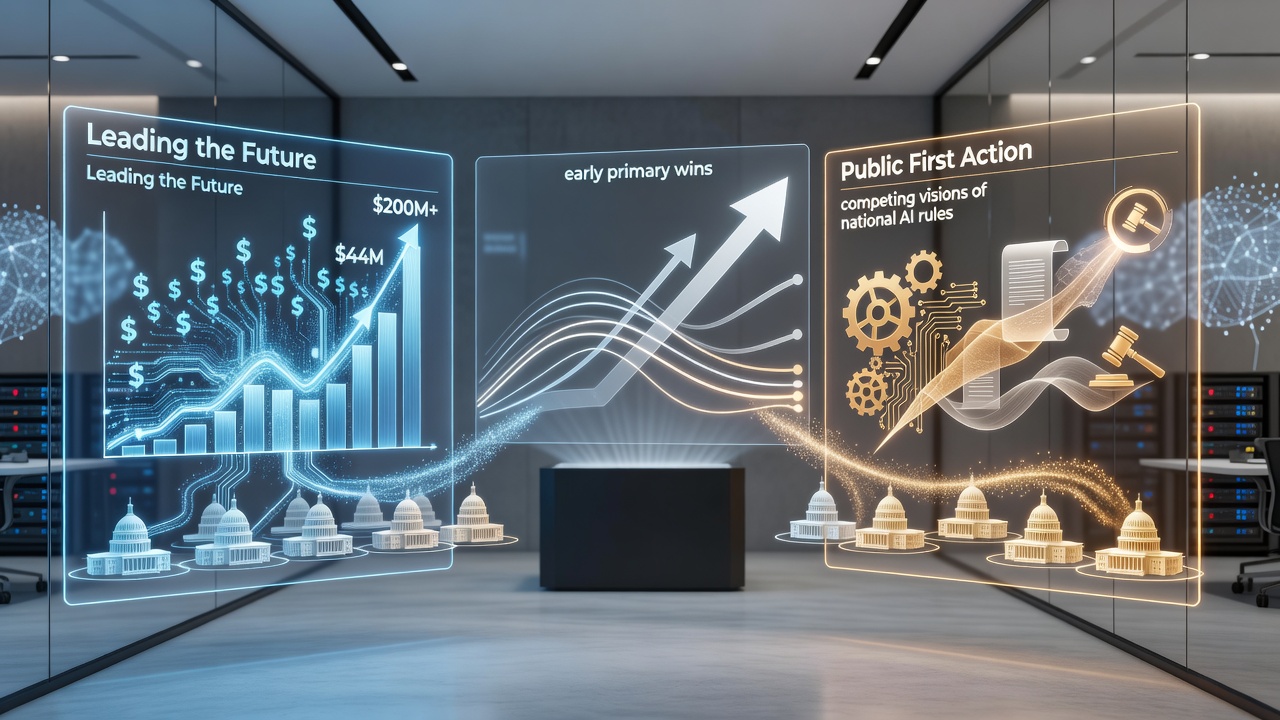
Two rival groups backed by artificial intelligence giants have already funneled more than $44 million into 40 congressional races this year. The outlay marks only the opening act. By the time voters head to the polls in November the two biggest AI-linked super PACs expect to deploy well over $200 million. Their target is clear. They aim to elect lawmakers who will write the first comprehensive federal AI legislation on terms the industry can accept.
Leading the Future, the larger of the pair, has collected $125 million since late 2025. Marc Andreessen and Ben Horowitz of the venture firm Andreessen Horowitz each contributed $25 million. OpenAI President Greg Brockman and his wife Anna added substantial sums. Palantir co-founder Joe Lonsdale, SV Angel founder Ron Conway and executives from Perplexity also gave. The group has spent more than $24 million on primaries alone through June, according to Federal Election Commission filings analyzed by CNBC.
Its rival network, anchored by Public First Action, raised $80 million by the end of June. Anthropic provided $20 million, though the company insists the funds support only public education on AI policy, not direct campaign activity. Employees of OpenAI, Google, DeepMind and X have also donated. Public First Action has spent roughly $20 million so far and plans to engage in 50 to 60 races before the midterms end.
Success rates tell part of the story. Of 28 candidates backed by Leading the Future, 25 won their primaries. One lost. Two contests remain. Public First Action backed winners in all but one of its early races. That exception, New York Democrat Alex Bores, drew heavy fire from both sides. Leading the Future poured about $8 million into ads against him. The reason? Bores had championed a tougher version of New York’s RAISE Act before Governor Kathy Hochul secured changes that softened reporting requirements and penalties.
The fight over that bill captures the real stakes. Leading the Future says it supports a “broad, national, consistent framework for regulation governing AI.” Spokesman Josh Vlasto told CNBC the group is not opposed to state action in principle. Yet it spent millions to defeat a legislator who wanted stricter rules than the final law contained. Public First Action, led by Brad Carson, expresses greater tolerance for state experiments. Carson noted that if Congress produces a “comprehensive federal approach,” preemption becomes “a natural part of our constitutional order.”
Republicans on Capitol Hill show less ambiguity. House Majority Leader Steve Scalise argued that state laws are “hurting innovation” and that overriding them “is going to be the foundation of anything we do.” Democrats appear divided. Representative Ted Lieu, co-chair of a House AI commission, said there is “bipartisan disapproval of preempting with nothing.” Still, many backed a children’s online safety bill that set a federal floor for privacy rules.
Both super PAC networks insist they favor some guardrails. They overlap on protecting children online. They diverge on the speed, strictness and uniformity of rules. Leading the Future pushes for one national standard to avoid a patchwork of 50 different regimes that could slow American developers and hand an advantage to China. Public First Action worries that weak federal rules could leave consumers exposed. Carson pointed to recent advances in models such as Mythos and Claude Fable as reasons for urgency. “It is so important that we do this now and urgently, because it is still the early innings of the technology, but it is being adopted quickly, at scale,” he said. “Everybody from the right to the left, from pro-Trump to anti-Trump recognizes that.”
The playbook borrows from crypto. In 2024 the industry-backed super PAC Fairshake spent nearly $200 million and helped pass stablecoin legislation while advancing a broader digital-assets bill. AI groups hope for similar returns. Yet the sums already exceed early crypto efforts in raw scale. A June report from Public Citizen found that cryptocurrency, AI, Big Tech and online betting interests had spent $517 million so far in the 2026 cycle, with AI and Big Tech contributing $60 million directly to groups such as Leading the Future.
Critics detect something more troubling than routine advocacy. The Campaign Legal Center filed a complaint with the FEC in May alleging that two super PACs in the Leading the Future network, American Mission and Think Big, funneled nearly all their disbursements through a single newly created LLC that appears to function as a shell. The arrangement, the group charged, unlawfully evades transparency rules. Campaign Legal Center called the structure an attempt to conceal true spending patterns.
Watchdogs also note the difficulty of tracing every dollar. Public First Action does not disclose all donors. Anthropic voluntarily revealed its $20 million commitment. The broader network tied to Leading the Future has drawn fire for “dark money” tactics even as it maintains all activity complies with federal law.
The original reporting on these super PACs first appeared in The Next Web on July 9. That account detailed how the industry’s central demand remains a single national framework that would preempt conflicting state rules. More than 1,000 AI-related bills appeared in state legislatures in 2025 alone. After the Senate stripped a federal preemption clause from pending legislation by a 99-to-1 vote, industry money shifted decisively toward the ballot box.
Anthropic stands somewhat apart. The company has publicly argued that governments should retain power to block especially dangerous AI systems. Its donation to Public First Action came with explicit limits against partisan use. Microsoft’s Brad Smith has separately complained that the United States currently “regulates AI with no clear rules at all.” The spending, in this view, could help fill that vacuum on terms that preserve innovation.
Yet public sentiment complicates the effort. Polls cited in earlier coverage by The Atlantic show a majority of Americans believe the risks of AI outweigh its benefits. Grassroots opposition has already blocked dozens of data-center projects. Ads funded by these PACs rarely mention artificial intelligence directly. They focus instead on jobs, national security or character attacks. The strategy echoes past industry campaigns that avoided naming the core issue.
Even so, the early primary results suggest the money carries weight. Candidates supported by one side or the other have largely prevailed. In New York’s 12th District the heavy spending against Bores elevated his profile but still contributed to his defeat. Public First Action later claimed the attack “backfired” and helped a more regulation-friendly candidate in a neighboring race.
The dueling PACs have clashed directly in several contests. They traded accusations in interviews and spent on opposite sides of the same Manhattan primary. Such proxy battles reflect deeper tensions between OpenAI-aligned accelerationists and Anthropic’s more cautious approach. Dario Amodei, Anthropic’s chief executive, has warned that AI could “test us as a species.” Greg Brockman’s camp appears more focused on rapid deployment under light federal oversight.
Congress shows signs of movement. Bills on AI safety, copyright, deepfakes and compute governance circulate on both sides of the aisle. Few expect final passage this year. The real work will begin in the next session. By then the new class of lawmakers will include dozens who owe their seats, at least in part, to checks written in Silicon Valley.
Whether those obligations translate into favorable statute remains uncertain. History offers mixed lessons. Tobacco, pharmaceuticals and fossil fuels all spent heavily to shape regulation. Sometimes they delayed rules for years. Other times public backlash forced tighter controls. The AI industry now bets it can thread the needle, securing national rules strong enough to preempt states yet flexible enough to let American firms outpace global rivals.
The sums involved make the wager credible. More than $200 million. Dozens of races. Two competing visions of what responsible oversight should look like. And a technology advancing faster than lawmakers can debate. The 2026 midterms will not settle the future of AI. They will, however, determine who sits at the table when the serious drafting begins.


 WebProNews is an iEntry Publication