
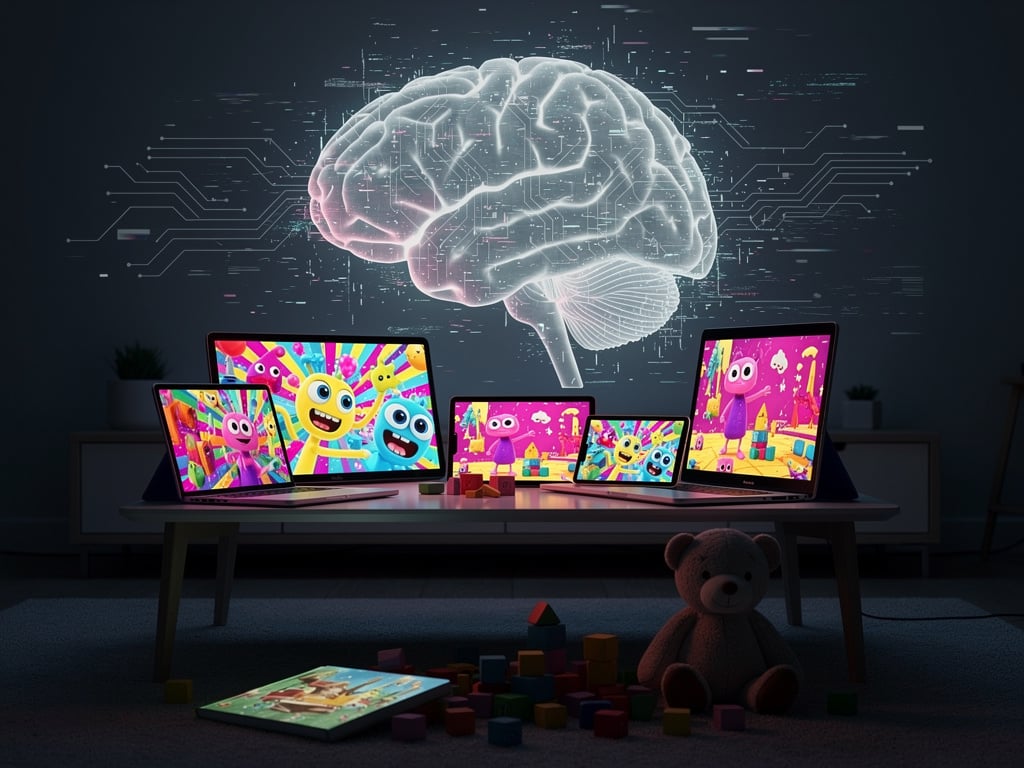
Business Insider recently highlighted a troubling pattern on TikTok where artificial intelligence tools generate low-quality videos aimed directly at young children. These clips, often called AI slop, flood the platform with bizarre animations, nonsensical stories, and repetitive sound effects that captivate toddlers while offering virtually no educational value. Parents scrolling through their kids’ feeds increasingly encounter content that looks polished at first glance but reveals itself as machine-made nonsense upon closer inspection.
The surge in this material stems from easy-to-use AI video generators that allow anyone to create dozens of shorts in minutes. Creators, motivated by the prospect of ad revenue from high view counts, pump out endless streams of talking animals, dancing fruits, and distorted nursery rhymes. Young viewers, whose attention spans align perfectly with the short-form format, get hooked on the bright colors and constant motion. What appears harmless on the surface actually trains developing brains to expect stimulation without substance.
Child development specialists express growing alarm over the long-term effects. Brains in early childhood form neural pathways based on the input they receive. When that input consists primarily of chaotic AI-generated scenes that lack coherent narratives or meaningful human interaction, the foundations for attention, language acquisition, and emotional regulation may suffer. Pediatricians report seeing more cases of children who struggle to engage with books or real-world play after extended exposure to these videos. The addictive loop of quick dopamine hits from one 15-second clip to the next mirrors other concerning screen habits but arrives wrapped in the innocent packaging of cartoon characters.
Platforms bear significant responsibility in this equation. TikTok’s algorithm learns rapidly from engagement signals. A toddler watching one AI-generated video to completion signals approval, prompting the system to serve up dozens more from the same genre. Within days, an entire For You page can transform into an endless parade of machine-crafted oddities. The company has attempted to introduce age-appropriate filters and parental controls, yet determined creators find workarounds by tagging content with popular child-friendly hashtags or using voices that mimic familiar nursery rhyme narrators.
Some creators defend their output by claiming they simply fill a market demand. Parents juggling work and household responsibilities sometimes rely on these videos as digital babysitters. A steady stream of bright, wordless animation can keep a two-year-old occupied while dinner gets made or laundry folded. Yet this convenience comes with hidden costs. Research from child psychology departments shows that passive consumption of screen content correlates with delayed speech development and reduced imaginative play. When AI produces the content, the absence of human creativity in the production process removes another layer of potential learning.
The financial incentives driving this phenomenon prove particularly strong. TikTok’s creator fund and related advertising programs reward high watch time regardless of content quality. A channel posting ten new AI-generated videos daily can accumulate millions of views from curious or bored toddlers. Even minimal ad revenue per thousand views adds up quickly at that scale. Some accounts operate multiple channels with slightly different character designs to maximize reach across various algorithm segments. The barrier to entry remains low since many AI tools now offer templates specifically designed for children’s content.
Visual characteristics of these videos follow predictable patterns. Characters often possess slightly distorted facial features that human eyes instinctively find off-putting, yet the constant movement and sound effects distract from these flaws. Backgrounds shift abruptly between unrelated scenes. Stories rarely maintain logical progression, jumping from one disconnected idea to another. Sound design relies heavily on repetitive loops and artificial laughter tracks. Despite these shortcomings, the combination proves remarkably effective at holding young attention.
Educators notice the impact in preschool and kindergarten classrooms. Teachers describe children who expect entertainment to arrive in rapid bursts and who show frustration when asked to focus on single activities for more than a few minutes. Some students repeat phrases or sound effects from popular AI videos instead of engaging in normal playground conversation. The normalization of machine-generated voices affects how children perceive authentic human communication. When a large percentage of daily media consumption comes from synthetic sources, the distinction between real and artificial begins to blur at an early age.
Regulatory bodies have started examining the situation more closely. Consumer protection agencies question whether platforms adequately shield young users from commercial content disguised as entertainment. Privacy advocates raise concerns about data collection practices that track toddler viewing habits to refine algorithms further. Some countries have proposed stricter rules around content labeling, requiring clear disclosure when videos are primarily AI-generated. Enforcement remains challenging given the sheer volume of material uploaded daily.
Parents seeking solutions face an uphill battle. Many discover the extent of the problem only after their children develop strong preferences for specific AI-created characters. Simple screen time limits help but do not address the underlying quality issue. Curating alternative content requires significant time and effort, resources that exhausted caregivers often lack. Some families have found success with co-viewing practices where adults watch alongside children and provide real-time commentary that adds context and meaning. Others have switched to vetted educational platforms that prioritize human-created material.
The technology itself continues advancing at a rapid pace. Newer AI models produce increasingly sophisticated animations that mask their artificial origins more effectively. Voice synthesis has improved to the point where distinguishing between human and computer narration becomes difficult even for adults. These developments suggest the problem may intensify before meaningful solutions emerge. Companies developing these tools often focus on capability and speed rather than potential societal impacts on the youngest users.
Content moderation teams struggle to keep pace. Human reviewers cannot possibly evaluate every video, so platforms rely on automated systems trained to detect certain patterns. Sophisticated creators quickly learn to avoid flagged keywords or visual markers. The result is an ongoing cat-and-mouse dynamic where low-effort content slips through while genuine educational creators sometimes face unnecessary scrutiny. This imbalance discourages quality production and rewards quantity instead.
Academic institutions have begun studying the phenomenon through controlled experiments. One longitudinal project tracks language development in groups exposed primarily to human-created versus AI-generated children’s content. Early findings suggest measurable differences in vocabulary acquisition and narrative comprehension by age four. Another study examines attention span metrics, finding that children accustomed to AI slop require more frequent prompts to maintain focus during structured activities. These results, while preliminary, align with broader concerns about digital media’s influence on cognitive development.
Industry insiders acknowledge the issue privately while publicly emphasizing platform improvements and user empowerment tools. Some larger creators have shifted toward hybrid approaches, using AI for initial concept generation while adding human oversight for storytelling and character development. This middle path offers a potential model for responsible content creation, though it requires more time and skill than pure AI generation. Smaller independent creators without such resources often feel squeezed between high-volume AI competitors and well-funded traditional studios.
The psychological effects extend beyond immediate attention and language concerns. Children form attachments to digital characters in ways previous generations reserved for books or television personalities. When those characters exist only as algorithmic variations without consistent personality or moral framework, the emotional bonds lack depth. Young viewers may experience confusion when encountering conflicting versions of the same character across different channels. The absence of human creators behind the content removes the sense of shared cultural experience that traditionally accompanied children’s media.
Looking forward, addressing this challenge requires coordinated action across multiple fronts. Platform design changes could de-emphasize pure engagement metrics in favor of quality indicators when serving content to young users. Developer guidelines for AI tools might include built-in restrictions or warnings for children’s content generation. Educational campaigns could help parents recognize the signs of AI-generated material and make more informed choices. Schools and pediatricians might incorporate digital media literacy into their guidance for families.
The situation reflects broader questions about technology’s role in childhood. As artificial intelligence capabilities expand, society must decide which aspects of human development remain best served by human touch. Entertainment designed specifically for young minds carries particular weight because it shapes foundational experiences. When profit motives drive the creation process without sufficient regard for developmental needs, the resulting content tends toward the lowest common denominator of stimulation rather than genuine enrichment.
Families navigating these waters benefit from establishing clear boundaries around screen content from an early age. Prioritizing interactive play, reading physical books, and real-world exploration provides necessary counterbalance to digital influences. When screens do enter the picture, selecting human-authored material with clear educational intent offers a safer alternative to algorithmically generated streams. Open conversations with children about where videos come from, even at young ages, can begin building critical thinking skills.
The proliferation of AI slop on platforms like TikTok represents more than just annoying background noise in modern parenting. It constitutes a large-scale experiment on developing minds with outcomes that may not become fully apparent for years. By understanding the mechanisms driving this content and taking deliberate steps to limit exposure, caregivers can protect the quality of their children’s early experiences. The responsibility ultimately falls on adults to curate environments that foster healthy growth rather than accepting whatever the algorithms serve up next. As the technology matures, maintaining vigilance about its application to children’s content becomes increasingly essential for preserving the richness of human creativity in early education and entertainment.


 WebProNews is an iEntry Publication