
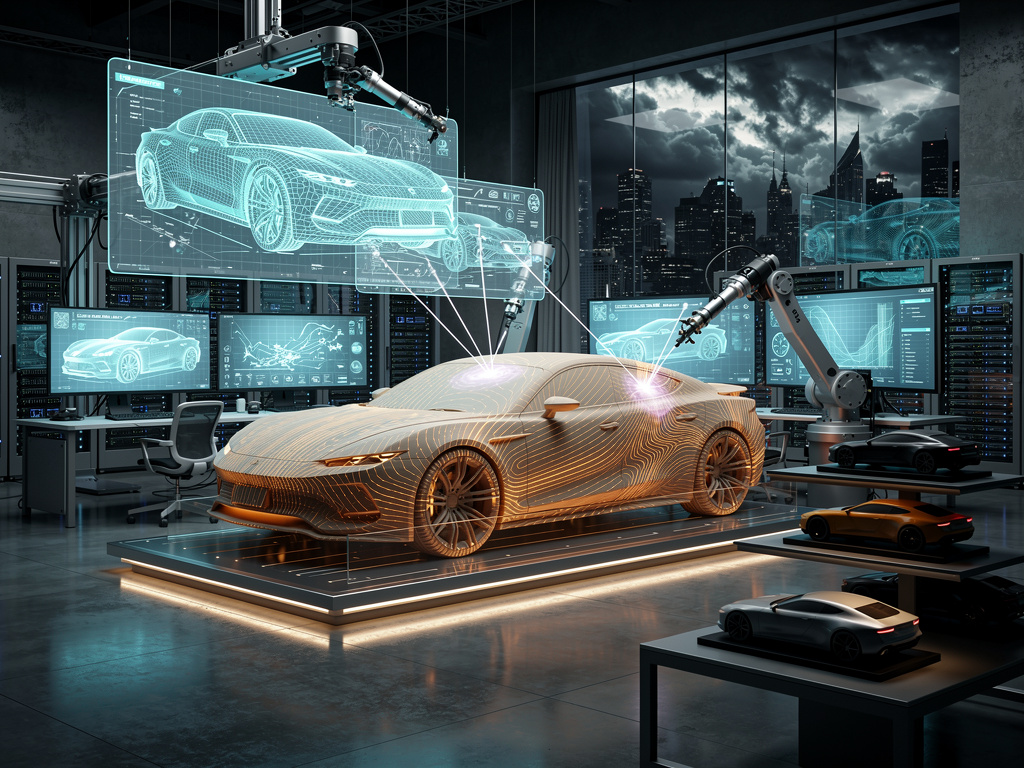
General Motors designers once spent months turning rough sketches into full 3D models. Now? Hours. Feed a hand-drawn concept into Vizcom, and out pops a rendered animation of the car cruising wet urban streets. GM’s Dan Shapiro calls it a window into the future. “That’s what the sketches are for,” he told The Verge. “And AI helps us see it sooner.”
Trade wars. Tariffs. Shifting EV policies. Automakers face chaos. Traditional timelines stretch five years or more from sketch to showroom. Sketches become clay models, wind tunnel tests, endless iterations. AI changes that. It compresses cycles, letting firms like GM and Nissan adapt faster. Nissan aims for 30 months on new models. Changes could hit roads by 2029.
But. Will machines pick our next rides?
Tim Stevens, automotive journalist, unpacked this on a recent Vergecast episode. Car companies swear AI amplifies humans, not replaces them. Stevens isn’t convinced. “Even though the car companies swear they’re not planning to replace humans with AI, we should be worried about what happens when car companies replace humans with AI.” At the end, AI might decide features. What sleek, efficient shapes would it favor? Bland pods? Or something wilder?
GM pushes boundaries. Scott Parrish, technical fellow at GM R&D, demos their AI-powered virtual wind tunnel. Designers tweak surfaces. Drag predictions flash instantly. No waiting days for computational fluid dynamics runs. “We’ve developed an AI model to provide a near-instantaneous prediction of drag,” Parrish said. Early feedback loops tighten designs before clay even hits the table.
Swiss firm Neural Concept powers much of this. Their neural networks slash aero simulations. Jaguar Land Rover cut jobs from four hours to one minute. Formula One teams like Williams Racing use it. CEO Pierre Baqué insists on balance. “We’re building autonomous systems that design cars with strong human oversight,” he told The Verge. “The value comes from the combination of AI speed and human judgment, not from removing the human from the equation.”
Nissan focuses software. Takashi Yoshizawa, executive in charge of software-defined vehicles, deploys code-generation AI for unit tests. It boosts speed and quality. Billions in delays elsewhere—Volkswagen comes to mind—highlight the stakes. AI automates the drudgery.
Bryan Styles, GM’s director of design innovation, sees upside for creatives. AI frees them to “do what they really came to GM to do.” Mood boards. Prompt tweaks like “dynamic view action shot… empty elevated streets.” Fixes for glitches, such as vanishing wheel covers. Humans still gatekeep brand soul—what feels like a Buick?
Skeptics abound. Matteo Licata, professor at Turin’s IAAD design institute, warns of fallout. “Jobs in design studios may not disappear right away, but… only a fool will believe that such a massive productivity boost isn’t going to affect a studio’s headcount one way or the other.” Entry barriers rise. Students face tougher odds.
Neural Concept agrees—mostly. Their platform “amplifies engineering teams,” Baqué says. GM deploys it for pedestrian safety redesigns, per Neural Concept’s site. Real-time collaboration between designers and aerodynamicists. Broader options explored. Yet productivity math suggests leaner teams ahead.
And the designs themselves. GM’s AI concepts evoke Cyberpunk 2077—aggressive lines, futuristic flair. Iterations refine. But Dodge’s AI-generated “old family photos” of cars flopped, riddled with errors. Oversight matters. AI hallucinates, just like in chat.
Vergecast tied this to bigger AI shifts. Stevens joined Hayden Field to debate Codex versus Claude Code in coding supremacy. OpenAI’s Codex update challenges Anthropic’s tool. Car software demands such agents—complex, safety-critical stacks. Failures cost billions.
Policy whipsaws accelerate adoption. Trump-era tariffs quashed EV incentives. Factories retool. Demand wavers. AI offers “agentic agility.” Nissan eyes U.S. rebound. GM preps next-gen vehicles, dates undisclosed.
Challenges persist. Simulations approximate reality. Human fixes needed. Overreliance risks blandness—or worse, unsafe corners cut. Fast Company noted AI eliminates aero bottlenecks, citing GM’s Rene Strauss: “We are using it on our next products.” (Fast Company)
So where next? PhysicsX, stealthy no more, raised $32 million in 2023 for AI simulations in auto and aerospace (TechCrunch). Founders from F1 and McKinsey tackle thorny problems. Neural Concept eyes CES 2026 demos with Azure, per their site.
Humans decide—for now. Monks guarding the flame, as Shapiro puts it. But cycles shrink. By 2029, AI-sketched cars flood lots. Efficiency wins. Jobs shift. Designs evolve. The road ahead? Faster. Sleeker. Decided by code.


 WebProNews is an iEntry Publication