
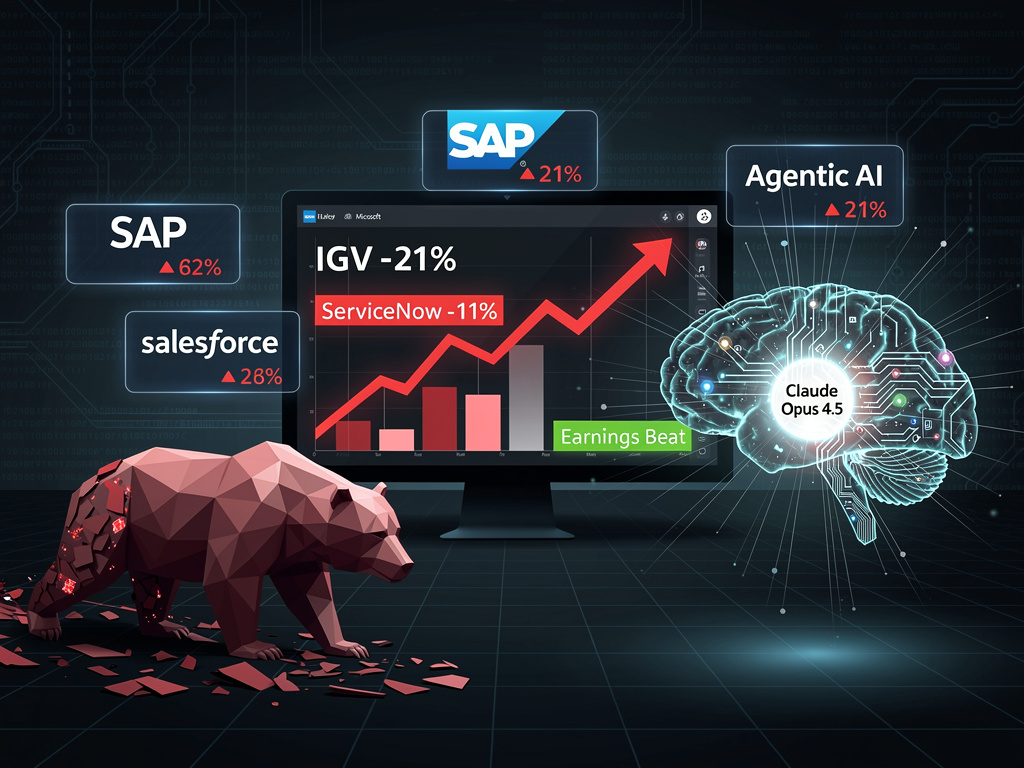
Software stocks plunged into bear-market territory Thursday as fears of artificial intelligence upending established business models overwhelmed solid quarterly results from sector leaders. The iShares Expanded Tech-Software Sector ETF (IGV) tumbled about 5% in morning trading, marking its steepest one-day drop since last April’s tariff-induced rout. The ETF has now shed roughly 21% from its recent peak, crossing the threshold for a bear market, while month-to-date it is down nearly 14%—on track for its worst monthly performance since the 23% decline in October 2008, according to CNBC.
ServiceNow Inc., a bellwether in enterprise software, saw its shares crater more than 11% despite beating fourth-quarter earnings expectations and issuing guidance that topped Wall Street forecasts. The company reported adjusted earnings per share of 92 cents against expectations of 88 cents, with revenue reaching $3.57 billion versus the anticipated $3.53 billion, up 20.5% year-over-year. Subscription revenue climbed 21% to $3.47 billion. Yet, as CNBC detailed, investors dismissed the figures as insufficient to counter AI anxieties. Morgan Stanley analysts captured the sentiment: “Good, but not good enough. In an environment of heightened investor skepticism on incumbent application vendors, stable growth, in line with expectations, likely falls short of shifting the narrative.”
Enterprise Earnings Ignite Broader Selloff
The rout extended beyond ServiceNow. Germany’s SAP SE plunged nearly 15% after its cloud backlog and 2026 revenue forecast missed projections, while Salesforce shares dropped 5.6%, Adobe and Datadog each fell 3.1%, as reported by Reuters. The S&P 500 Software and Services Index sank 6.5%, poised for a third consecutive monthly loss, lagging the broader S&P 500’s 0.1% gain. Even Microsoft, reporting a slowdown in fiscal second-quarter cloud growth to 39% from 40% prior, with third-quarter guidance at 37%-38%, saw shares slide 9.8% after spending a record on AI infrastructure, per CNBC.
ServiceNow CEO Bill McDermott pushed back during the earnings call, arguing AI needs workflow orchestration. “The real payoff comes when trillions of tokens move beyond pilots to be embedded directly into the workflows where business decisions are made,” he said. “ServiceNow is the gateway to this shift, serving as the semantic layer that makes AI ubiquitous in the enterprise.” He stressed AI’s probabilistic nature requires software for reliable outcomes. The firm guided Q1 2026 subscription revenue at $3.65-3.66 billion and full-year at $15.53-15.57 billion, with acquisitions like Moveworks and Armis accelerating growth, as noted in Bloomberg.
AI Agents Stoke Existential Fears
Investor jitters stem from rapid AI advances threatening traditional software licenses and per-seat pricing. Anthropic’s Claude Opus 4.5, unveiled late last year—its third major model in two months—excels in coding, computer operation, and enterprise tasks for developers, analysts, consultants, and accountants, outperforming rivals on benchmarks like SWE-bench Verified, according to CNBC. Fears mounted further with Anthropic’s Claude Cowork agent, prompting selloffs in Intuit (down 16% last week), Adobe, and Salesforce (each over 11%), as a Morgan Stanley SaaS basket fell 15% year-to-date.
“All these software names are performing terribly because the market’s kind of in our view pricing a worst case scenario that software is dead because AI is disrupting the space,” said Adam Turnquist, chief technical strategist at LPL Financial, in Reuters. J.P. Morgan analysts highlighted a “malaise in software sentiment persists, coupled with a seemingly paradoxical and vicious cycle of depressed valuations, with maintained, if not rising, investor expectations.” Chamath Palihapitiya echoed on X: “The Great SaaS Meltdown has started and there’s no going back,” questioning growth durability amid AI threats to heuristics-based products.
Valuations Recast in AI’s Harsh Light
Once prized for recurring revenue and high margins, software firms now face repricing as AI promises cheaper, custom alternatives. The sector’s weighting in the S&P 500 has slipped below semiconductors, which benefit from AI hardware demand. ServiceNow shares have dropped 45% over 12 months, trading at levels not seen in years. RBC’s Matthew Hedberg expressed surprise at the post-earnings slide, while Bloomberg Intelligence’s Anurag Rana viewed the $5 billion buyback as a confidence signal amid fears.
Earlier tremors hit in January, with Anthropic’s tools rekindling 2025 disruptions. “No reasons to own,” some traders quipped, per Bloomberg reports. On X, Puru Saxena noted pressure on software as markets see AI as existential, though infrastructure plays like cybersecurity hold firmer. Rohan Paul highlighted Claude Code’s prowess fueling “selfware” fears, compressing multiples across the board.
Sector-Wide Tremors and Divergent Paths
Adobe is down 35% over 12 months, Salesforce 27%, HubSpot 45%, per Morningstar analysis from late 2025, with valuations now at discounts—Adobe 40% below fair value, ServiceNow 23%. Yet, some analysts see opportunity. William Blair’s Arjun Bhatia called the selloff indiscriminate, while D.A. Davidson’s Gil Luria urged selective buying for scalable models. Goldman Sachs views AI as expanding total addressable markets.
Venture investor Chamath Palihapitiya warned private markets are drying up for legacy SaaS, shifting risk calculus after 15 years. On X, ZaStocks likened it to a “Claude moment,” with markets selling first amid uncertainty over winners like Palantir. ServiceNow counters with AI integrations, including expanded Anthropic and OpenAI deals, positioning as an “AI control tower,” but sentiment remains skeptical.
Analyst Pushback and Buyback Signals
Mizuho’s Jordan Klein noted entrenched bearish positions post-Anthropic launches. LPL’s Turnquist sees worst-case pricing. Yet, BNP Paribas Exane holds Outperform on ServiceNow despite target cuts. Wealthspire’s Chris Maxey said, “We’re not in a position where we can say the turn is here, since existential fears about AI will be here for a while, but the sector does look more interesting.” M&A speculation rises, with RBC’s Rishi Jaluria predicting deals as valuations compress.
Microsoft’s 15 million Microsoft 365 Copilot seats show demand outstripping supply, with Anthropic committing $30 billion in cloud spend. ServiceNow’s Now Assist hit $600 million in annual contract value. Despite this, the market fixates on disruption risks to workflows, coding, and knowledge work, driving the IGV toward deeper losses.
Path Forward Amid Uncertainty


 WebProNews is an iEntry Publication