
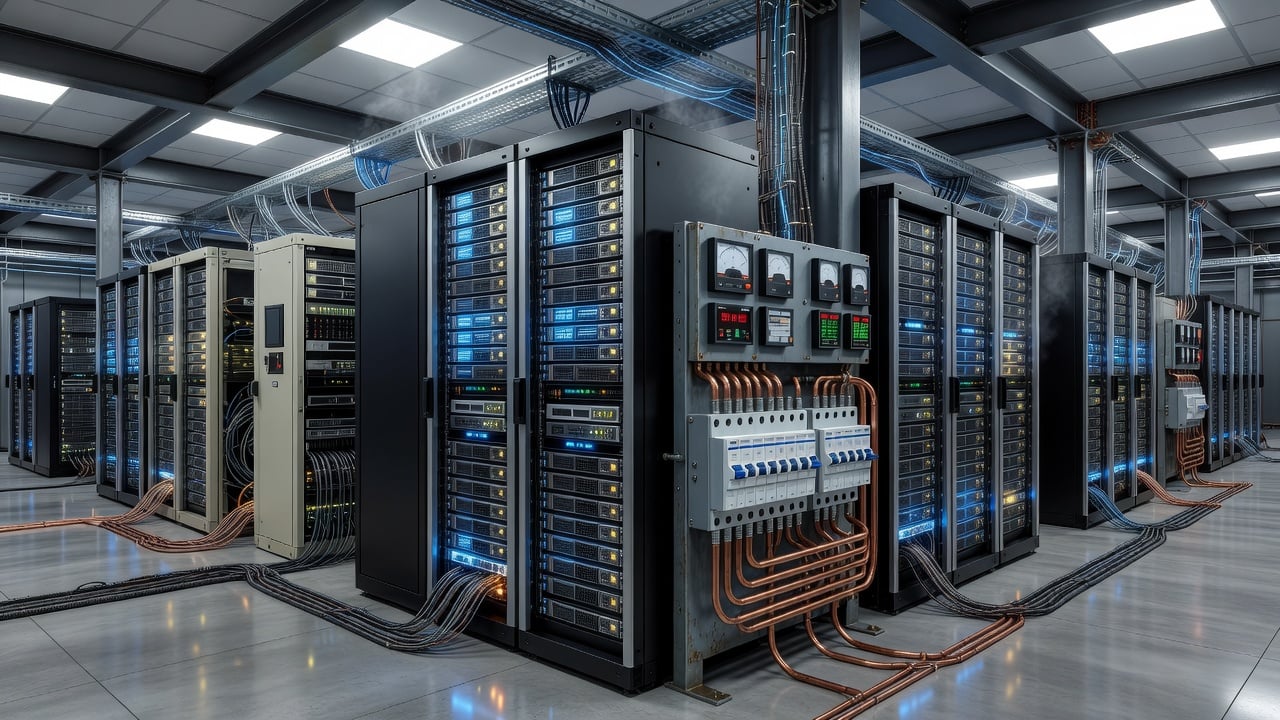
Data center electricity demand is exploding. And the main driver isn’t the familiar servers that have powered the internet for decades. It’s the specialized hardware built for artificial intelligence.
By next year, AI-optimized servers will consume more electricity than all conventional data center equipment combined. The crossover point comes fast. Forecasts show AI servers drawing 258 terawatt-hours in 2027. Conventional ones hover near 200 TWh. The gap only widens from there.
Gartner laid out the numbers in detail this summer. Global data center electricity consumption hits 565 TWh in 2026, a 26% jump from 2025. AI servers alone climb from 95 TWh in 2025 to 175 TWh in 2026. That’s an 84% surge in a single year. (Tom’s Hardware, July 2026)
The same analysis projects AI servers making up 31% of total data center power in 2026. Up from roughly 20% the year before. By 2030 they approach half of everything data centers use. Conventional servers stay almost flat. Less than 1% growth in 2025. Just 1.2% the following year.
These figures line up with broader forecasts. The International Energy Agency sees data centers reaching 945 TWh by 2030 in its base case. That equals nearly 3% of global electricity. Accelerated servers, driven mainly by AI, grow 30% annually. Conventional servers expand at 9%. The AI segment accounts for almost half the net increase in data center demand. (IEA)
Power availability now dictates the pace of AI expansion.
TechRadar captured the shift in stark terms. “Surging demand for compute-intensive AI workloads is driving unprecedented data center power growth, while AI capacity is now constrained by power availability, making data center power security the new battle ground for scaling and protecting margins in the global AI race,” said Linglan Wang, research director at Gartner. (TechRadar, July 10, 2026)
Operators feel the pinch already. Nearly half of planned U.S. data center projects for 2026 face delays or cancellation. Grid shortages and local opposition play roles. In the United States, which represents 36% of global data center power in 2026 at 204 TWh, AI facilities alone take 68 TWh. Non-AI demand grows only modestly.
Cooling adds another layer. Electricity for cooling systems climbs 22.6% in 2026 to 195 TWh. Dense AI racks generate intense heat. Traditional air systems struggle. Liquid cooling gains traction yet brings its own costs and complexity. Power density per rack rises from 36 kilowatts in 2023 toward 50 kilowatts by 2027, according to industry analyses.
But the story runs deeper than raw consumption. Hyperscalers race to secure supply. Former Google CEO Eric Schmidt told Congress data centers will need 29 gigawatts of additional power by 2027 and 67 GW more by 2030. Anthropic projects the U.S. AI sector alone could demand 50 GW of new capacity by 2028. That’s roughly twice New York City’s peak load. (Brookings Institution, April 2026)
Goldman Sachs sees U.S. data center power demand more than doubling from 31 GW in 2025 to 66 GW in 2027. The bank’s longer view forecasts a 160-165% rise in global data center power demand by 2030 compared with 2023. Inference workloads, not just training, drive much of the growth. (Goldman Sachs, May 2026)
Recent government projections reinforce the trend. The U.S. Energy Information Administration expects national power consumption to set new records in 2026 and 2027, fueled by data centers, cryptocurrency, and electrification. Demand rises from 4,195 billion kWh in 2025 to 4,399 billion kWh in 2027. (Reuters, July 7, 2026)
So what happens when supply can’t keep up? Gartner warns that once total consumption passes 1,200 TWh around 2030, grid shortfalls hit everyone. Not just AI operators. Infrastructure and operations leaders must prioritize efficiency upgrades, lock in grid access early, and explore high-efficiency cooling plus edge computing.
Some companies already pivot. Google plans a dedicated 933 MW natural gas plant for one AI data center campus. Others eye nuclear restarts, small modular reactors, or direct contracts with generators. Renewables grow fast but their intermittency complicates baseload needs for always-on AI clusters.
The IEA notes data centers cluster in specific locations. That concentration makes grid integration tougher. Long lead times for new power plants and transmission lines add friction. In its more aggressive Lift-Off scenario, consumption exceeds 1,700 TWh by 2035. A High Efficiency case holds it near 970 TWh. Outcomes depend on technology gains and policy choices.
Chip makers respond too. TSMC and design software partners use AI itself to cut energy per chip. Next-generation GPUs already push 1,200 watts under load. Efficiency improvements of 10 times sound ambitious. Yet without them the numbers become unmanageable. (Reuters, September 2025)
Wall Street watches margins closely. Power security directly affects costs. Hyperscalers with locked-in supply or on-site generation hold an edge. Those scrambling for capacity pay premiums or slow deployments. The battle isn’t only about GPUs anymore. It’s about electrons.
By 2030 AI servers could represent close to half of data center electricity. Total demand might double or more from today’s levels. The United States, already at 4.4% of national electricity for data centers in 2023, could see that share reach 6.7% to 12% by 2028 in some forecasts from Lawrence Berkeley National Laboratory.
Analysts differ on exact trajectories. Yet the direction stays consistent. AI workloads accelerate faster than anything before. Conventional compute plateaus. Cooling overhead swells. Grid operators scramble. And the industry shifts focus from raw compute scale to sustainable power access.
Edge deployments offer one outlet. They reduce latency and ease central grid pressure. Google Cloud has highlighted the approach. Still, most heavy training and large inference stay in massive centralized facilities. The power hunger follows.
One thing feels clear. The AI boom’s next chapter writes itself in kilowatts and terawatt-hours. Companies that solve the power equation first gain the biggest advantage. Those that don’t risk watching their ambitions run into the limits of the grid.


 WebProNews is an iEntry Publication