
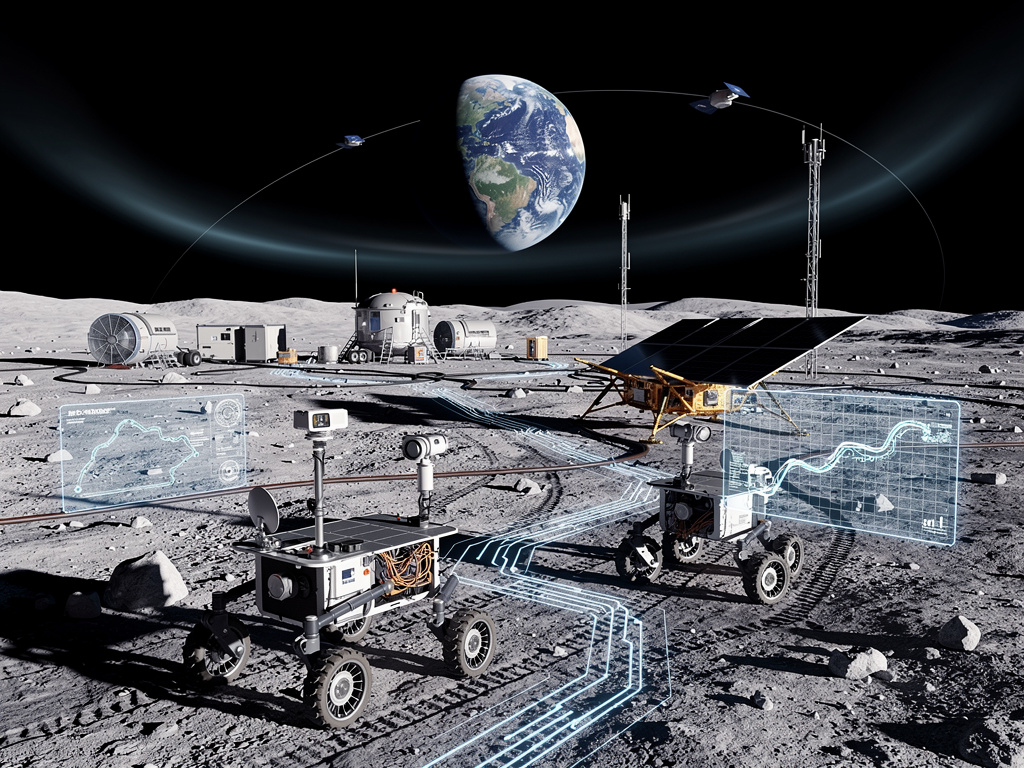
AI’s Odyssey to the Lunar Frontier: Pioneering Intelligence in Extraterrestrial Exploration
In the realm of space exploration, artificial intelligence is no longer confined to Earth’s laboratories or data centers—it’s venturing into the cosmos, with the Moon as its next major proving ground. Recent advancements have positioned AI as a critical component in lunar missions, enabling autonomous operations, data analysis, and decision-making in environments where human intervention is limited or impossible. NASA’s initiatives, particularly through programs like Artemis, are at the forefront, integrating AI to enhance rover navigation, resource identification, and mission planning.
The integration of AI in lunar exploration traces back to early experiments but has accelerated with modern computational power. For instance, NASA’s Volatiles Investigating Polar Exploration Rover (VIPER) employs AI algorithms to assess terrain risks and optimize paths across the Moon’s challenging surface. This rover, set to land near the lunar South Pole, uses machine learning to interpret data from previous orbiters, allowing it to navigate without constant Earth-based control.
Beyond navigation, AI is revolutionizing how we process the vast amounts of data generated by lunar missions. Systems developed by NASA analyze spectral data to detect water ice and other volatiles, crucial for future human settlements. This capability not only speeds up scientific discoveries but also reduces the bandwidth needed for communication between the Moon and Earth, where delays can span several seconds.
Autonomous Rovers Redefining Lunar Mobility
One of the most compelling applications of AI on the Moon is in autonomous rovers, which must operate in harsh conditions including extreme temperatures, dust, and radiation. The VIPER mission, detailed in a NASA blog post, showcases how AI helps in site selection and path planning, drawing from lunar landmarks captured by the Lunar Reconnaissance Orbiter. This technology addresses the unreliability of GPS on the Moon, relying instead on visual recognition and pattern matching.
Industry insiders note that these AI systems are designed with robustness in mind, incorporating redundancy to handle potential failures. For example, AI agents can simulate multiple scenarios before executing a maneuver, minimizing risks in real-time. This approach is vital for missions where a single error could jeopardize years of preparation and investment.
Moreover, private sector involvement is amplifying these efforts. Companies like Intuitive Machines are partnering with NASA under the Commercial Lunar Payload Services (CLPS) initiative to deliver AI-enhanced payloads to the lunar surface. A recent announcement highlighted in a NASA Marshall post on X underscores the role of these collaborations in advancing robotic flights, carrying scientific instruments that leverage AI for on-site analysis.
AI’s Role in Resource Utilization and Sustainability
As lunar missions evolve from exploration to exploitation, AI is pivotal in in-situ resource utilization (ISRU), the process of harvesting local materials for fuel, oxygen, and construction. Advanced algorithms can identify optimal mining sites by analyzing geological data, predicting yields of resources like helium-3 or regolith-based building materials. This is evident in concepts discussed in a Nature article, which forecasts AI-driven discoveries shaping 2026 research, including moon missions.
The potential for AI to enable fully autonomous operations is particularly exciting for long-term lunar bases. Chinese researchers, as reported in a Global Times post on X, emphasize intelligent manufacturing and collaborative robotics as pillars for future lunar stations, where AI orchestrates clusters of machines to build habitats without human presence.
However, challenges persist, such as ensuring AI reliability in the Moon’s vacuum and radiation-heavy environment. Engineers are developing radiation-hardened chips and error-correcting codes to safeguard AI systems, drawing lessons from past missions like the Mars rovers, which have used similar technologies to extend operational lifespans.
Data Deluge: AI as the Lunar Analyst
The sheer volume of data from lunar sensors overwhelms traditional analysis methods, making AI indispensable for pattern recognition and anomaly detection. NASA’s AI use cases, outlined in their 2024 inventory, highlight applications in mission support, from trend analysis to system development, ensuring responsible integration in space operations.
In recent developments, AI is being used to enhance imaging and interferometry on the Moon. A proposal for a lunar Long-Baseline Optical Imaging Interferometer, mentioned in an X post by Erika, aims to leverage AI for high-resolution astronomical observations, potentially revolutionizing our understanding of the universe from a lunar vantage point.
Furthermore, AI’s predictive capabilities are aiding in mission forecasting. By modeling environmental variables, these systems can anticipate dust storms or seismic events—known as moonquakes—that could impact operations. This foresight is crucial for the Artemis program’s goal of returning humans to the Moon by 2026, as previewed in a Space.com article comparing it to the historic Apollo 8 mission.
Collaborative Horizons: Public-Private AI Synergies
The synergy between government agencies and private enterprises is accelerating AI’s lunar deployment. Elon Musk’s ventures, touched upon in a Guardian review of 2025’s tech stories, include AI investments that could extend to space applications, potentially influencing missions like Starship’s lunar ambitions.
On the international stage, India’s Aditya-L1 spacecraft, as noted in the Nature piece, will observe solar activity using AI-enhanced data processing, indirectly benefiting lunar missions by improving space weather predictions that affect AI systems on the Moon.
Private initiatives, such as those from GITAI, are pushing boundaries with autonomous robotic construction, as discussed in a Stellarix post on X. These efforts envision AI turning lunar infrastructure into programmable assets, paving the way for sustainable human presence.
Ethical and Strategic Considerations in Lunar AI
As AI lands on the Moon, ethical questions arise regarding autonomy and decision-making authority. Industry experts debate the balance between machine independence and human oversight, especially in scenarios involving resource allocation or emergency protocols. NASA’s guidelines emphasize responsible AI use, ensuring systems align with mission objectives without unintended consequences.
Strategically, AI could shift the dynamics of space competition. Nations and companies investing in lunar AI gain advantages in establishing bases, mining rights, and scientific primacy. A Sri Lanka Guardian article highlights how AI-driven space missions will define global research in 2026, underscoring the geopolitical stakes.
Technological hurdles, like power constraints on the Moon, are being addressed through efficient AI models that run on limited energy, such as edge computing frameworks mentioned in a SpaceDaily report on 6G integration for satellite intelligence.
Future Trajectories: AI Beyond the Moon’s Horizon
Looking ahead, AI’s lunar applications could extend to swarm robotics, where multiple AI units collaborate on tasks like habitat assembly or exploration grids. This is inspired by concepts in NASA’s Ames research, as shared in an X post, focusing on AI for the VIPER rover.
Integration with quantum computing might further enhance AI’s capabilities, enabling complex simulations of lunar geology in real-time. Such advancements could accelerate discoveries, from confirming water deposits to mapping underground lava tubes as potential shelters.
Ultimately, the arrival of AI on the Moon represents a paradigm shift in how humanity explores and utilizes space. By enabling machines to think, adapt, and act in extraterrestrial settings, we’re not just landing technology—we’re seeding the foundations for a multi-planetary future, where intelligence transcends earthly bounds.
The video “What Happens When Artificial Intelligence Lands on the Moon” from MSN vividly illustrates these possibilities, depicting AI rovers traversing lunar craters and analyzing samples autonomously, a vision that’s rapidly becoming reality through ongoing missions.
In 2026, with Artemis 2 set to orbit the Moon, AI will play a starring role in ensuring crew safety and mission success, as detailed in a USA Today preview of upcoming spaceflights. This integration promises to unlock new scientific frontiers, from astrobiology to materials science, all powered by intelligent systems operating light-years from home.
Private moon landings, like those achieved in 2025 and chronicled in a Space.com year-end review, demonstrate the maturity of AI in commercial ventures, setting the stage for even more ambitious endeavors.
As Jared Isaacman assumes leadership at NASA, as reported in a Houston Chronicle article, the focus on AI-driven telescopes and moon missions could herald breakthroughs in understanding dark matter, further intertwining artificial intelligence with cosmic discovery.
Visions of an AI-Infused Lunar Era
The evolution of AI in lunar contexts also involves adaptive learning, where systems improve over time based on encountered data. This is crucial for long-duration missions, allowing rovers to evolve strategies for unforeseen challenges, much like how AI agents are projected to advance in 2026 according to the Nature outlook.
Collaborative international efforts, including China’s push for autonomous lunar operations, signal a global race in AI space tech, potentially leading to shared standards or competitive innovations.
In essence, AI’s lunar odyssey is transforming space exploration from a human-centric endeavor to one augmented by machine intelligence, promising efficiencies and discoveries that will redefine our place in the universe.


 WebProNews is an iEntry Publication