
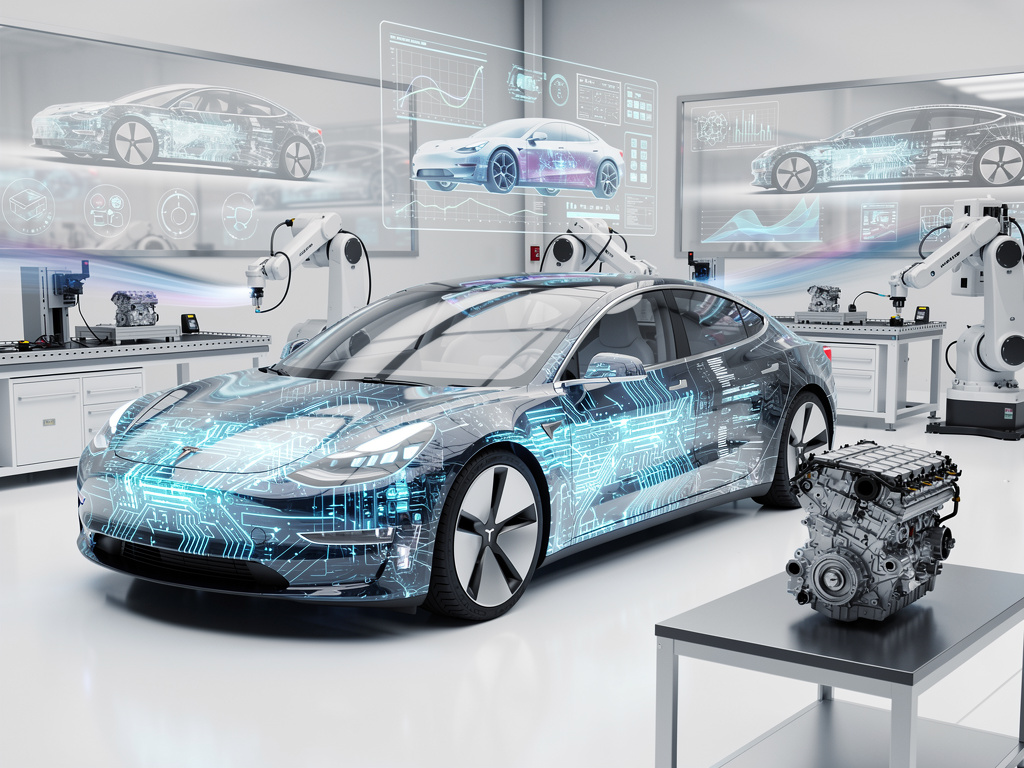
AI’s Accelerating Grip on Auto Innovation: Forging Tomorrow’s Vehicles Today
In the high-stakes world of automotive engineering, artificial intelligence is no longer a futuristic add-on but a core driver reshaping how vehicles are conceived, built and refined. From streamlining assembly lines to optimizing aerodynamic profiles, AI tools are enabling manufacturers to push boundaries faster and more efficiently than ever. Major players like Tesla and BMW are leading this charge, embedding machine learning algorithms directly into their design workflows to predict performance issues before prototypes even hit the test track.
This integration isn’t just about speed; it’s about precision and cost savings. AI-powered simulations can run thousands of virtual crash tests in hours, a process that once took weeks of physical trials. Companies are leveraging these capabilities to iterate designs rapidly, reducing material waste and accelerating time-to-market. For instance, generative AI models are now generating multiple chassis configurations based on input parameters like weight distribution and fuel efficiency goals, allowing engineers to select optimal variants without exhaustive manual modeling.
Beyond design, AI is transforming manufacturing floors into smart ecosystems. Robotic arms guided by computer vision systems assemble components with sub-millimeter accuracy, while predictive maintenance algorithms forecast equipment failures, minimizing downtime. This shift is evident in facilities where AI monitors production in real time, adjusting variables like welding temperatures on the fly to ensure consistency.
Pioneering Players and Their AI Strategies
Tesla stands out as a frontrunner, with its Full Self-Driving (FSD) hardware and software ecosystem heavily reliant on AI for both vehicle autonomy and underlying design processes. According to recent insights from Financial Content, Tesla is evolving from a traditional automaker into an AI powerhouse by 2026, with plans for Cybercab production featuring no steering wheels or pedals. This bold move underscores how AI is not just enhancing but fundamentally redefining vehicle architecture, incorporating neural networks that learn from vast datasets of real-world driving scenarios to inform safer, more efficient body structures.
BMW is another key innovator, integrating AI into its iX3 EV SUV development, as highlighted in posts on X discussing upcoming CES 2026 reveals. The German giant uses AI for knowledge management systems that optimize everything from battery placement to interior ergonomics, drawing on data from millions of simulated miles. This approach has led to vehicles that are lighter and more energy-efficient, with AI algorithms predicting how design changes affect range and handling.
Ford, meanwhile, employs AI in predictive maintenance and supply chain optimization, ensuring manufacturing lines run smoothly amid global disruptions. Recent web searches reveal that Ford’s AI initiatives focus on edge computing, where on-vehicle processors handle real-time data analysis, influencing design decisions like sensor integration for advanced driver-assistance systems (ADAS).
Manufacturing Metamorphosis Through Machine Learning
The manufacturing side sees AI automating quality control with unprecedented rigor. Vision AI systems, as seen in collaborations like Huawei and JAC Motors’ EV production lines mentioned in X posts, inspect welds and paint finishes in real time, flagging defects that human eyes might miss. This not only boosts reliability but also cuts recall costs, a perennial headache for the industry.
Volkswagen Group is pushing boundaries here, as detailed in their own publication on Volkswagen Group’s website. They describe how AI redefines production by using data analytics to streamline assembly sequences, reducing energy consumption by up to 20% in some plants. This involves AI models that simulate entire factory operations, optimizing robot paths and worker assignments for peak efficiency.
General Motors (GM) integrates AI into its Ultium battery platform design, employing machine learning to model cell chemistry and predict longevity. This has implications for manufacturing scalability, allowing GM to ramp up EV production while minimizing defects through AI-driven process controls.
Design Revolutions Powered by Data
Diving deeper into design, AI’s role in generative processes is game-changing. Tools like those from Autodesk, often used by automakers, generate hundreds of part variations, evaluated against criteria such as crashworthiness and aerodynamics. Toyota, for example, uses AI to refine hybrid powertrains, simulating fuel consumption under diverse conditions to inform component shapes and materials.
Mercedes-Benz leverages AI for virtual prototyping, as noted in industry analyses from Itransition. Their systems create digital twins of vehicles, allowing engineers to test modifications in virtual environments that mirror real-world physics. This has accelerated the development of models like the EQS, where AI optimized the drag coefficient for better range.
Nissan incorporates AI in human-machine interface design, using sentiment analysis from user data to shape intuitive dashboards. Recent news from OilPrice.com points to how such integrations in 2025 paved the way for 2026 advancements, with AI accelerating EV adoption by refining battery management systems during the design phase.
Challenges in AI Adoption for Autos
Yet, this rapid adoption isn’t without hurdles. Data privacy concerns loom large, as AI systems require vast amounts of telemetry from test vehicles, raising questions about user consent and cybersecurity. Automakers must navigate regulations like Europe’s GDPR while ensuring AI models aren’t biased toward certain driving conditions, which could lead to safety disparities.
Supply chain integration poses another challenge. As seen in X discussions about semiconductor shortages, the 10x increase in chip content for autonomous vehicles demands robust AI for forecasting demand. Companies like Intel and Nvidia are partnering with automakers to embed custom silicon, but scaling these for mass production remains complex.
Cost is a barrier too, particularly for smaller manufacturers. Implementing AI requires significant upfront investment in computing infrastructure and talent. However, as cloud-based AI services from providers like AWS democratize access, even mid-tier firms are beginning to experiment with design simulations.
Emerging Trends and Future Trajectories
Looking ahead, embodied AI—where intelligence is embedded in physical systems—is gaining traction. X posts highlight Tesla’s Optimus robot, which could extend to manufacturing, assisting in assembly with AI that adapts to human workers. This points to a future where AI not only designs but actively participates in building vehicles.
Sustainability is another frontier. AI optimizes material use in design, minimizing carbon footprints. For instance, AI Magazine lists firms like Honda using AI for eco-friendly optimizations, from lighter composites to efficient recycling processes in manufacturing.
Collaborations are accelerating progress. Partnerships between tech giants and automakers, such as Google with Renault, bring cloud AI to vehicle infotainment design, influencing how interfaces evolve based on user behavior data.
Global Impacts and Competitive Edges
On a global scale, Chinese manufacturers like BYD are surging ahead with AI-integrated production, leveraging government support for smart factories. This is shifting competitive dynamics, pressuring Western firms to innovate faster. Recent web news from Automotive World discusses visions for AI-centric mobility ecosystems, where vehicles communicate seamlessly with infrastructure.
In the U.S., regulatory pushes for safer autonomous tech are driving AI investments. The National Highway Traffic Safety Administration’s guidelines encourage AI use in crash avoidance systems, influencing design standards across the board.
Europe emphasizes ethical AI, with the EU’s AI Act requiring transparency in algorithms used for vehicle safety features. This is prompting companies like Volvo to document AI decision-making in design, ensuring accountability.
Innovative Case Studies in Action
Take Rivian, which uses AI to customize truck designs for off-road performance, analyzing terrain data to tweak suspension geometries. This data-driven approach has shortened development cycles from years to months.
Hyundai’s AI initiatives focus on manufacturing robotics, with systems that learn from errors to improve precision over time. As per Appinventiv, such applications enhance efficiency while reducing labor costs.
Stellantis, parent of Jeep and Fiat, employs AI for global supply chain resilience, predicting disruptions and rerouting parts accordingly, which indirectly bolsters manufacturing stability.
Pushing Boundaries with Predictive AI
Predictive analytics are revolutionizing maintenance in design phases. By forecasting wear patterns, AI helps engineers build more durable components. Porsche uses this to refine engine designs, simulating decades of use in virtual models.
In autonomous vehicle realms, Waymo’s AI designs sensor arrays that adapt to urban environments, informed by machine learning from fleet data. This integration ensures manufacturing aligns with real-world demands.
Finally, as CES 2026 approaches, per CNET, expect showcases of AI in flying vehicle prototypes, hinting at how these technologies could extend beyond traditional autos to aerial mobility.
Strategic Imperatives for Industry Leaders
For executives, the imperative is clear: invest in AI talent and infrastructure now. Training programs, like those at Daimler, upskill engineers in machine learning, bridging gaps between traditional automotive expertise and digital prowess.
Partnerships with startups are vital. Investments in firms specializing in AI simulation tools provide established players with cutting-edge capabilities without building everything in-house.
Ultimately, the automakers that master AI integration will dominate, creating vehicles that are smarter, safer and more sustainable. As the industry hurtles toward an AI-infused future, the race is on to harness this technology’s full potential in every bolt and circuit.


 WebProNews is an iEntry Publication