
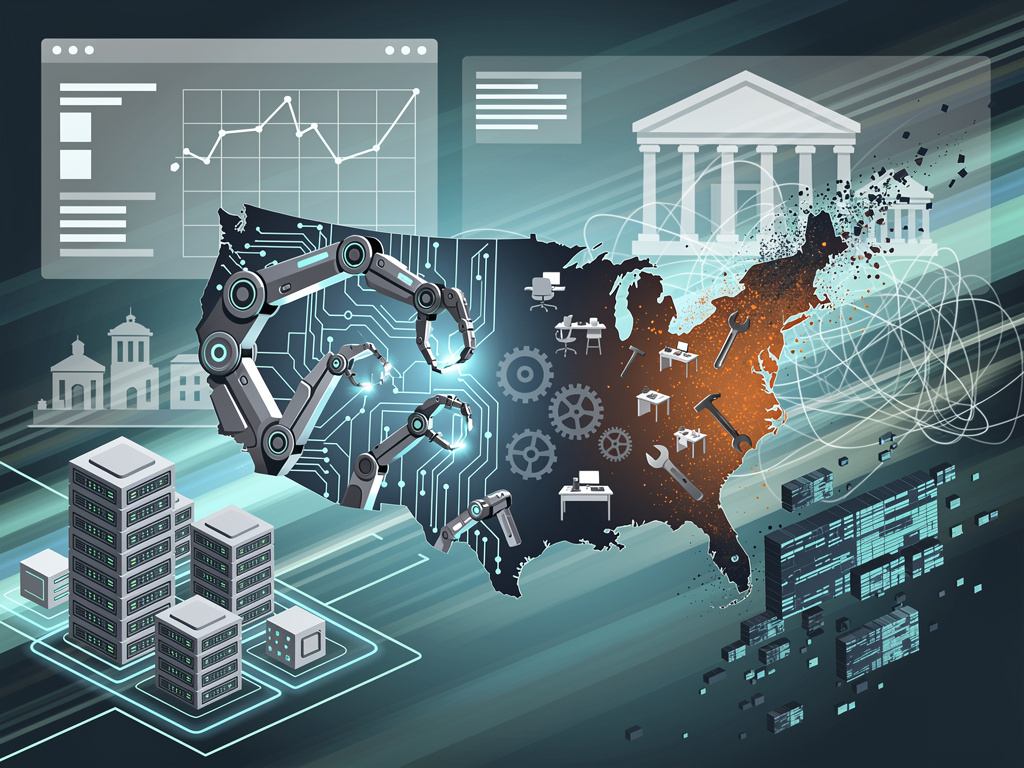
Artificial intelligence now touches half of all American jobs. Yet Washington’s data systems still treat the upheaval as a minor statistical blip. Companies announce thousands of positions eliminated with AI cited as the reason. Federal labor statistics lag months behind and lack the granularity to show exactly which tasks vanished.
Marco Riedesser saw the shift early. In a recent interview with Digital Trends, the entrepreneur described how AI systems handle customer service, basic coding and routine analysis with growing competence. The question he poses lands hard. Are governments paying attention?
They should be. Evidence piles up quickly. The Boston Consulting Group reported in April that over the next two to three years, 50 to 55 percent of U.S. jobs will be reshaped by AI. Only 10 to 15 percent face outright elimination in the next four to five years. Most roles will change. Workers will amplify their output with AI tools, rebalance their duties or gain new capabilities. The report maps six categories from substituted tasks to enabled new work. The pattern repeats across sectors.
But reshaping carries risks. The Federal Reserve Bank of Dallas examined employment data since ChatGPT’s debut in late 2022. Total U.S. employment rose 2.5 percent. In the 10 percent of sectors most exposed to AI, employment fell 1 percent. Computer systems design shed 5 percent of jobs. Young workers bore the brunt. Stanford researchers Erik Brynjolfsson, Bharat Chandar and Ruya Chen documented that employment declines in AI-exposed sectors hit those under 25 especially hard. Older cohorts held steadier.
Tech layoffs tell part of the story. In 2025 alone, 55,000 positions were explicitly tied to AI automation. That figure runs more than 12 times higher than two years earlier. Early 2026 brought another 9,200 AI-linked cuts in the first quarter. Meta planned reductions of roughly 8,000 roles while pouring $115 billion to $135 billion into AI infrastructure. Capital moves fast. Labor absorbs the delay.
Geoffrey Hinton, often called a godfather of AI, warned in recent interviews that 2026 could mark a sharp acceleration. He sees capabilities arriving that replace many, many jobs. His tone carries urgency. Others echo the concern without the same alarm. Goldman Sachs Research projects only a modest half-percentage-point rise in unemployment during the transition. The firm expects new opportunities to offset losses eventually. The gap between displacement and creation still creates hardship.
Federal Reserve Governor Lisa Cook addressed the timing problem directly. She noted that AI may displace workers before it generates new positions. This outcome could cause hardship, she said last month at an economic policy conference. Rising unemployment among recent college graduates, even as the overall rate sits near 4.3 percent, underscores her point.
Tracking the change proves difficult. A Congressional Research Service report released in early June painted federal labor data infrastructure as dangerously outdated. Employers cited AI in thousands of 2025 layoffs. Yet official systems miss the nuance. The report urges Congress to add occupational questions to monthly surveys, update job classification codes more often, expand state unemployment insurance data and invest in better statistical tools. Without these steps, policymakers fly partially blind.
International bodies sound similar alarms. The International Monetary Fund estimates 40 percent of global employment stands exposed to AI. In advanced economies that exposure climbs to 60 percent. Roughly half those affected jobs may see productivity gains from AI integration. The other half face substitution. Emerging markets sit lower on the risk scale but also capture fewer immediate benefits.
The Organisation for Economic Co-operation and Development stresses the need for policies that help countries, firms and individuals gain from these shifts while addressing risks. AI can lift productivity, improve job quality and strengthen safety. Those gains arrive unevenly. Workers in high-exposure, low-complementarity occupations already see employment rates 3.6 percent lower in regions with rapid AI skill demand.
Fear among workers grows. A KPMG survey found anxiety over AI-driven displacement nearly doubled in a year. Senators Josh Hawley and Mark Warner introduced legislation requiring large companies and federal agencies to report AI-related layoffs to the Labor Department. The goal is a public accounting of the scale. Progress remains slow.
Some analysts push for fiscal creativity. A Brookings Institution paper argues that AI threatens traditional labor tax bases. Modest displacement could strain public finances precisely when safety nets face heavier loads. Anton Korinek and colleagues call for ambitious fiscal innovation, including possible taxation of AI systems and new forms of wage insurance or AI dividends. International coordination matters here. Competition between nations can render unilateral rules ineffective.
The World Economic Forum sketches four possible futures for jobs in 2030. In some scenarios ethical frameworks lag and safety nets buckle. In others governments experiment with income supports while businesses focus on augmentation. One path sees mass regulation of AI deployment collapse under competitive pressure. Tax bases shrink in several versions. The report highlights how views have shifted. Many now see AI as opportunity more than threat. That optimism does not erase the transition costs.
Young people feel the pressure first. Unemployment for 20- to 30-year-olds in tech-exposed occupations jumped nearly 3 percentage points since early 2025. Those same workers often lack the domain expertise that complements AI. They compete against both machines and experienced humans who adopt the tools faster.
Yet data also show augmentation effects. Workers who master AI see wage premiums between 25 and 56 percent in certain roles. The divide sharpens between those who use the technology and those replaced by it. Tasks matter more than entire occupations. Repetitive documentation, structured transactions and predictable information handling face the highest pressure. Roles built on human judgment, creativity and complex interpersonal trust hold value longer.
So the data presents a mixed picture. Productivity may rise. GDP forecasts for the U.S. sit between 2.25 and 2.6 percent through 2026. Those headline numbers hide regional pain and sectoral churn. Service-sector ripple effects trail capital spending by two to four quarters. The asymmetry favors owners of AI infrastructure.
Governments possess levers. They can commission detailed country-specific research on at-risk workers. They can update education and training programs for AI complementarity skills. They can redesign social insurance to cover transitions rather than permanent unemployment. They can measure what actually happens in the labor market instead of relying on yesterday’s categories.
Failure to act carries consequences. Displaced workers without clear pathways lose skills, confidence and income. Communities tied to vulnerable sectors stagnate. Political backlash builds when change feels imposed from above. Public trust erodes if statistics no longer describe reality.
Entrepreneurs like Riedesser watch the pace and wonder why policy moves so deliberately. Companies deploy AI aggressively because markets reward speed. Governments move cautiously because they bear responsibility for those left behind. The tension defines the next decade.
Recent analyses add texture. The Dallas Fed research shows AI simultaneously aids and replaces, with wage data reflecting both forces. BCG emphasizes that most jobs will transform rather than disappear. The CRS warning on data gaps may prove the most immediate policy priority. Without better visibility, all other responses risk missing the target.
Workers adapt when given chances. History includes previous technology waves that eventually raised living standards. The difference this time lies in speed and breadth. Cognitive tasks once considered safe now fall within AI reach. The window for preparation narrows each quarter.
Policymakers hold the tools. Updated statistics. Targeted retraining. Modern safety nets. Tax structures that capture gains and redistribute them intelligently. International agreements that prevent a race to the bottom. The technology will advance regardless. The distribution of its benefits depends on choices made now.
Attention alone solves nothing. Concrete action matched to accurate data offers a path forward. The evidence grows clearer by the month. Half the workforce stands on shifting ground. The other half may soon follow. Governments that treat this as a data problem first, then a policy problem, stand the best chance of guiding the transition instead of reacting to its fallout.


 WebProNews is an iEntry Publication