
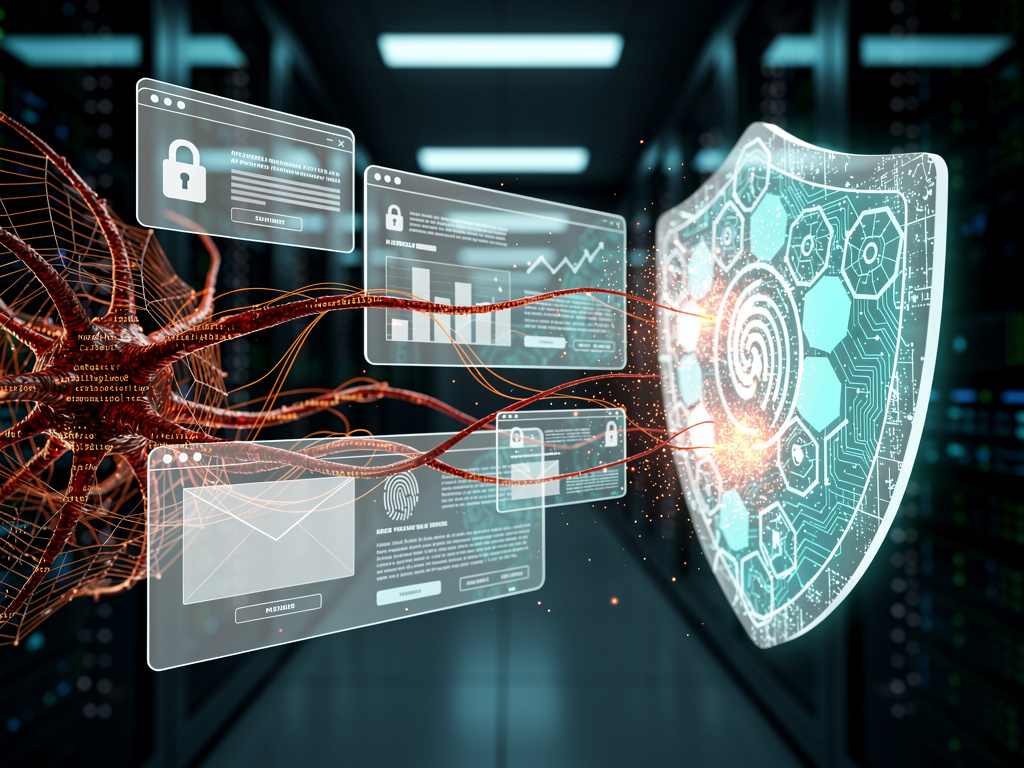
The AI Shadows Lurking in Your Inbox: Unmasking the Next Wave of Phishing Deception
In the ever-evolving realm of cyber threats, a new breed of phishing kits is emerging, armed with artificial intelligence that promises to redefine how attackers infiltrate systems and steal sensitive data. These tools, detailed in a recent report by cybersecurity researchers, are not just incremental upgrades but sophisticated packages designed to bypass traditional defenses like multi-factor authentication (MFA) and scale attacks across major online services. According to The Hacker News, four standout kits—BlackForce, GhostFrame, InboxPrime AI, and Spiderman—are leading this charge, each incorporating AI-driven tactics that make them alarmingly effective.
BlackForce, for instance, leverages AI to generate dynamic phishing pages that mimic legitimate login portals with uncanny accuracy. This kit doesn’t stop at visual deception; it integrates real-time adaptation, adjusting content based on user interactions to evade detection. Researchers note that such capabilities allow attackers to target high-value accounts in banking and corporate environments, where a single breach can lead to massive data exfiltration. Similarly, GhostFrame employs advanced obfuscation techniques, using AI to rewrite code on the fly, making it nearly invisible to automated scanners.
InboxPrime AI takes personalization to a new level, utilizing machine learning algorithms to craft emails that feel eerily tailored to the recipient. By analyzing publicly available data, it constructs narratives that exploit personal details, increasing click-through rates dramatically. Spiderman, on the other hand, focuses on MFA bypass, employing man-in-the-middle attacks enhanced by AI to intercept and relay authentication tokens seamlessly. These kits represent a shift toward automated, intelligent offensives that challenge even the most vigilant security teams.
Emerging Tactics in AI-Enhanced Deception
The integration of AI into phishing isn’t merely about efficiency; it’s about creating attacks that learn and evolve. As outlined in a piece from StrongestLayer, AI-generated phishing has become the top enterprise threat this year, outpacing legacy email security measures. These systems can produce grammatically flawless, contextually relevant messages at scale, turning what was once a labor-intensive craft into an industrial operation.
Posts on X highlight the growing concern among cybersecurity professionals. Users like Dr. Khulood Almani have shared insights into AI-powered threats, emphasizing how deepfakes and adaptive malware are weaponizing automation. One post warns of quantum computing’s role in breaking encryption, compounding the phishing problem by weakening foundational security protocols. This sentiment echoes broader industry warnings, where AI isn’t inventing new attacks but amplifying old ones, as noted in a Rappler analysis from just hours ago.
Defenders are racing to keep up. Tools like those from Hoxhunt demonstrate how AI can be turned against itself, with research proving that generative AI agents can outperform human red teams in simulated phishing scenarios. A study referenced in Hoxhunt’s blog shows AI agents crafting spear-phishing emails that are more convincing than those from elite cybercriminals, underscoring the dual-edged nature of this technology.
Bypassing the Guardians: MFA and Beyond
Multi-factor authentication has long been a cornerstone of digital security, but these new kits are dismantling it with precision. BlackForce and Spiderman, in particular, use AI to orchestrate relay attacks that capture and replay MFA prompts in real time, fooling users into authenticating fraudulent sessions. This tactic, detailed in The Hacker News report, allows attackers to scale operations across platforms like Microsoft, Google, and financial services without raising alarms.
The rise of such methods correlates with a 400% year-over-year surge in successful phishing attacks, as reported by KnowBe4. This spike is attributed to AI’s ability to hijack legitimate platforms, blending malicious content with trusted environments. Industry insiders point to the sophistication: attacks now incorporate behavioral analysis, predicting user responses to refine phishing lures on the fly.
Countermeasures are evolving too. Check Point Software’s exploration of AI phishing attacks in their cyber hub reveals how machine learning can detect anomalies in email patterns, offering a proactive defense. Yet, the challenge lies in the speed—AI offenses operate in seconds, demanding real-time responses that many organizations lack.
The Human Element in an Automated War
Despite technological advances, phishing’s success often hinges on human vulnerability. AI kits exploit this by creating hyper-personalized campaigns, drawing from vast datasets to reference recent events or personal milestones. A Coalition blog post warns that scams in 2025 will be harder to spot, with AI ensuring messages are personalized and error-free.
On X, discussions from users like Ethan Mollick years ago foreshadowed this, noting how accessible AI models enable spear-phishing at scale. Recent posts amplify this, with cybersecurity hubs sharing alerts about kits like those in The Hacker News article, emphasizing regular account monitoring as a basic yet crucial defense.
Training programs are pivotal. Hoxhunt’s infographic on AI phishing threats, found in their blog, analyzes millions of reported emails, revealing that user awareness can reduce success rates by up to 70%. However, as attacks grow more deceptive, education must incorporate simulations that mimic these AI-driven tactics.
Scaling Attacks: From Niche to Epidemic
The scalability of these kits is perhaps their most insidious feature. What once required teams of hackers can now be automated, allowing lone operators to launch thousands of attacks daily. InboxPrime AI exemplifies this, using generative models to produce variant emails that evade spam filters, as explored in StrongestLayer’s defense-focused article.
News from ITWeb reports a 14% increase in attack volumes over the past year, driven by AI’s role in platform hijacking. This involves compromising legitimate services to host phishing content, blurring lines between safe and malicious.
Looking ahead, predictions from SecurityBrief suggest that by 2026, AI agents and deepfakes will dominate, making trust the central battleground. Organizations must adopt intent-aware defenses, as advocated in StrongestLayer’s phishing defense piece.
Regulatory Ripples and Industry Responses
Governments and regulators are beginning to respond to this surge. In the U.S., discussions around AI’s misuse in cybercrime are gaining traction, with calls for stricter controls on AI tools that could enable such kits. A BetaNews article warns that AI will accelerate attacks, potentially overwhelming defenders without new frameworks.
Industry collaborations are forming. Check Point’s insights stress the need for AI in countermeasures, while Hoxhunt pushes for defensive AI agents. X posts from figures like The Cyber Security Hub echo these calls, sharing updates on kits like BlackForce to foster community vigilance.
Yet, the arms race continues. As kits like GhostFrame evolve, incorporating quantum-resistant elements, the onus falls on enterprises to integrate adaptive security measures.
Fortifying Defenses Against Intelligent Adversaries
Building resilience requires a multifaceted approach. First, enhancing email security with AI-native platforms that analyze intent in real time, as described in StrongestLayer’s enterprise threat blog. Second, implementing robust identity management to counter MFA bypasses, drawing from KnowBe4’s phishing surge report.
User training remains essential, evolving from basic awareness to immersive simulations that prepare for AI-personalized attacks. Coalition’s predictions underscore this, noting the financial and reputational damage from undetected phishing.
Finally, monitoring emerging trends on platforms like X provides early warnings. Posts detailing top tactics for 2025, such as those from 0b1d1, highlight AI’s role in making phishing smarter and faster.
The Path Forward in Cyber Vigilance
As these kits proliferate, collaboration between tech firms, regulators, and users will be key. Insights from Rappler’s 2025 predictions emphasize scaling defenses to match AI’s volume game. Techerati’s look at the 2026 security shift, in their feature, points to AI-driven strategies reshaping priorities.
Innovations in detection, like those from Check Point, offer hope. By leveraging AI for good, as Hoxhunt demonstrates, defenders can stay a step ahead.
Ultimately, awareness and adaptation will determine who prevails in this digital cat-and-mouse game. With kits like Spiderman bypassing safeguards effortlessly, the imperative is clear: evolve or fall victim to the AI shadows in your inbox.


 WebProNews is an iEntry Publication