
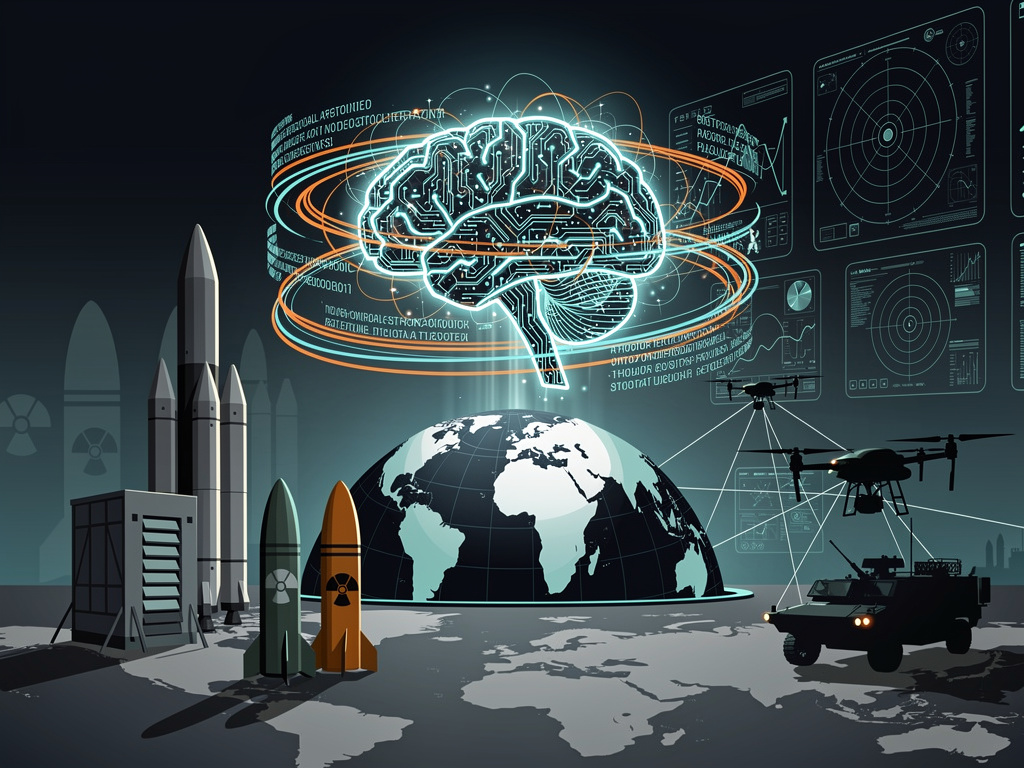
Singapore — Defense leaders gathered here last week for the annual Shangri-La Dialogue. They came to talk strategic stability. They left with a new consensus. Artificial intelligence now ranks as a greater immediate risk than nuclear weapons.
The shift stunned longtime observers. For decades this forum fixated on missile counts, no-first-use pledges and deterrence math. This time the conversation centered on speed. On algorithms that collapse decision windows. On humans pushed to act before they can think.
Compressed Timelines Redefine Escalation Risks
Lieutenant General Nauman Zakria laid it out plainly. The commander of 1 Corps and the Army Rocket Force Command in the Pakistan Army spoke of the classic OODA loop — observe, orient, decide, act. AI shrinks that loop so tightly a human can’t evaluate the situation fast enough. “People will act irrationally, and the actions will be extreme,” he said Saturday during the strategic stability panel, according to The Next Web.
His warning carried weight. Pakistan sits in one of the world’s most volatile nuclear dyads. Yet even there the general saw AI as the faster path to miscalculation. Short reaction times breed fog. Fog breeds panic. Panic produces launches no one intended.
General Onno Eichelsheim, the Netherlands’ chief of defence, refused any illusion of restraint. “AI is a huge risk in escalation. I think that’s clear,” he declared. “But I’m not naive. It’ll be used in the domain. It is already being used.” He pointed to Ukraine’s AI-driven drone targeting trained on years of battlefield footage. He cited U.S. employment of advanced AI tools for strike planning in operations against Iranian targets. Real conflicts. Real deployments. No longer theory.
Mirjana Spoljaric, president of the International Committee of the Red Cross, brought the human cost into focus. “We don’t know where the trigger is pulled,” she said. “It could be thousands of kilometres away. So while there are potentials of AI for protecting civilians, what we see at the moment is only the negative side.” Her organization has pushed for meaningful human control over lethal autonomous systems for years. Few powers have listened.
These statements came during the 23rd Shangri-La Dialogue, held May 29-31, 2026. Fifty-four ministerial delegates from 44 nations attended. For the first time a major multilateral defense forum ranked AI risks above nuclear ones in its public consensus language. The AI Weekly report captured the moment. Compressed decision timelines, not sheer destructive power, drove the elevation. Autonomous systems remove the human pause that once allowed de-escalation.
But nuclear dangers have not vanished. Far from it. The International Institute for Strategic Studies, which organizes the Dialogue, released fresh analysis ahead of the meetings. China’s nuclear buildup continues at pace. Projections show Beijing approaching 1,000 warheads by 2030 and 1,500 by 2035. The Asia-Pacific sits at the center of a nascent arms race. Daniel Salisbury’s assessment for IISS describes the region as “on the cusp of a nuclear-arms race – if not already in the early stages of one.”
People’s Liberation Army Major General Meng Xiangqing addressed the nuclear file directly. He reaffirmed Beijing’s no-first-use policy and urged the five recognized nuclear states to negotiate a mutual version. “If we can do so, we can reduce the risk and we can further enhance strategic stability,” he said, per reporting in The Times of India. China has also floated ideas for AI governance. Its published position paper calls for rules yet stops short of banning lethal autonomous weapons. The PLA invests heavily in AI-enabled capabilities all the same.
The contrast exposed a deeper tension. Traditional nuclear deterrence relies on time. Leaders assess intelligence, consult allies, weigh retaliation costs. AI systems promise faster target identification, quicker recommendations, near-instant execution. Seconds replace minutes. Minutes replace hours. In a Taiwan crisis or South China Sea clash, that difference could prove decisive.
And. The technology already operates in current fights. Ukrainian forces use machine learning to predict Russian moves and adapt drone swarms in real time. American planners turned to AI to process vast data streams during recent strikes. These cases demonstrate capability. They also reveal vulnerability. What happens when two peer adversaries deploy similar systems against each other? When one side’s AI misreads the other’s intent? When both race to strike first because waiting feels fatal?
Analysts have warned of this dynamic for some time. SIPRI’s 2024 paper on military AI and nuclear risk mapped exactly these pathways. Integration of AI into early-warning systems, command-and-control networks and autonomous delivery platforms raises accident probabilities. False positives become more dangerous when response windows shrink.
Yet governments show little appetite for binding limits. Discussions at the UN Convention on Certain Conventional Weapons drag on without progress. No nuclear power has accepted legal curbs on autonomous weapons. China’s proposals remain vague. The United States prioritizes technological edge. Europe talks ethics but fields systems anyway.
The Shangri-La panel offered no new treaties. No codes of conduct. No verification mechanisms. It did something perhaps more significant. It marked a perceptual turning point. Senior officers from nuclear-armed states and close U.S. allies alike declared AI the sharper near-term threat. That consensus, reached in public among defense chiefs, carries diplomatic weight.
Speed is the problem. Not sentience. Not some sci-fi takeover. Simple velocity. Machines that see, decide and fire faster than humans can intervene. In nuclear scenarios this compression could trigger inadvertent escalation. A misinterpreted sensor reading. An autonomous drone swarm crossing a red line. An AI-assisted launch recommendation delivered with seconds to spare.
So defense establishments now face dual tracks. They must modernize nuclear forces amid rising great-power competition. China’s silo fields, Russia’s modernization, North Korea’s expanding arsenal. All demand attention. Yet they must simultaneously grapple with AI’s disruption of the very logic that makes nuclear deterrence stable.
The Dialogue ended without fanfare. Delegates returned home to capitals buzzing with fresh anxiety. Military planners will accelerate AI adoption anyway. The technology delivers real advantages on the battlefield. Commanders cannot afford to fall behind. But the conversation in Singapore suggests they now recognize the accompanying hazard.
Humans still sit in the loop. For now. The question defense leaders must answer is whether that loop can survive the pace AI imposes. Irrational acts born of extreme time pressure carry catastrophic potential. In a region already bristling with nuclear weapons and territorial disputes, the margin for error has narrowed dramatically.
Recent coverage reinforces the alarm. A Bloomberg-sourced report echoed across platforms, noting the forum’s historic elevation of AI risk. Separate IISS commentary highlighted how Asia-Pacific nuclear dangers continue to mount in parallel. The two threats do not cancel each other. They compound. Faster decisions around slower but vastly more destructive weapons create a uniquely unstable mix.
Plenty remains unknown. How exactly will militaries integrate AI into nuclear command chains? What safeguards can prevent automation bias from overriding human judgment? Can any verification regime keep pace with software updates? Answers stay elusive. The Singapore meetings at least forced the questions into the open.
Defense ministers, generals and humanitarian leaders spoke with unusual candor. Their message was blunt. The era of comfortable nuclear predictability is ending. Something faster, less predictable and already in use has taken center stage. Whether governments respond with serious restraint or simply race ahead will shape security for decades.


 WebProNews is an iEntry Publication